Implementing AI in Consumer Products Procurement: A Practical Roadmap


AI integration is becoming a strategic necessity, driving innovation within consumer products procurement. Clarkston supply chain experts have identified that incremental adoption of the technology is the preferred strategy to minimize overspend and reduce organizational churn. We’re seeing that successful consumer products companies are handling integration through focused AI pilots and effective organizational change management to ensure long-term value and maximize benefits.
Consumer Products Companies are Adapting: Pilot Use Cases
Traditional procurement systems struggle with slow decision cycles, inconsistent workflows that limit flexibility, and fragmented data. Incorporating AI, when paired with modern architecture and an effective operating model, reduces the procurement cycle and decreases decision time and costs.
Specifically, intelligent sourcing, invoicing, error detecting, and automated purchase order processing improve a company’s decision-making, efficiency, and scalability. Companies are beginning transformation with small-scale pilot efforts:
CPG giant Nestlé utilized an AI pilot within the invoice review process for e-auctions and the deployment of global specifications catalogs, to which they saw benefits of efficiency and savings. Nestlé had the AI pilot analyze supplier and spend data, identify sourcing opportunities, assist in evaluations, and automate purchasing workflows – Nestlé’s CEO has stated the company will expand upon AI use based on the pilot’s quantifiable success.
PepsiCo took on an AI pilot utilizing agents that proactively find suppliers and create sourcing insights to provide recommended actions that are more intuitive than basic analytics. The pilot allows procurement users to communicate with AI in a conversational manner – a pilot designed to be a colleague over a dashboard. The company is the first major food and beverage company to utilize this AI tool, Salesforce’s Agentforce, across procurement operations.
Salesforce’s Data Cloud has also helped PepsiCo turn procurement data from multiple sources into holistic supplier profiles – another way the CPG giant is moving away from traditionality and toward agentic procurement.
Kimberly-Clark, owner of brands like Huggies and Kleenex, used GEP Quantum to enhance procurement operations using AI. The tool uses MSFT Azure’s generative AI to analyze spend and supplier data, provide sourcing recommendations and supplier risks, automate source-to-pay workflows, and even serve as an interface to assist category managers. AI-enabled workflows using the tool have shown productivity improvements of 25-50%, GEP reports.
Activating AI in Procurement for Your Organization with OCM
Organizational Change Management (OCM) is a strategic priority when implementing AI into your company’s procurement workflows, as this type of transformation often involves a time management shift for procurement specialists. By reallocating admin tasks, your company’s procurement specialists can now prioritize time on more strategic supplier engagement, leaving the AI agents to do the otherwise grunt work.
Successful OCM highlights a human-in-the-loop (HITL) approach that builds confidence among various procurement stakeholders involved in the AI integration process. With HITL, your company can permit AI to conduct analysis and recommendations that a procurement professional reviews and decides whether to approve or not before any business action takes place. For different procurement stakeholders like analysts, for example, this entails the analyst generating insights using AI that are verified, catching any errors and continuously improving prompts as the tool learns. The analysts build confidence with more use, increasing successful AI utilization and delegating more work to the tool.
For suppliers, concerns over AI integration are eliminated by giving them authority to override AI’s recommendations, ensuring that supplier relationships and negotiations don’t occur between AI models, but between real people. Similarly for buyers, confidence is built by maintaining a focus on letting the AI create recommendations, leaving all the ownership over decision-making to the buyers and category managers.
Creating Your Pilot Roadmap
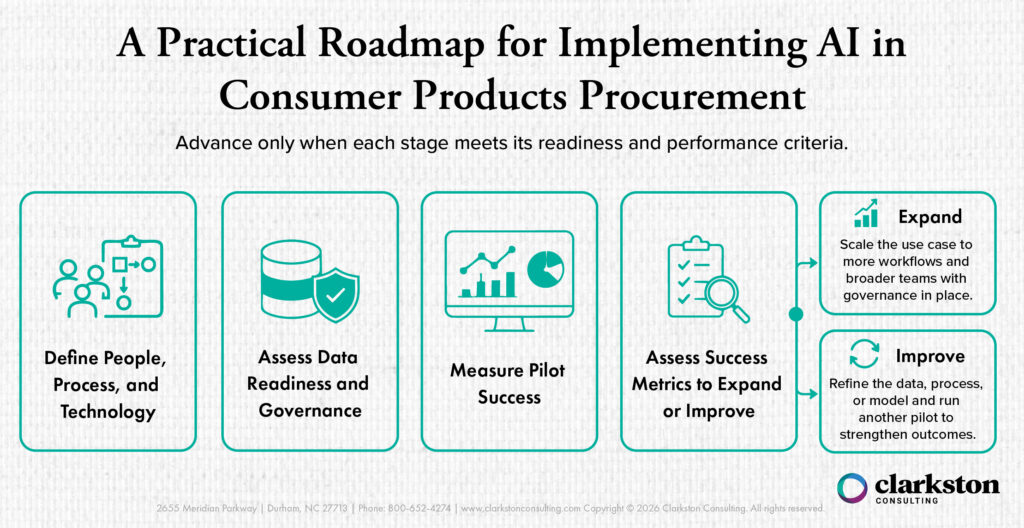
As seen above, it’s important that your organization begins AI implementation methodically using low-scale pilots involving small cross-functional teams, enhancing and expanding capability over time. This approach allows teams to evaluate AI’s value in procurement workflows while maintaining HITL governance – in essence: creating a low-risk ramp up of the AI’s value before expanding adoption via incremental enhancements.
People, Process & Technology
In the pilot, your organization needs to start by blueprinting and defining the specific process, tech, and stakeholders that will be involved. Teams should establish what a successful implementation looks like and identify the specific procurement pain point the AI will address. By narrowing the scope, procurement teams can utilize targeted AI tools to optimize operations as needed or where they improve a specific workflow.
One CPG company that streamlined operations in this way is Unilever, who deployed AI specifically into its legal operations to support contract drafting, negotiation, and review activities. They established dedicated legal services teams equipped with targeted AI tools to address the business’s pain point in contract-related work rather than applying AI broadly across the entire organization.
Data Readiness & Governance
Organizations should also assess data readiness and governance before launching a pilot. If data is fragmented or has low quality, outputs will be fragmented or have low quality. This starts with ensuring spend data is clean, current, and categorized as well as maintaining high-quality digitized historical and contract data that the AI can work with.
Data governance is equally critical, requiring organizations have clear policies and guidelines that ensure AI systems can operate safely and effectively – handling where certain HITL checkpoints occur, which AI application has access to which data, and ensuring data quality standards – to eliminate untrusted outputs.
The tech involved typically includes procurement platforms like SAP Ariba or Coupa, supporting data sources like supplier databases and spend cubes, and an AI layer powered by tools like Azure OpenAI or GEP Quantum. Stakeholder groups behind an AI pilot often include compliance teams, who ensure data governance; IT, who maintain data readiness; buyers and analysts who define success outputs; and procurement sponsors like the VP of Procurement who get the ball rolling on the AI implementation.
Measuring Success
Implementing a pilot begins with the initial design: the stage when your organization defines which specific process, tech, and stakeholder groups they should involve to address specific business pain points. Once the design has been established, the AI solution should be configured to support the organization’s success metrics. The pilot can then be deployed to a small group, where usage and outcomes are tracked for accuracy as well as KPIs such as time savings.
Throughout the pilot, procurement teams should measure both business outcomes and AI-driven efficiencies. Business KPIs may include supplier performance or savings achieved, while AI adoption metrics can include percent of sourcing supported by AI and cycle time reduction (i.e., where AI has streamlined data processes or automated repetitive workflows). As teams track usage, they should also evaluate whether the pilot delivers meaningful improvements, like saving time or improving the accuracy of procurement outputs.
Moving Beyond the Pilot
Once testing is complete, teams should reassess the success metrics that were established at the outset. If the pilot addressed specific pain points or met its defined objectives, the organization can determine whether the AI use case should be expanded or if it needs improvements.
As AI capabilities mature, organizations can enhance their environment by running multiple AI agents in a single procurement platform. Eventually, AI agents can automate and perform portions of defined low-risk workflows while maintaining human oversight for higher-risk decisions. This measured approach allows organizations to expand automation while still preserving governance and accountability.
In-house change champions will be a critical part of a successful expansion of the tool. These team members can help build or reinforce confidence in the AI’s effectiveness throughout your organization and help support users as new capabilities are introduced.
Over time, organizations will need to continue measuring outcomes like contract efficiency and cycle time reduction to evaluate where additional investment delivers meaningful business value and justify any broader in-scale integration.
The Future of Procurement in Consumer Products
There’s no question about it: the future of procurement in consumer products is headed toward total AI integration. However, it’s essential that consumer products companies today focus on developing effective organizational change management and prioritize AI adoption, starting with low-risk pilots before full-scale implementation in procurement.
When efforts are made to allow an AI agent the time to learn within your company’s operating system, you save costs and time, mitigate risks, improve audit readiness, and drastically accelerate procurement workflows.
Learn more about our change management and procurement consulting services.
Subscribe to Clarkston's Insights
Contributions by Spencer Simco
AI-assisted: A human led the content and final approval of this piece, with AI used to support ideation, drafting, editing, summarization, or repurposing.