Automation, AI Workflows, and AI Agents: Choosing the Right Approach for Your Organization

As artificial intelligence (AI) becomes more visible in everyday business conversations, many organizations struggle to articulate what they’re actually implementing. Terms like automation, AI workflow, and AI agent are often used interchangeably, even though they represent very different capabilities and risk profiles. When organizations mislabel or misunderstand what they’re building, they can over-invest in the wrong solution or set expectations the technology was never designed to meet.
Three Approaches: Automation, AI Workflows, and AI Agents
Understanding the differences between these approaches is essential and helps organizations make better decisions. Not every problem requires AI, and not every AI-enabled solution should behave autonomously. The distinction isn’t academic – each approach requires the right governance process to support reliable outcomes and organizational trust.
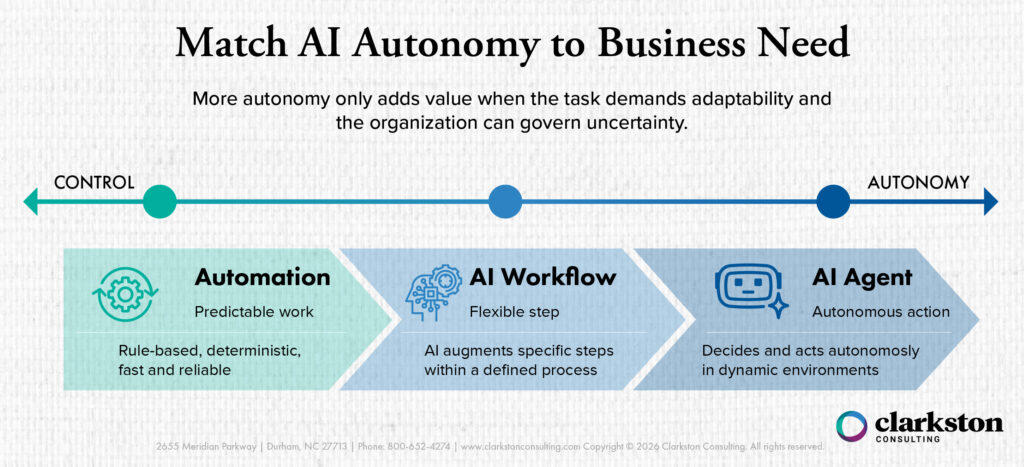
1. Automation: Predictable Systems for Predictable Work
Automation is the most mature and widely understood of the three approaches. At its core, automation refers to software that executes predefined, rule-based tasks automatically. These systems operate on Boolean logic, meaning they rely on fixed rules that classify activity as either allowed or blocked based on predefined conditions rather than learning from new patterns or behaviors. Conditions are evaluated as true or false, and actions follow accordingly.
Automation excels at deterministic tasks. If a rule is met, the outcome is known in advance. This predictability is its greatest strength. Automated systems are fast and reliable, and because their behavior follows clearly defined rules, both successful operations and errors are typically easy to trace and diagnose. They work best in environments where processes are stable and variation is limited.
However, automation has clear limits. It can’t adapt to new scenarios unless explicitly programmed to do so. As complexity grows, rules become harder to maintain and more difficult to interpret and manage effectively. Edge cases multiply, and changes require manual intervention. Automation struggles when decisions require interpretation rather than evaluation.
In many organizations, automation forms the backbone of operational efficiency. It remains foundational; however, it’s not adaptable in dynamic environments in the way modern AI systems are designed to be. This means it can’t independently adjust to changing conditions or learn from new data without predefined rules or updates.
2. AI Workflows: Introducing Flexibility within Controlled Systems
AI workflows represent a middle ground between traditional automation and fully autonomous systems. In this approach, a program still follows a predefined structure, but one or more steps involve calling a large language model (LLM) or similar AI capability through an API.
The key distinction is that AI workflows combine deterministic processes with intelligent tools capable of handling dynamic or unstructured data. The overall process is still controlled, but specific tasks benefit from the flexibility of AI. This is particularly useful when teams need to interpret complex rules or work with unstructured inputs.
AI workflows are well-suited for tasks that require interpretation but still operate within a known sequence. The system is not deciding what to do next on its own. It’s being asked to assist at specific points where rigid rules fall short.
Although AI capabilities enable a greater degree of flexibility, they also introduce new challenges. Because many AI systems produce nondeterministic outputs that can vary between interactions, their behavior can be more difficult to trace, debug, and explain compared to traditional rule-based systems. Still, they strike a balance that many organizations find practical as they experiment with AI.
3. AI Agents: Autonomy and Non-Deterministic Behavior
AI agents represent a different design model. Rather than executing a predefined sequence of steps, an AI agent is designed to perform tasks autonomously. It operates in a non-deterministic way, adapting its goal-oriented behavior as it interprets its environment based on context, feedback, and changing conditions.
In this model, the system is not just assisting within a workflow. It’s deciding what actions to take and when to take them, then executing them. This autonomy is what makes AI agents powerful, but it’s also what makes them risky.
AI agents rely heavily on written instructions, model outputs, available tools, and feedback from their environment. They can respond to new variables and simulate human-like decision-making. This makes them attractive for complex, dynamic environments where predefined rules can’t cover all scenarios.
However, autonomy requires strong governance. When AI agents are allowed to take actions without appropriate guardrails, they can create unintended business consequences such as triggering incorrect workflows or executing decisions that don’t align with business intent.
To mitigate these risks, organizations often implement Human in the Loop (HITL) controls, where human oversight is required at key decision points to review, approve, or intervene before critical actions are executed. This approach helps balance the efficiency of autonomous systems with the accountability and judgment of human operators.
Choosing the Right Approach
One of the most common mistakes organizations make is assuming that more autonomy automatically means more value. The appropriate solution depends on the nature of the task.
If a process is stable and well understood, automation is often the best choice. It delivers reliable outcomes with minimal risk and overhead.
If a process requires interpretation or flexibility but still follows a known structure, an AI workflow can provide meaningful improvement without sacrificing control.
AI agents should be reserved for situations where adaptability is essential and where the organization is prepared to manage uncertainty. They aren’t a drop-in replacement for existing systems. They require careful design and ongoing governance.
Implications for Data and Governance
As systems move from automation toward autonomy, expectations for data quality and accountability increase significantly. Deterministic systems can be validated through rules and test cases. Non-deterministic systems require ongoing observation and adjustment.
This progression reinforces an important point. The technology choice cannot be separated from the organization’s data maturity, risk tolerance, and intended business value. Introducing AI agents without strong foundations often leads to unpredictable outcomes and erosion of trust.
Clearly defined processes and well-governed data are critical prerequisites for successful automation and AI adoption. Without reliable data structures, strong data governance, and clearly documented workflows, organizations risk embedding existing inefficiencies and inconsistencies into automated systems rather than improving them.
Final Thoughts
Automation, AI workflows, and AI agents are distinct tools suited to different problems. Confusion arises when organizations treat them as interchangeable or assume that adopting AI automatically implies autonomy.
The most effective teams understand what they are building – and why – before they decide how to build it. They apply automation where predictability matters, introduce AI workflows where flexibility adds value, and approach AI agents only when autonomy is tied to a clear business need.
If your organization is looking to strengthen existing automation, introduce AI into key decision points, or evaluate where autonomy truly makes sense, our team brings practical experience grounded in real-world implementation. Contact us today to explore how we can help you apply AI intentionally and position your organization at the forefront of innovation.
Subscribe to Clarkston's Insights
AI-assisted: A human led the content and final approval of this piece, with AI used to support ideation, drafting, editing, summarization, or repurposing.