Retail Inventory Visibility: The Foundation of Unified Commerce

The introduction of omnichannel into retail gave customers the ability to move seamlessly between channels – online, mobile, and store. Capabilities like BOPIS, ship-from-store, and endless aisle emerged from this model, giving retailers new ways to serve customers wherever they choose to shop.
As customer expectations have evolved toward same-day fulfillment and dependable pickup and delivery options, the limitations of traditional omnichannel architecture have become harder to ignore. We’re seeing retailers move beyond omnichannel to real-time, unified ecosystems, making retail inventory visibility a make-or-break capability in this space.
Omnichannel vs. Unified Commerce
Beneath the surface, most omnichannel environments are built on multiple systems – including POS, eCommerce, OMS, and WMS – that exchange information rather than operate from the same data. Inventory is often synchronized through integrations or scheduled updates instead of being shared across the business as events occur.
The customer experience may appear seamless, but retailers often rely on complex integrations and manual workarounds to make it possible. That disconnect is why canceled orders, inaccurate inventory availability, and inconsistent fulfillment experiences persist.
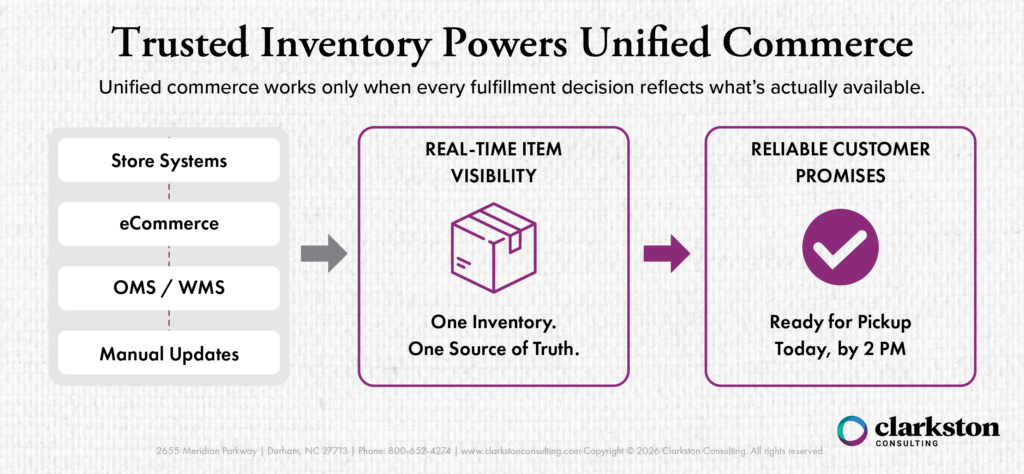
Unified commerce takes a different approach. Rather than connecting fragmented systems, it establishes a single, real-time data model across all channels. This creates a centralized view of inventory, orders, and customer information, supported by event-driven updates instead of periodic syncing between applications. In a unified commerce model, there’s no distinction between “store inventory” and “online inventory” – there’s only enterprise inventory.
The distinction matters because retailers are increasingly competing on execution. Promising same-day pickup or fulfilling an online order from a nearby store depends on knowing exactly what inventory is available. Without that confidence, unified commerce remains an aspiration instead of an operational capability.
Ensuring Inventory Accuracy
Unified commerce can succeed or fail based on one key question: Can retailers trust what their inventory systems say is available?
For many retailers, the answer is: not consistently. Inventory visibility remains fundamentally broken. Most retailers still operate with 60-70% inventory accuracy, and only a minority achieve reliable perpetual inventory records. The discrepancy between recorded and actual inventory remains a critical gap in retail execution, creating problems long before an order even reaches the customer.
When inventory data is inaccurate, retailers make promises they can’t keep. Orders are canceled after purchase, pickup windows are missed, and products shown as “available” can’t be located. Research also suggests these visibility gaps destroy value, costing retailers approximately 4% of annual sales due to stockouts and phantom inventory.
These challenges are operational ones, not just technology ones. Retailers can’t execute a unified commerce strategy if they can’t trust the inventory data that supports every fulfillment decision.
Building Better Inventory Visibility
Improving inventory visibility starts with knowing where every item is and keeping that information current as products move through the business. Delivering that level of precision requires advanced technologies – most notably RFID, IoT sensors, and computer vision.
- Radio Frequency Identification (RFID) technology captures item-level movements automatically, reducing the need for manual scanning and providing a more accurate picture of available inventory.
- IOT Sensors extend this visibility by connecting physical assets – products, shelves, and storage locations – to digital systems, enabling continuous updates as inventory moves through distribution centers and stores.
- Computer vision, or vision-based tracking, uses cameras and AI-driven image recognition to identify, count, and track products without manual scans, helping close gaps where traditional tagging or scanning may fall short.
Individually, each technology improves inventory accuracy. Together, they give retailers a more dependable view of inventory without relying on periodic reconciliation.
Companies like Amazon have built competitive advantage by embedding these capabilities into their supply chains to improve fulfilment performance and support better customer experiences. Increasingly, retailers are combining the strengths of each technology to create a more complete, real-time picture of inventory across the enterprise while also balancing cost and scalability.
Organizations adopting these approaches have seen substantial improvements in inventory accuracy (increasing accuracy ~95-98%. Apparel retailers, in particular, are reporting SKU sales lifts in the low-double-digit range, as improved inventory accuracy reduces out-of-stock and improves product availability.
Why Inventory Visibility is the Foundation of Retail Unified Commerce
So how is inventory visibility the foundation of unified commerce execution?
Unified commerce depends on a continuous view of inventory reflecting what’s available – not what was available hours ago. In this model, stores become extensions of the fulfilment network, making inventory accuracy essential to every customer promise.
When retailers know exactly what inventory is available, they can fulfill orders with greater confidence and make fewer promises they can’t keep. Ship-from-store becomes more reliable. Pickup orders are fulfilled more consistently. Inventory can be positioned where it creates the greatest value instead of where systems assume it exists.
Better inventory visibility also improves day-to-day operations. Retailers can identify discrepancies sooner, respond more quickly to changing demand, and make inventory decisions with greater confidence. The result is more reliable fulfillment and better customer experience.
In a unified commerce environment, inventory becomes a trusted source of operational information that guides decisions across the business.
Looking Ahead
Consumer expectations continue to evolve toward shopping experiences that are flexible, convenient, and dependable. Retailers will increasingly differentiate themselves by how well they execute, not simply by the channels they offer.
The future of retail will be shaped by continued advances in RFID, computer vision, connected devices, and AI. Together, these technologies will make inventory tracking more automated and inventory decisions more predictive.
Technology alone, however, won’t define the next generation of retail. Success depends on having inventory data that retailers can trust. Without that foundation, even the best customer experience strategy begins to break down.
The shift from omnichannel to unified commerce represents a move from coordinating channels to operating from a single source of truth. Retailers have spent years improving customer experience at the front end. The next opportunity is to improve the operational foundation behind it. Organizations that can trust their inventory data will be better equipped to support new fulfilment models and deliver the experiences customers increasingly expect, particularly as demand and preferences continue to change.
Reach out to our retail supply chain team today to continue the conversation.
Subscribe to Clarkston's Insights
AI-assisted: A human led the content and final approval of this piece, with AI used to support ideation, drafting, editing, summarization, or repurposing.