When Production Costs Outpace Consumer Prices: Rethinking RGM for Profitable Growth


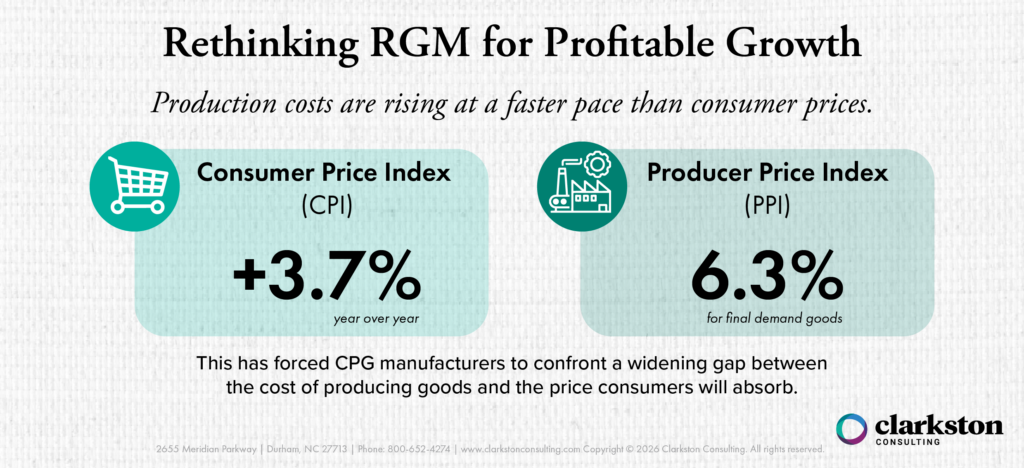
Production costs are rising at a faster pace than consumer prices. In September 2026, Consumer Price Index (CPI) was +3.7% year-over-year, compared with 6.3% for the Producer Price Index (PPI) for final demand goods. This has forced CPG manufacturers to confront a widening gap between the cost of producing goods and the price consumers will absorb.
Consumers remain highly attentive to affordability and are quicker to trade down, reduce consumption, or switch brands when prices rise too far. The challenge is exacerbated by an increased resistance from certain retailers to accept any price increases. This reality must be carefully balanced with absorbing higher costs when it comes to sourcing ingredients and materials, manufacturing products and packaging / transportation / fulfillment via increasingly complex supply chains.
The Pressure on CPG Margins
Recent company results show that this is perhaps the largest challenge facing the CPG industry today. Kraft Heinz characterized today’s operating environment as “volatile and marked by increasing inflationary pressure” and listed “inflationary pressures in manufacturing and logistics costs” as key factors behind lower operating income in the first quarter of 2026.
Campbell’s Q3 FY26 Earning Report noted “operating earnings declined 16% due to lower gross profits, primarily reflecting the gross impact of tariffs, elevated input cost inflation and other supply chain costs” and further estimated that sustained oil prices would add 2% to 3% of incremental inflation above its typical base inflation rate. We see this echoed in FY26 earning reports across the industry, with organizations such as P&G and BellRing similarly identifying tariffs, freight, and input costs as material headwinds to their businesses.
The Tradeoffs Behind Pricing and Promotions
Organizations no longer operate in a world where it’s possible to simply pass costs through price alone. While price increases remain an important lever that can restore some economics, it’s crucial to ensure that they don’t materially weaken demand, shift mix, or damage long-term brand preference.
Conagra’s Q2 FY26 report demonstrates as much: the company attributed lower organic volume in its international business segment to “lower consumption trends in response to inflation-justified pricing actions”. It’s important to note that this report also cites input-cost inflation, labor inflation, commodity volatility, and supply chain pressures as contributors to pressure on profits across multiple segments.
Promotional activity is another key lever for protecting demand and preserving customer relationships, but it also requires greater discipline. When the underlying cost of producing and serving incremental volume changes, promotions that previously generated profitable growth can quickly erode margins.
Taking a Broader View of RGM
Revenue growth management (RGM) teams already devote considerable effort to understanding shopper affordability and price sensitivity. Rising production and operating costs make it increasingly important to connect that understanding with the economics behind each commercial choice. For many organizations, this means refining existing RGM practices to incorporate a more complete view of profitability.
General Mills, for example, reported global input-cost inflation of 4% in both FY25 and FY26 and expects approximately 4% to 5% in FY27, explicitly identifying strategic revenue management as part of its response.
The key focus of RGM, then, must extend far beyond consumer willingness to pay, price elasticity, and promotional response. Decisions across pricing, promotion, portfolio, customer, and channel strategy need to incorporate the most current economics of manufacturing, logistics, fulfillment, and customer service. This requires a more complete and involved view of the tradeoffs between consumer affordability, aggregate margin pressure, logistics and manufacturing economics, customer economics, promotional response, and the profitability of incremental demand.
Connecting Cost Information to Commercial Decisions
Organizations should be asking themselves: Do we have readily available cost information that is sufficiently granular, current, and connected enough to RGM decision-making to materially affect commercial choices? Are we confident in our ability to effectively include true costs in pricing and promotional decisions?
The ability to quickly and accurately respond to meet today’s challenges can’t be accomplished merely with the creation of another cost dataset or dashboard. Instead, it’s via evaluating today’s RGM frameworks to ensure that relevant, comprehensive information reaches commercial decision-makers quickly enough and at the right level of detail to have a real impact.
As costs and shopper prices continue to adjust, yesterday’s optimal commercial decision may need to change. A connected RGM model can help organizations optimize for profitable growth by enabling more targeted price pack architecture and better-directed trade investment. It can also inform sharper assortment and channel choices and provide a clearer understanding of which products, customers, and occasions create the strongest incremental economics.
This allows RGM to become the mechanism for reconciling what consumers value, what customers need, and what the enterprise can profitably deliver.
Reach out to our RGM Consulting team to continue the conversation.