Why Most Revenue Growth Management Programs Stall After Year One


Revenue Growth Management (RGM) has become a priority for consumer products organizations working to protect profitable growth in a more volatile market. At its core, RGM is meant to be an enterprise capability that helps organizations maximize revenue and profit at the customer level.
In practice, many RGM programs struggle to sustain momentum beyond their initial phase. Based on our experience, the greatest challenge is rarely identifying opportunities. Early pricing and promotion initiatives often uncover significant value and generate enthusiasm across the organization. The challenge emerges as organizations attempt to scale those successes into an integrated capability that connects insights, decisions, and execution.
Organizations typically start strong. Early efforts uncover clear opportunities in pricing and trade spend, and initial results build confidence in the approach. But as RGM expands beyond pricing and promotion into a broader commercial capability, progress slows. Complexity increases, adoption stalls, and impact becomes harder to sustain.
The issue isn’t necessarily a lack of intent. More often, organizations build RGM capabilities without changing how commercial decisions are actually made.
Why Organizations Invest in RGM
After several years of inflation-driven pricing, many consumer products companies are finding that growth is harder to capture through price alone. Cost pressures remain high, retailers continue to push for stronger value, and volume has become less predictable as consumers shift across channels or choose private label alternatives.
As pricing becomes a less reliable growth lever, organizations need a more coordinated way to manage revenue and margin.
RGM is intended to provide that coordination by bringing structure to decision-making and improving visibility into customer profitability. When it works, RGM becomes part of how the business manages profitable growth, not a separate analysis function.
The Pattern of Early Success and Why It Fades
Most RGM programs deliver early wins by focusing on pricing and promotion. These areas often contain long-standing gaps, including limited trade visibility, inconsistent pricing execution, and fragmented data.
Addressing these gaps can create immediate value. Pricing actions improve margin, while Trade Promotion Management (TPM) systems increase transparency and control over trade spend.
But these wins are often reactive, not transformative, and don’t always change how the business operates.
RGM is frequently introduced to solve specific pricing and promotion challenges rather than to reshape the organization’s commercial operating model. Efforts are often led within Sales, with limited cross-functional integration. Other levers, including assortment, mix, channel strategy, and shopper insights, receive less attention. This becomes evident in how decisions are made.
For example, an organization may identify an opportunity to increase pricing on a core product line and realize immediate margin improvement. But if that decision is made outside the broader price pack architecture, it can create unintended gaps across channels. Grocery pricing may increase while club pack pricing remains unchanged, creating larger price gaps across channels and influencing shopper behavior in ways the organization didn’t intend.
The same pattern appears in promotion planning. An optimization model may recommend reducing discount depth on a high-performing item to improve profitability. The recommendation looks attractive analytically, but retailer objectives or field-level concerns lead Sales to negotiate a different outcome. The recommendation stays analytical instead of becoming part of the customer plan.
In both cases, the individual initiative generates value, but the broader operating model remains unchanged.
As organizations move into year two, momentum begins to erode. Pricing decisions drift from structured guidance back to negotiation. Promotion plans become repetitive and focused on protecting volume. Insights continue to be generated, but they start explaining results instead of shaping decisions.
RGM teams may produce strong recommendations, but commercial teams selectively adopt them. When guidance conflicts with customer dynamics or performance measures, it’s often overridden. Organizations may have TPM systems, dashboards, and advanced analytics in place, yet struggle to sustain impact.
RGM owns the analysis, but not always the outcome.
Understanding the Root Causes
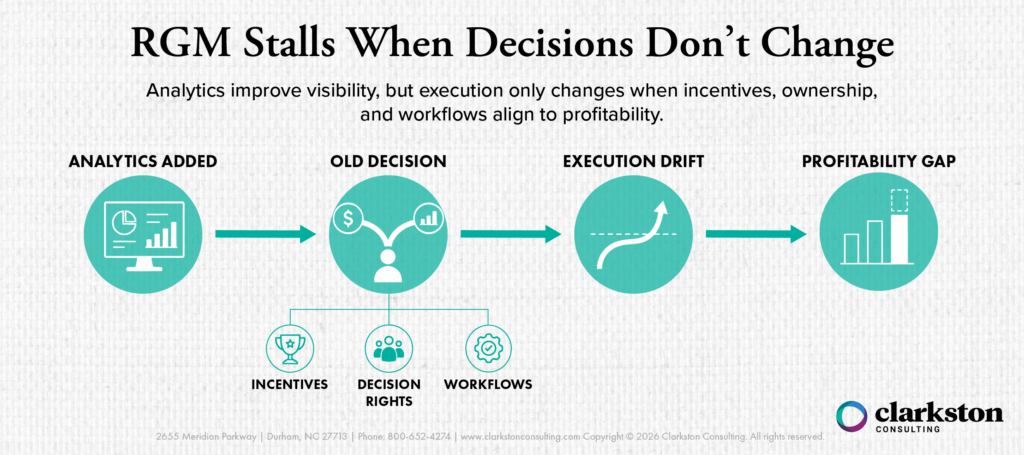
RGM programs rarely stall because of a lack of analytics. They stall because the organization’s decision-making process doesn’t change, and that breakdown usually starts in the operating model.
Incentives override profitability.
Sales is typically measured on volume, while RGM focuses on net sales and margin. When recommendations challenge volume through price increases or reduced promotion, they conflict with how Sales is incentivized. As a result, guidance is adjusted to hit a volume plan.
Decision rights are unclear.
RGM generates insights and recommendations, but accountability for the final commercial outcome often remains distributed across multiple functions. Sales retains control at the customer level, while Finance validates results after the fact. Pricing becomes a negotiation starting point, and promotion optimization becomes optional. No single role is accountable for whether the decision delivers the intended P&L outcome.
Analytics aren’t embedded into execution.
Organizations invest in dashboards and models but fail to integrate them into planning and workflows. Insights are shared, but they aren’t consistently built into the planning routines where decisions are made. As a result, analytics operate alongside the business rather than within it.
The pattern is consistent. Organizations add RGM capabilities without redesigning the operating model. New tools may improve visibility, but the same incentives and decision paths continue to shape what actually gets executed.
Year one delivers improvement. Year two exposes the limits of that approach.
From Tools to a Decision System
Sustained growth requires more than optimizing individual levers. It depends on connecting commercial decisions across customers and channels.
This is where many organizations fall short. RGM remains a collection of tools that support isolated decisions rather than an integrated discipline that shapes how decisions are made.
The relationship between Trade Promotion Management and Trade Promotion Optimization provides a useful example. TPM creates visibility and control over trade investments. TPO builds on that foundation by applying advanced analytics to optimize promotional decisions. Without a strong TPM foundation, TPO recommendations are difficult to scale because the underlying data and trade governance aren’t yet in place. In that environment, optimizations may identify better choices, but teams still lack the process discipline to act on them consistently.
The same principle applies across RGM. Advanced analytics, AI, and optimization capabilities only create value when they are connected to decision-making processes and execution. Technology can enable better decisions, but clear ownership and accountability determine whether those decisions translate into outcomes.
RGM as a Capability
RGM is an enterprise capability. Organizations that sustain momentum treat it as part of how commercial decisions get made, not as a separate support function. They establish clear ownership for revenue-driving decisions and align incentives around profitable growth.
In these organizations, analytics become part of the core planning and customer-facing routines. Teams use insights as part of the decision-making process instead of recommendations to evaluate after the fact. The result is a decision system where RGM guidance is easier to act on and easier to measure.
Building Sustainable RGM Capabilities
RGM programs stall when organizations improve individual levers without changing how decisions are made.
With pricing-led growth becoming harder to sustain, profitable growth depends on coordinated execution across the commercial levers that shape revenue and margin. Organizations that treat RGM as a true enterprise capability rather than a reporting function are better positioned to sustain impact over time.
Building that capability, however, requires more than analytics or technology alone. It requires an operating model with clear decision ownership, reliable data, and incentives to support profitable and sustainable growth.
For many organizations, the next phase of RGM maturity is less about adding new tools and more about making guidance usable in day-to-day decision-making. Clarkston works with CP companies to strengthen their operating models and data practices to apply RGM guidance more consistently in execution. When organizations make that shift, RGM becomes a long-term driver of profitable growth rather than a short-term optimization initiative.
Subscribe to Clarkston's Insights
AI-assisted: A human led the content and final approval of this piece, with AI used to support ideation, drafting, editing, summarization, or repurposing.