TPM vs. TPO: Maximizing the Return on Trade Investments

Many organizations invest heavily in trade promotions but lack clear visibility into whether those investments are truly delivering value or how to improve them. In my experience, the root of the issue is not the absence of data, but a misunderstanding of the roles that Trade Promotion Management (TPM) and Trade Promotion Optimization (TPO) play within the organization. Without a clear distinction between the two, companies often struggle to move from tracking performance to actually improving it.
Understanding TPM vs. TPO
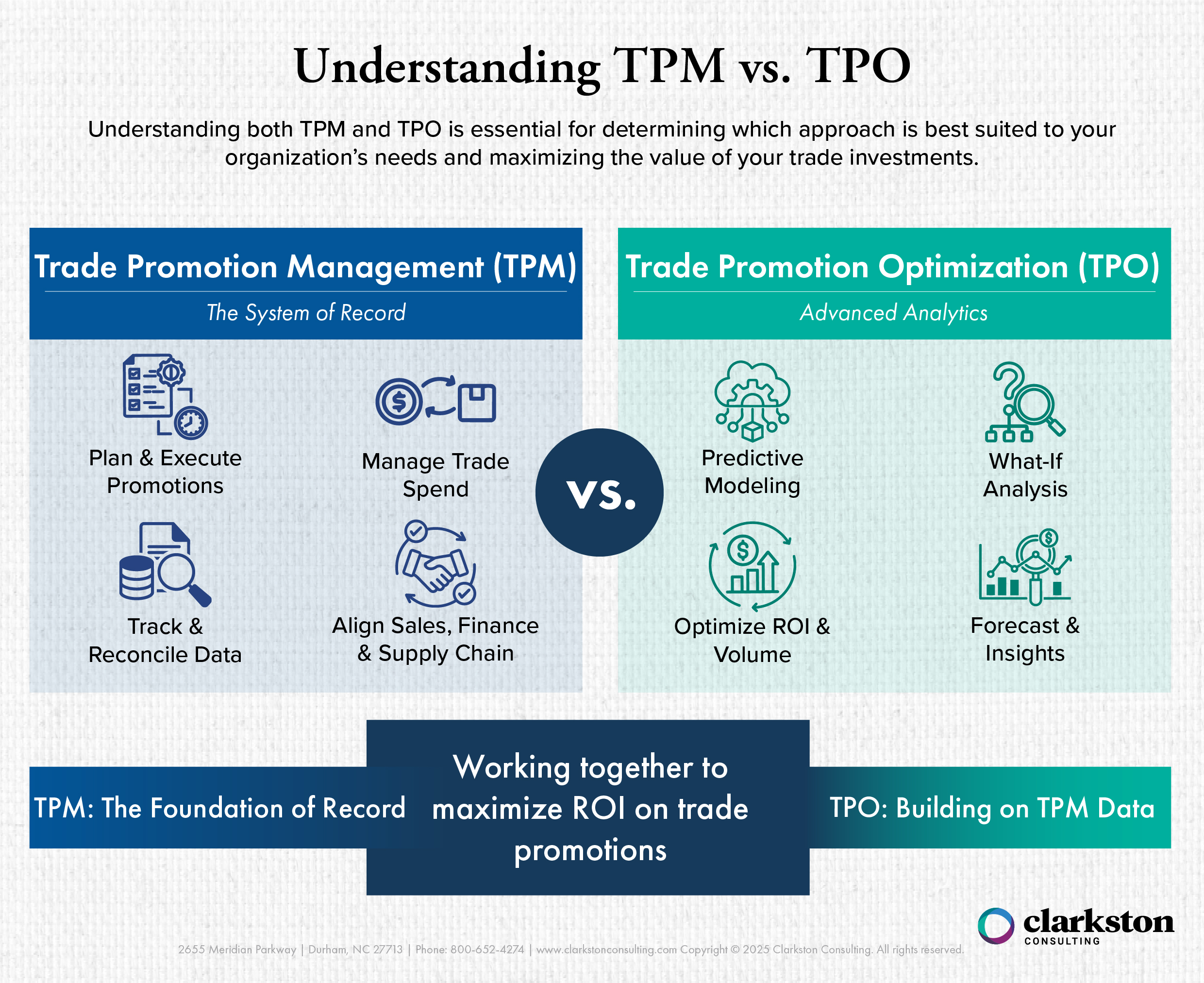
Understanding how TPM and TPO work together is critical to maximizing the return on trade investments. While TPM and TPO are closely related, they serve distinct purposes within an organization. TPM acts as a record system, while TPO builds on the foundation of TPM to optimize promotion decisions. Understanding the differences between these two platforms and how to use and implement each is the key to maximizing ROI on promotional investments.
Trade Promotion Management (TPM)
TPM is designed to plan, execute, track, and financially manage trade promotions and customer investments. It is the system of record – tracking trade data and promotional executions. This tool focuses on planning and executing promotions, controlling and governing trade spend, financial accountability and reconciliation, and ensuring cross-functional alignment between Sales, Finance, and Supply Chain.
Trade promotion managers support a range of capabilities, including promotion and event planning, fund and budget management, and base and incremental volume planning. They also enable accruals and deduction linkage, post-event performance analysis, and ensure auditability and compliance. TPM answers business questions like:
- What promotions are we running, where, and why?
- How much trade spend is committed and remaining?
- Did the promotion perform as expected financially?
- Are we accurately accounting for trade investments?
Trade Promotion Optimization (TPO)
Once this foundation is in place, TPO builds on TPM data to optimize promotional decisions through advanced analytics, helping organizations identify the most effective scenarios. TPO focuses on predictive modeling, scenario evaluation, and optimizing promotion mechanics such as timing, depth, and frequency to maximize ROI, volume, or profit outcomes.
In practice, TPO enables capabilities such as lift and elasticity modeling, “what-if” scenario analysis, machine learning–driven forecasts, and insights into assortment and pricing sensitivity. TPO answers business questions like:
- Which promotions should we run?
- At what depth, duration, and frequency?
- Which scenarios maximize profit or ROI?
- What is the optimal promotion mix?
When to Use TPM vs TPO?
If your organization is experiencing any of the following, TPM is not optional – it’s foundational.
TPM should be considered when:
- Promotions are managed manually or across disconnected tools
- Trade spend lacks visibility or control
- Finance cannot reconcile promotions confidently
- Deductions, accruals, or settlements are pain points
- The organization needs a single source of truth for trade activity
TPM is foundational to all other trade functions. Optimization by TPO without a clear TPM structure and governance can create risks.
TPO should be considered when:
- TPM processes are stable and consistently adopted
- Historical data quality is high
- Promotional performance is measurable and reliable
- The organization is ready to act on analytical recommendations
- The business wants to improve how promotions are chosen, not just tracked
It’s important to keep in mind that the optimization is only effective when the underlying data and processes provided by TPM are sound.
When Both TPM and TPO are Needed
There are many instances when organizations can benefit from using both TPM and TPO, particularly when the trade spend is significant and strategically important. The real value is not in having both systems – it’s in how they are connected.
This approach can also be valuable to businesses that operate at scale across customers, channels, or geographies, as well as in organizations where there is executive appetite for data-driven decision making or where the organization can operationalize optimization insights.
That said, incorporating TPM and TPO together can be challenging. A best practice approach involves setting up TPM as the system of record and execution engine, while TPO serves as the decision intelligence layer. In this model, TPO generates data-driven recommendations that can be fed into TPM planning workflows, ensuring that these insights can be transformed into action.
Common Pitfalls to Avoid
While setting up TPM and TPO integration, there are some common obstacles businesses run into. For starters, you should wait to implement a TPO until all TPM fundamentals are in place. This ensures a strong foundation for which TPO can work.
It’s also important to remember that TPO isn’t a replacement but rather an enhancement. TPM remains the core system of planning and execution, while TPO adds a layer of advanced analytics and intelligence-driven decision making.
Finally, organizations should avoid assuming that optimization recommendations will be automatically adopted. Successful TPO integrations require thoughtful change management and building trust in the models.
Moving Forward
Overall, TPM ensures that promotions are planned, executed, and financially controlled, and TPO functions to improve the quality of promotional decisions. The optimizations made by TPO should build upon strong TPM foundations, not replace them.
Whether you’re building your TPM capabilities or exploring advanced TPO strategies, our team can help assess your current TPM and TPO and define a roadmap for success. Contact us today to learn how we can help you maximize the value of your trade promotions.
Subscribe to Clarkston's Insights
Contributions from Natalie Pollock
AI-assisted: A human led the content and final approval of this piece, with AI used to support ideation, drafting, editing, summarization, or repurposing.