How Modern Supply Chain Planning Tools Create Business Value

In the first part of this series, we explored why traditional planning environments are struggling to keep pace with today’s volatility and how leaders can recognize the gaps limiting their teams. Spreadsheet dependence, disconnected processes, delayed information, underperforming tools, and heavy manual effort may look like separate problems, but they often point to a broader issue: the organization’s planning capabilities haven’t evolved at the same speed as the business.
The next question is how modern supply chain planning tools can help organizations close that gap and translate new capabilities into measurable value.
Modern Supply Chain Planning Tools
The modern supply chain planning market includes a range of mature solutions designed to help companies navigate increasingly complex operating environments. Platforms such as SAP IBP, Logility, RELEX, Kinaxis, and O9 demonstrate how far the market has evolved, with capabilities spanning areas such as concurrent planning and AI-enabled decision support, as well as integrated business planning, demand planning, supply planning, and continuous network optimization. Many platforms bring several of these capabilities together within a single solution.
For business leaders, however, the significance is broader than any one platform. The market now offers leading-edge technology capable of supporting more connected, responsive, and resilient planning than legacy approaches could ever deliver. The critical question isn’t just which solution is most visible in the market, but which capabilities best align to the organization’s business needs and risk profile. Those capabilities should also reflect its planning maturity and future-state goals.
In that sense, modern planning tools should be as part of the core operating model rather than as one-off solutions for an individual purpose. The right capabilities can help teams focus on the decisions that need to be made, reducing risk and chaos that often get in the way of execution.
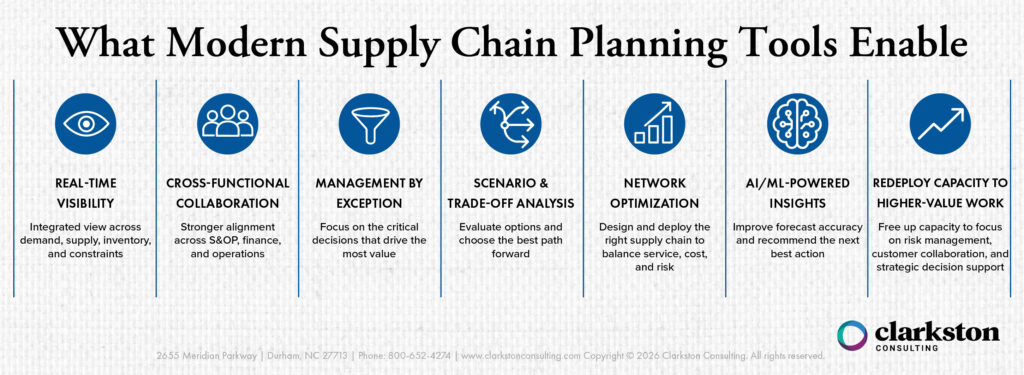
Key Capabilities
- Real-time visibility and reporting
Imagine analyzing month-old news to predict what’s going to happen next quarter. That’s what companies with legacy reporting infrastructure are doing to support business decisions. Modern planning tools provide integrated, real-time views across demand, supply, inventory, and end-to-end supply chain constraints. These capabilities give decision-makers access to more current and connected information, enabling earlier identification of issues and faster response to risk.
- More efficient collaboration and stronger S&OP / IBP
Better reporting leads to better decision-making. Modern platforms support tighter coordination across supply chain, commercial, operations, and finance teams, creating a more connected planning environment and improving the quality of cross-functional decision-making. Best-in-class companies take the time to research the key data points needed for each step of their IBP/S&OP/S&OE process and build one-click dashboards that enable meetings on demand with minimal preparation required.
- Management by exception
Decisions being made by the right people at the right time is critical in dynamic planning environments. Modern tools enable a step change in capability to shift from manually reviewing large volumes of data and routine signals, to focusing attention on the issues that matter most. This shift helps planners spend less time assembling information and more time evaluating risk, prioritizing trade-offs, and driving action.
- Scenario planning and trade-off analysis
Decisions are best made when several choices are weighed against each other. Modern planning tools allow organizations to take snapshots of their complete end-to-end supply chain and model potential scenarios, assess the impact of different decisions, and respond with greater confidence when disruption occurs.
- Network design and optimization
Beyond supporting day-to-day planning decisions, modern tools can also help organizations evaluate the structure of their supply chain network itself. This includes modeling sourcing footprints, manufacturing and distribution locations, inventory positioning, lane efficiency, and service trade-offs to better align the network to changing business requirements, cost pressures, and risk exposure.
- AI/ML-supported planning
In large organizations, hundreds, and in some cases thousands, of people hours are spent every cycle gathering data, analyzing reports, collaborating, and making decisions. Now imagine a future where you can cut that time in half by leveraging AI/ML to create a baseline forecast that matches the accuracy of your current consensus process. That future is here. Advanced analytics and machine learning algorithms, when implemented correctly, help organizations craft an accurate baseline forecast and then focus on an additive decision making process. Now, planners should ask:
-
- What are the emerging market patterns and competitive threats that we need to layer in?
- How much are events, promotions, and ad-spend going to influence the forecast?
- What are the key decisions that we must make now to hit the current quarter?
These are the real questions that your organizations should be considering, and AI/ML enables that evolution, creating more capacity for planners to evaluate the business factors that technology can’t assess on its own.
- Redeployment of planning capacity toward higher-value work
As management by exception reduces the time planners spend manipulating data or reviewing routine decisions, organizations can redirect that capacity toward work where human judgment adds more value. This could include deeper customer collaboration or proactive risk management. It may also create more capacity for analytically focused decision support.
These capabilities matter because they do more than modernize planning activities. They improve how the business makes decisions, responds to disruption, and balances cost, service, and growth. When modern planning tools are aligned to the right operating model, the result is not just better planning process execution, but measurable business value.
Key Business Benefits
Results will vary based on the starting point, scope, and adoption of the new planning approach. Still, benchmark research indicates the scale of improvement that may be possible. In a study of 68 supply chain planning users, Nucleus Research found an average 24% inventory reduction and a 27% improvement in demand forecast accuracy. The same research reported a 3% improvement in fill rates.
Separate Nucleus Research analysis has cited planner-efficiency improvements of 30% to 50% in supply chain planning deployments, though outcomes will depend on the process design and the specific technology environment.
- Better inventory and working capital performance through more informed decisions about inventory levels and service requirements.
- Improved service performance through closer alignment between demand, supply, and inventory plans.
- Stronger forecast accuracy through better data foundations and more focused planner input.
- Greater planner efficiency by reducing repetitive analysis and directing attention to meaningful exceptions.
- More informed commercial decisions by connecting demand signals with promotional activity, allowing supply plans to reflect expected changes.
- Stronger cross-functional alignment through a shared view of the plan and a clearer understanding of key assumptions.
- Decisions aligned to financial requirements through scenario planning that connects operational trade-offs to financial targets.
This is the real opportunity. Modern planning tools enable a different level of decision-making, one that is faster – and more connected, more predictive, and more capable of supporting growth in an increasingly volatile environment.
Considerations for Planning Transformation and Tool Selection
The most successful transformations begin with a clear understanding of the organization’s current state environment and future state needs. That means assessing not only technology, but also planning processes, data quality, governance, user roles, decision rights, and organizational readiness.
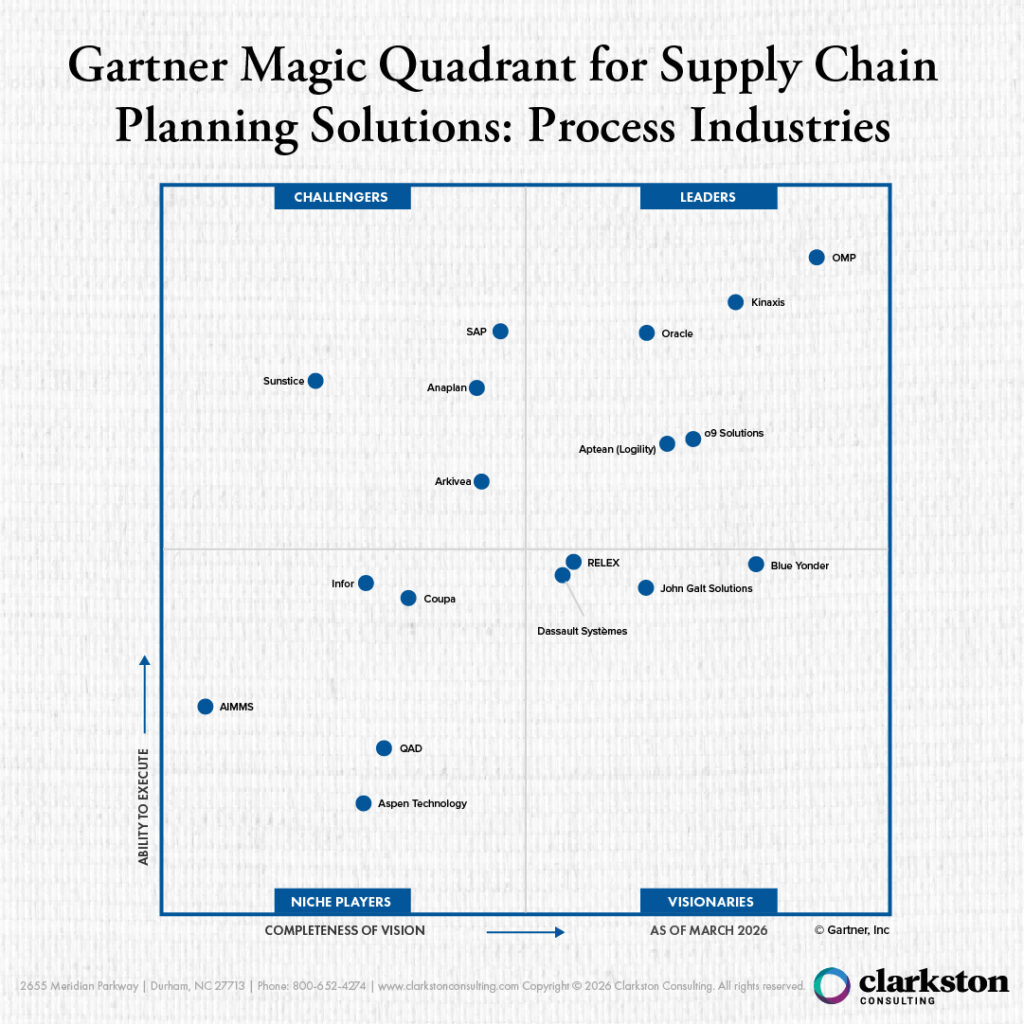
The market for supply chain planning solutions is broad and continues to evolve. Analyst perspectives, including the Gartner Magic Quadrant, can help organizations understand the vendor landscape and develop an initial shortlist – but they can’t determine which tool is right for a specific business.
Analyst reports and vendor demonstrations are only part of the evaluation process. Organizations still need to determine where their current planning model is falling short, which capabilities are most critical to future success, and how those requirements should shape solution selection. This is where choosing the right partner can add tremendous value.
How Clarkston Can Help
Most supply chain planning transformations don’t fail because of the technology or the system; they fail because the organization underestimates the complexity of aligning data, processes and decision-making across their business. Too often, we see companies so focused on selecting the right tool that they underestimate the importance of addressing data quality, cross-functional alignment, and process governance early. The result is often an underutilized platform, with frustrated business users and limited business value.
At Clarkston we help our clients take a different approach. We believe any planning transformation to fundamentally be a business transformation that is enabled by technology, not the other way around.
Subscribe to Clarkston's Insights
AI-assisted: A human led the content and final approval of this piece, with AI used to support ideation, drafting, editing, summarization, or repurposing.