Modern Supply Chain Planning: Enabling Resilient, Intelligent Decision-Making

Legendary former college football coach Nick Saban offers a powerful lesson in resilience. He asks a question that is critical for all business leaders to consider when their team is faced with adversity: “Are you able to stay focused on the process and vision? Or are you only able to focus on your circumstance?”
Modern supply chain planning puts that distinction to the test. When planning processes and tools can account for variability, teams have a better chance of responding deliberately. When they can’t, planners are often left reacting to the latest disruption.
Teams are operating in an environment characterized by demand volatility, tariffs, global sourcing disruptions, and geopolitical risk. The ability to react to this disruption and plan for variability has become a critical driver of business performance. Organizations need to understand the potential impact of disruption early enough to evaluate their options and adjust their plans for that variability with the right supply chain design and analytics.
Yet, many companies still rely on planning environments that are fragmented, driven by spreadsheets, and not equipped to support the fast-moving complexity of their business. This places pressure on planners to perform their best with an infrastructure that forces them to choose heroics or failure.
For business leaders, there’s a major opportunity to not just select a new planning tool, but to build a dynamic, predictive planning ecosystem on the foundation of a modern planning engine.
Why Supply Chain Planning Tools Matter
The role of planning has evolved significantly in recent years. What was once a periodic, spreadsheet-driven activity within individual functions now must operate as a connected decision-making capability across the supply chain. Product portfolios continue to expand, and fulfillment models are more complex. Global supply networks also remain exposed to disruption. As a result, leaders are asking for more timely insights and greater confidence in the decisions being made.
Planning teams are expected to balance competing priorities while responding to variability. They also need to coordinate decisions across functions that may have different objectives. This is a tall order.
The ask of your planning teams has evolved and become far more complex, but the process and tools that support the ask often lag far behind, putting pressure on your people. Even companies with established planning technologies may find that those tools are underutilized, poorly integrated into business processes, or no longer sufficient to meet the organization’s evolving needs.
Talented, experienced planners find workarounds in environments like this by creating spreadsheets or offline reports to override forecasts and planned purchase orders. But doing so takes real-time data and processes that are offline and static. Inevitably, people and processes reach their breaking point, quickly fighting fires and prioritizing which fires are the most important to fight to keep the house from burning down. This is no fault of the planners; static reports, spreadsheets, and disconnected systems can slow decision-making and create inconsistent views of the truth.
Modern supply chain planning tools are designed to help organizations address these gaps. By integrating data and planning activities across functions, planners can spend more of their capacity reconciling data and responding to exceptions rather than understanding what is driving them.
How to Get Started
Issues can present themselves in a multitude of ways, but you often have indicators of issues that happen month after month, with every planning cycle. You may face visible pain points, like missing your working capital goals, large fines from retailers, or consistently missing your fill rate targets. Or you may experience more subtle issues such as slow response times, weak cross-functional alignment, or planning teams consumed by manual work creating consistent asks for additional headcount. These are all indicators of misalignment somewhere in your infrastructure that must be addressed.
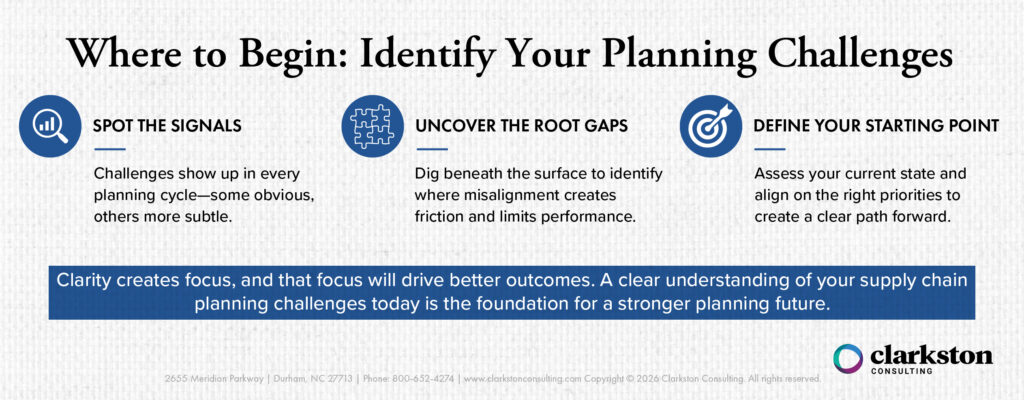
Here are some more common starting points:
- Spreadsheet-dependent planning: Spreadsheets are used to bridge system gaps, support ad hoc analysis, or drive decisions outside formal planning tools. The flexibility they offer is tempting, but in practice they are hard to scale, dependent on tribal knowledge for version control, and often reduce transparency and collaboration.
- Legacy or underperforming planning tools: Some organizations have planning solutions in place, but the tools no longer support the speed, complexity, or scenario capabilities the business requires. In other cases, the technology exists, but poor adoption, weak governance, or immature processes limit value realization.
- Fragmented planning processes: Demand, supply, inventory, and financial planning often operate in silos with limited coordination. This can lead to disconnected decisions and weaker management of trade-offs across service, cost, and risk.
- Delayed reporting and limited visibility: By the time information is consolidated and shared, it may already be outdated. This makes it harder to identify issues early, assess impacts, and respond in a timely manner.
- Heavy manual effort: Planning teams often spend too much time gathering data, updating spreadsheets, and preparing routine reports. This reduces the time available for exception management, scenario analysis, and valuable human decision-making.
Next Steps
If you’re ready to build a more resilient planning organization and pursue true transformation, you must first understand your starting point and clearly define the gaps that need to be solved. Selecting an experienced partner for this part of the journey is critical. They can help map supply chain risk hotspots against current capabilities across people, processes, data, and tools, creating a clear view of where the current operating model is creating friction and limiting performance. Once those gaps are understood, leaders can begin defining the capabilities needed to address them.
We look forward to exploring modern supply chain planning tools in our next piece, including how these tools can unlock those capabilities, improve business performance, and help organizations move from reactive planning toward more connected, intelligent decision-making.
Subscribe to Clarkston's Insights
AI-assisted: A human led the content and final approval of this piece, with AI used to support ideation, drafting, editing, summarization, or repurposing.