Understanding the Value of a PMO for CPG Companies

Today’s project environments are increasingly complex, especially amid rapid market shifts that have become ordinary for consumer products companies. The value of a Project Management Office (PMO) for CPG companies comes from its ability to bring greater structure to these environments while helping teams keep projects connected to broader business priorities.
A PMO establishes consistent project management practices and governance across the organization. By applying best practices, a PMO can help teams manage complex initiatives while maintaining alignment with business goals.
Four Key Benefits of CPG PMOs
What are some of the key benefits enabled by a PMO? Below, we outline four examples that demonstrate the value of a PMO to a consumer products organization:
1. Improved Strategic Alignment
CP organizations manage complex portfolios of initiatives across brand growth, product innovation, commercialization, supply chain transformation, digital enablement, sustainability, and regulatory compliance. A PMO helps ensure that these initiatives are aligned to enterprise priorities by implementing standardized methodologies, governance routines, status reporting, and integrated roadmap planning – bridging the gap between daily execution and long-term goals.
One CP company, Procter & Gamble, upgraded its nearly 20-year-old software systems with regional PMOs, impacting a portfolio of 250,000 products. The project standardized project management practices, ensuring strategic priorities and resources remained aligned across the business.
2. Increased Flexibility, Visibility, and Risk Management
Many CP companies grow frustrated by a lack of flexibility and visibility in their organization’s operations. A PMO improves this capability, granting enterprise-wide visibility into the projects within an organization and assisting with resource and budget needs while identifying potential conflicts across projects. PMOs allow organizations to plan for risks and failures, then plan strategy around how to manage them.
Adding to the previous example, P&G’s global transformation implementing PMOs also centralized risk management, helping leadership proactively deal with resource conflicts. Rather than leaving individual functions to address these issues independently, the PMO provided a mechanism for resolving conflicts before they disrupted implementation.
3. Improved Collaboration Across Departments
Many consumer products initiatives depend on coordination across functions. A PMO can strengthen that coordination by clarifying the needs and responsibilities of teams across functions such as supply chain and finance, as well as brand, sales, or IT. By unifying objectives and defining clear ownership amongst departments, accountability is shared – centralizing timelines, budgets, and data as well as setting clear procedures for early risk escalation.
4. Stronger Innovation and Commercialization Pathways
A PMO can help improve innovation and commercialization execution by establishing clear timelines, decision rights, launch readiness criteria, and cross-functional accountability. This structure helps reduce delays, improve transparency, and ensure that teams are focused on the highest-value initiatives in the portfolio.
For example, Coca-Cola HBC established a PMO during major SAP and enterprise transformation initiatives to coordinate deployments across several countries. The PMO supported governance and schedule management while providing a structure for issue escalation and stakeholder coordination throughout the rollout.
Implementation – Four Key Challenges
While a PMO can improve how consumer products companies manage projects, implementation can introduce its own challenges. Addressing these issues early can help organizations establish a PMO that supports the business without adding unnecessary complexity. We outline four of those challenges below:
1. Resistance to Change
CP organizations may face resistance when implementing new systems and methodologies, particularly when employees are accustomed to a particular project management style. With core causes of pushback being fear of control and a data habit shift, a PMO implementation may require thoughtful change management strategies to overcome that resistance.
2. Balancing Standardization with Agility
A PMO should strike a balance between standardizing business processes and allowing flexibility for teams to pivot when necessary. Facing challenges in speed-to-market pressures, cultural resistance, and complex legacy technology, organizations should implement agility into project methodologies to maintain versatility in a rapidly changing business environment.
One CP company, Mondelez International, utilized a PMO to standardize global governance across over 6,500 product initiatives while allowing dynamic portfolio management based on real-time data. By constructing a single source of truth for project execution, resource planning, and portfolio management, Mondelez enhanced governance without compromising its agility to respond to changing demand and market opportunities.
3. Securing Executive Buy-In
Securing support from senior leadership can be challenging, especially when the value of a PMO isn’t clearly defined or when leadership expects the PMO to demonstrate value quickly. Organizations can demonstrate value through KPIs tied to specific business outcomes, such as shorter project delivery times or cost savings. A focused pilot addressing a visible business problem can also provide leadership with tangible evidence of the PMO’s impact, while an influential change champion who understands day-to-day operations can further support adoption among leadership.
4. Breaking Down Silos
CP organizations often experience siloed teams with redundant functions or competing priorities. A PMO can help address these challenges, but doing so requires teams to recognize where disconnected processes or data are limiting cross-functional work. Establishing shared processes and clearer ownership can help functions work together more consistently.
Struggling with disconnected systems and inconsistent cross-functional collaboration, Hershey implemented a PMO. The initiative identified departmental silos and mapped processes across functions. It also established a transformation roadmap intended to improve collaboration and decision-making.
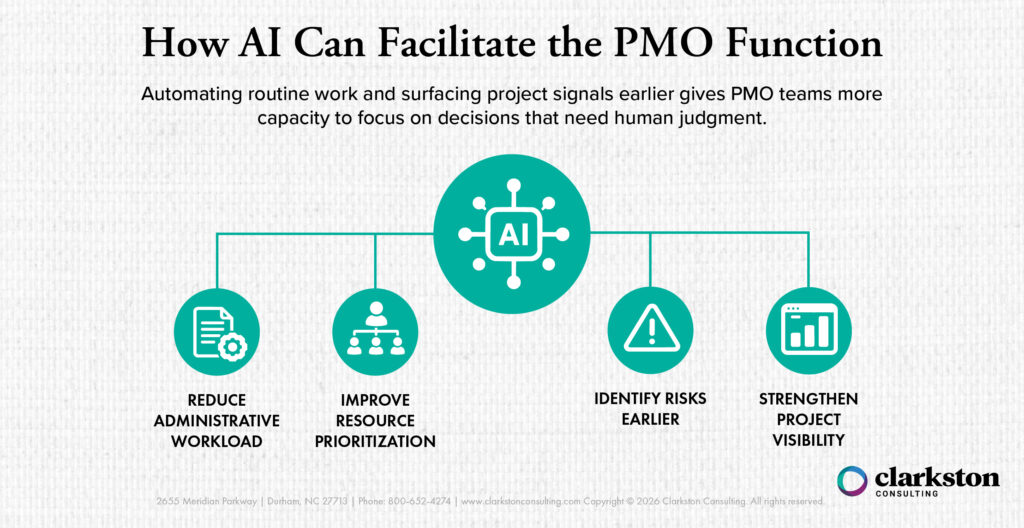
How AI Can Facilitate the PMO Function
It’s important to note AI’s role in today’s PMO environments, too. AI can support PMO teams by reducing the time project managers spend on reporting and other routine tasks. It can also help teams prioritize resources and coordinate work across functions. By analyzing historical data, AI can help identify potential risks or delays earlier, including possible budget overruns. AI-enabled dashboards can also give management a more current view of project performance.
Key Takeaways
As consumer products companies navigate increasingly complex project environments, a well-structured PMO can provide greater consistency in how projects are managed across the organization. Clear governance and cross-functional coordination can help teams respond to change while keeping projects connected to broader business priorities. As market conditions continue to shift, the value of a PMO comes from providing the structure and visibility teams need to manage projects more effectively.
At Clarkston, we can help your business construct and optimize a PMO.
Subscribe to Clarkston's Insights
Contributions by Spencer Simco
AI-assisted: A human led the content and final approval of this piece, with AI used to support ideation, drafting, editing, summarization, or repurposing.