Finding the Money for AI Projects: How Operational Savings Can Fund Innovation

While many companies are looking to the potential of AI to improve decisions and outcomes for the organization, budget constraints can hamper efforts to make significant progress. For many companies, the path forward may not begin with a larger innovation budget. It may begin with a more disciplined approach to operational and commercial efficiency.
What if you could invest in operational and commercial efficiencies that increase your organization’s readiness for AI and use those efficiencies to fund AI innovations?
Finding the Money for AI Projects
Investments to assess and create efficiencies in commercial and operational models can free up money to invest in AI projects while simultaneously readying the organization for AI capabilities.
With Clarkston’s approach, known as the Self-Funding Flywheel, organizations can realize the benefits of investing in the right “non-AI” improvement projects to create measurable savings, releasing working capital and simultaneously improving the data, process, and organizational foundations required for AI to succeed. These efficiencies can then be reinvested into AI pilots, data infrastructure, governance, change management, and future-facing capabilities. With this self-funding flywheel model, your organization can realize gains in operating model efficiencies that prepare the organization for the next level of AI investment and find the money in savings to invest in those new AI capabilities.
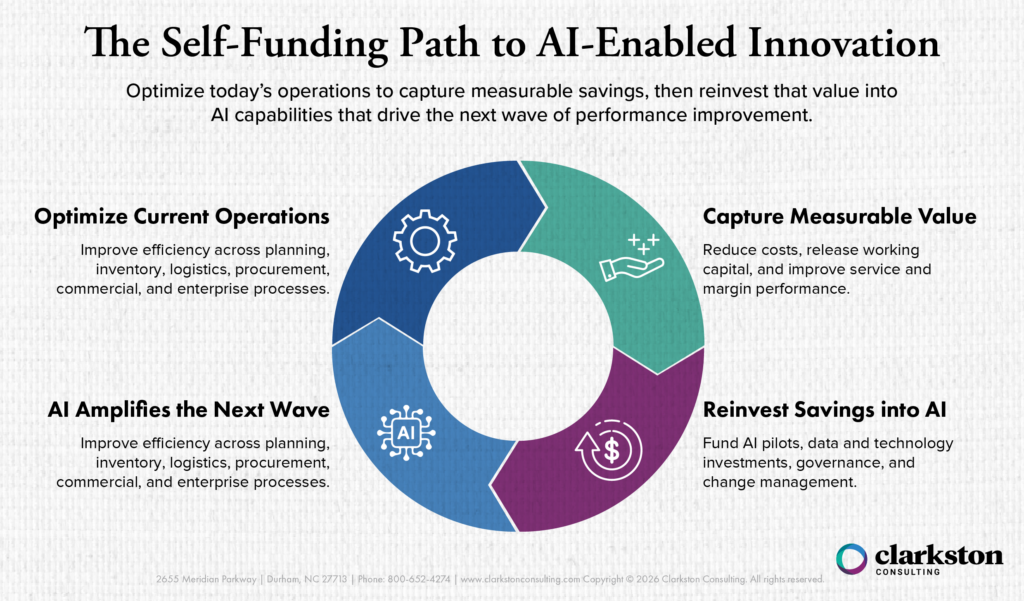
Getting Started: Clarkston’s Self-Funding Flywheel
The first step of the Self-Funding Flywheel is to assess where value may be trapped in your commercial, operational, supply chain, and enterprise models and processes. So then, what types of projects can find those resources for your AI innovation pipeline? Here are a few of the biggest opportunities to explore:
Commercial Spend Optimization
Trade continues to be one of the biggest line items in CPG, and without some sort of trade management system and optimizer in place, companies are very likely leaving money on the table. Investments in RGM capabilities can extend those gains to the beyond trade into areas like shopper marketing, retail media, and customer profitability. Many companies still lack the systems, visibility, and analytics needed to understand which investments are truly creating value. Deduction management and optimization can be one of the most straightforward ways to see measurable return on investment. Managing deductions, including automating deduction reconciliation wherever possible, saves money in efficiency but also helps teams catch overspends, mis-spends and errors earlier. Organizations can reduce revenue leakage and improve cash flow, creating a more direct funding source for future innovation.
Planning and Inventory Performance
Forecast accuracy and optimization of inventory and obsolescence are common areas where organizations can identify savings to reinvest or funnel into their innovation pipeline. With better forecast accuracy comes lower inventory and warehousing costs as well as improved service levels. These gains not only create financial capacity but also improve the organization’s readiness for AI-enabled demand sensing, autonomous planning, and dynamic replenishment.
Supply Chain Cost and Performance Improvement
From warehouse management to route management and procurement efficiencies, the supply chain offers numerous areas to find cost savings that can be reinvested. Assessing and prioritizing upgrades and efficiencies all along your supply chain – from lower input costs to improved supplier terms and contract compliance – can serve as a win across the organization. These initiatives can reduce operating costs while improving the quality and consistency of supply chain data, which is essential for future AI use cases in logistics, procurement, risk management, and scenario planning.
Enterprise Process and Organizational Readiness
Almost every organization struggles with manual processes, duplicated work, and inconsistent master data that fuel inefficiencies in time and resource management. Investing in projects that reduce manual and duplicated work by reviewing workflows, master data, and organizational structure can free up resources and capacity while readying the organization for AI initiatives. This work helps to standardize processes, clarify ownership and decision rights, and strengthen data quality.
Taking the Next Steps
Organizations should identify projects with the potential to deliver tangible, real savings, and then prioritize those projects based on strategic relevance and speed to value. Leadership alignment is equally critical so that savings and efficiencies gained from these operations and commercial optimizations are intentionally reinvested into the AI innovation pipeline.
Done well, these upgrades can create a practical self-funding model where operational improvements create the dollars, data, and discipline needed to invest in AI responsibly and scale into the future. Our team can support the next step; explore our strategy services or reach out to our team today to learn more about our Self-Funding Flywheel approach.
Subscribe to Clarkston's Insights
Human-created: This content was ideated, drafted, edited, and approved by a human. AI use, if any, was limited to incidental support.