Serialization Managed Services: Supporting Compliance Beyond Go-Live

Serialization supports product authentication, counterfeit prevention, recall readiness, and end-to-end supply chain visibility. As serialization environments mature, organizations are shifting beyond implementation and into ongoing operations, increasing the need for Serialization Managed Services and specialized expertise to support them.
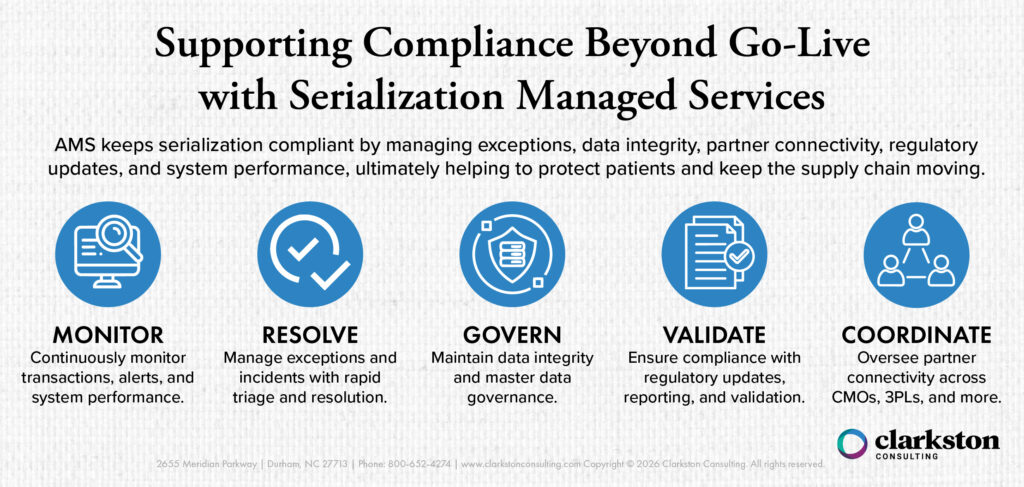
While serialization managed services includes application support, it also encompasses capabilities such as EPCIS monitoring, exception management, master data governance, partner onboarding, and regulatory support.
In this piece, we break down how organizations can leverage a managed services model to adapt to the evolving demands of serialization. We also explore how to maintain effective operational support, sustain compliance and reporting requirements, and coordinate increasingly complex data and partner networks.
Shifting from Implementation to Ongoing Operations
Serialization has moved from implementation to day-to-day operations across the enterprise. Regulations are now established, so teams are focused on managing alerts, data integrity, and partner interactions. The FDA’s one-year DSCSA stabilization period has concluded for many trading partners, marking the start of reinforcing the shift toward electronic, package-level traceability while some targeted exceptions remain in place.
Sustaining performance and compliance at scale is the new challenge to address, even for organizations that already have a defined roadmap and selected platforms. Many operating models aren’t caught up to the demands of running serialization, creating strain across functions. Serialization and traceability requirements are inherently cross-functional, spanning supply chain, IT, quality, and regulatory operations.
At the same time, managed services have moved from reactive support into a proactive model focused on performance and alignment with business objectives. More than 76% of pharmaceutical manufacturers outsource serialization services to meet tight regulatory timelines, making outsourcing the default rather than the exception.
As organizations move beyond implementation, the focus is shifting toward scalability, operational continuity, partner coordination, and long-term support models that can sustain serialization across evolving regulatory environments. For many businesses, this creates a natural transition to managed services, where serialization activities are managed through a structured model.
Running Effective Serialization Operations
Continuous monitoring is required to support critical processes and manage incidents as they arise. Components of support include ticket triage, routing, escalation, and user support. Organizations are increasingly using automation and structured knowledge bases to resolve routine issues faster. Root cause analysis and performance tuning also help keep systems stable.
Alert and exception management should be coordinated with quality and compliance teams. Based on industry data, 3-7% of serialized transactions generate exceptions, with spikes significantly higher during onboarding of new trading partners or system upgrades.
Trading partners must also be able to respond to product trace requests in as little as 24 hours for suspect products. As organizations scale partner networks and transaction volumes, maintaining operational continuity becomes increasingly difficult without dedicated support structures and defined escalation paths.
For successful integration with ERP, MES, and other enterprise systems, businesses must execute careful configuration to avoid disruptions. Serialization operations also require ongoing monitoring of partner connectivity, transaction flows, and system performance to reduce disruptions across CMOs, wholesalers, and distribution partners.
These activities are difficult to sustain, making managed services a valuable source of dedicated operational support that allows organizations to focus on strategic priorities.
Sustaining Compliance and Reporting
Regulatory requirements continue to evolve, requiring ongoing oversight and updates. Leading enterprises are linking compliance to business metrics such as risk and service levels. Organizations must manage regulatory reporting and verification requirements, in addition to conducting impact assessments.
Compliance performance should be consistently tracked and reported. System changes should also remain aligned with validation and GxP expectations. As organizations make ongoing adjustments to serialization systems and processes, structured change control becomes increasingly important. This includes configuration changes within serialization platforms, testing and validation activities, and impact assessments across systems and partners.
As global regulations mature, organizations are no longer focused only on achieving compliance milestones. The focus has shifted toward maintaining compliance while ensuring visibility and control across the supply chain. Ongoing compliance now depends on close coordination across operational teams, IT, quality, and external partners to reduce risk and support uninterrupted product movement.
Coordinating Data and Partner Networks
Serialization relies on strong governance regarding product, GTIN, and serial number data accuracy. Serialization also generates large volumes of transaction data that must be reconciled and made accessible over time. It’s crucial to identify data quality issues and EPCIS errors quickly, enabling prompt resolution. A managed services model can provide the stewardship needed to maintain integrity across the ecosystem.
Differences in data standards and system configurations across partners can make interoperability difficult to maintain. Regularly updating serialization platforms ensures that they keep pace with internal systems and external partners. Partner connectivity across CMOs, 3PLs, and wholesalers also requires active management.
Issues often originate outside the organization, so coordination across multiple external partners is crucial. Ongoing management efforts maintain data exchange and support overall network performance. As organizations onboard new trading partners, expand globally, and adjust operational processes, maintaining interoperability and transaction accuracy becomes more resource intensive.
Getting Started
Enterprises should begin by assessing current operations to identify gaps across support and data management. From there, defining a roadmap can unify strategy with supporting technology. Focusing on high-impact areas like partner onboarding and data integrity is critical while ensuring processes are connected across functions and external partners.
Evaluating supporting platforms like TraceLink or SAP ATTP within the broader IT landscape allows businesses to leverage platforms that evolve based on their needs. Scalable, interoperable technology also supports real-time data exchange.
To support long-term success, organizations need to go beyond compliance and optimize processes for continuous improvement. Next steps can include the following:
- Improving exception management and escalation processes
- Tracking KPIs related to system performance and partner connectivity
- Conducting regular service reviews to identify optimization opportunities
- Strengthening alignment across IT, supply chain, quality, and regulatory teams
Establishing these capabilities early on positions organizations to better sustain performance and support future growth across the serialization landscape.
To continue the conversation, contact Clarkston’s experts today.
Subscribe to Clarkston's Insights
Contributions by Hannah Yang
AI-assisted: A human led the content and final approval of this piece, with AI used to support ideation, drafting, editing, summarization, or repurposing.