How Enterprise AI Is Evolving: Three Lessons from the First Half of 2026

Over the last year, organizations have moved quickly from exploring artificial intelligence to deploying it across functions and business processes. While the pace of innovation continues to accelerate, many companies are now facing a different challenge: determining how to scale AI in a way that delivers measurable business value.
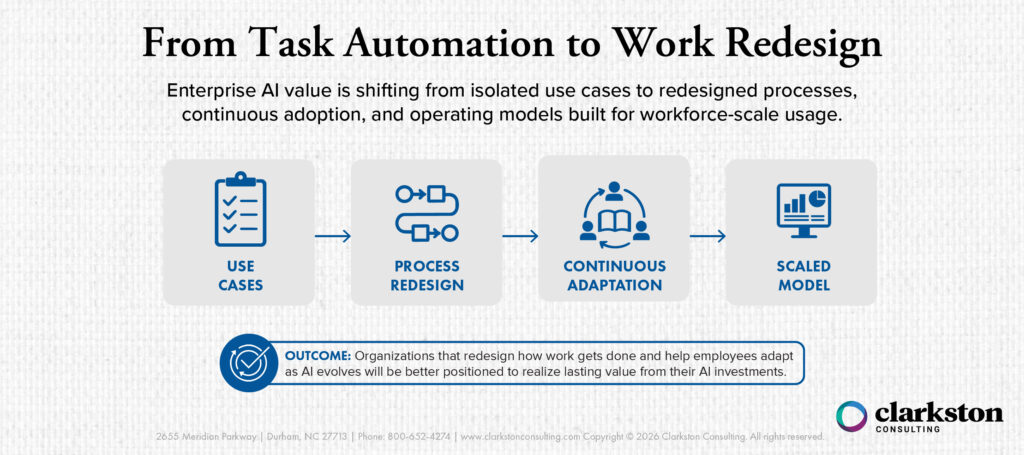
Three Lessons from the First Half of 2026
As we reflect on the first half of 2026, three key lessons have emerged from conversations with clients across industries. These lessons are reshaping how organizations approach AI strategy, adoption, and investment.
1. The Focus Is Shifting from Individual Use Cases to End-to-End Process Optimization
When generative AI first entered the enterprise, organizations naturally focused on identifying individual use cases. Teams experimented with content creation, meeting summaries, research support, and code generation to understand where the technology could create value. AI was largely embedded in existing processes, helping employees complete individual tasks more quickly.
Today, the conversation is evolving.
Organizations are increasingly recognizing that the greatest opportunity isn’t within a single task, but across an entire process. Rather than asking where AI can improve one activity, leaders are evaluating how AI can redesign workflows across an entire process instead of optimizing isolated tasks.
For example, the value of AI in content creation extends beyond drafting content. Organizations are exploring how AI can support research, generate insights, coordinate reviews, and accelerate approvals throughout the content creation lifecycle.
This shift represents an important evolution in AI maturity. Individual use cases remain valuable, but they are increasingly viewed as components of a broader transformation effort. The organizations realizing the greatest return on investment are focusing on process redesign rather than task automation alone. This includes evaluating how evolving processes impact employee responsibilities and identifying the skills needed to support new ways of working.
2. Change Management Requires a New Approach
Many organizations entered their AI journey assuming traditional change management practices would be sufficient to drive adoption. However, AI is creating a different type of organizational change.
One reason is the scope of transformation. As organizations shift their focus from individual use cases to end-to-end process redesign, change extends beyond a single function or team, impacting multiple stakeholders and workflows. Additionally, unlike previous technology implementations, AI capabilities continue to evolve rapidly. New tools, features, and use cases emerge on a near-weekly basis. In many cases, employees are discovering new ways of working faster than organizations can formally document them.
As a result of both the scale and speed of AI, the role of change management is expanding.
Rather than focusing solely on training and adoption, change management teams are increasingly responsible for enabling continuous learning, experimentation, and knowledge sharing across the organization. A core component to change management is empowering teams to build AI fluency and become leaders in their organizations.
The organizations making the most progress with their AI programs create practical ways for employees to share successful prompts, document emerging use cases and best practices, and learn from one another as AI capabilities evolve. In this environment, change management becomes less about managing a one-time transition and more about supporting ongoing adaptation.
Organizations that recognize this shift are often better positioned to sustain momentum as AI capabilities continue to evolve.
3. Many Organizations Underestimated Employee AI Consumption
One of the more surprising lessons from the first half of the year has been the relationship between AI adoption and usage volume – we’re seeing AI usage growing faster than expected.
Initially, many organizations initially saw AI adoption come from a small group of advanced, often technical, users. Today, we’re seeing that usage is becoming increasingly distributed across the workforce as AI adoption becomes more widespread.
As less technical employees gain confidence, they often engage with AI differently than experienced or technical users. They ask more exploratory questions, iterate more frequently, and use AI as a thought partner while learning how the technology can support their work.
This behavior is a positive sign of adoption, but it also has implications for capacity planning, governance, and cost management. This is particularly relevant as AI-powered development tools become more widely adopted. Often referred to as “vibe coding,” these tools enable employees to generate code and applications through natural language prompts.
Organizations that based their forecasts primarily on expert-user behavior are finding that broader workforce adoption can drive significantly higher token consumption than originally anticipated. Understanding these usage patterns is becoming an important component of AI operating models and investment planning.
It also highlights the importance of training and maintaining technical skills in the organization. While everyone can theoretically vibe code, an experienced developer will be far more efficient in token usage than a non-technical employee. Effective AI training helps employees maximize value from AI while developing more efficient usage patterns that improve both productivity and token consumption.
Looking Ahead
The first phase of enterprise AI focused on proving value through experimentation. The next phase is about redesigning how work gets done, preparing employees to adapt as AI evolves, and building operating models that can support enterprise-scale adoption.
Organizations that redesign how work gets done and help employees adapt as AI evolves will be better positioned to realize lasting value from their AI investments.
Subscribe to Clarkston's Insights
AI-assisted: A human led the content and final approval of this piece, with AI used to support ideation, drafting, editing, summarization, or repurposing.