Why the Future of DTC is Bigger Than Just Direct Sales


For years, direct-to-consumer (DTC) was a clear growth story in consumer products. Emerging brands built loyal followings online, bypassed traditional retail channels, and proved that consumers were willing to buy everything from mattresses to skincare products without ever stepping foot in a store. But that environment has changed.
Customer acquisition has become more expensive. New commerce channels continue to emerge. Consumer expectations have evolved. Most importantly, consumers no longer shop in a straight line. Today, a shopper might discover a product on TikTok, compare options on Amazon, visit a retailer’s website, purchase in-store, and later engage with a brand through a loyalty program. The shopper journey is more complex than ever, and omnichannel strategies are fundamentally reshaping how consumers discover, evaluate, and purchase products.
This doesn’t mean DTC is losing relevance. In fact, DTC sales now account for roughly one in seven eCommerce dollars globally and continue to grow.
What’s changed is DTC’s role. The era when DTC alone could reliably drive growth is fading. The brands winning today aren’t choosing between DTC, retail, marketplaces, social commerce, and wholesale. They’re using all of them together, leveraging DTC as a strategic capability that strengthens every other channel. We’re unpacking the future of DTC below and what consumer brands should be doing now.
Consumers Don’t Shop in Channels
Consumers don’t think about channels nearly as much as brands do – they think in moments and experiences. They move fluidly between digital and physical touchpoints (social platforms, marketplaces, retailers, brand-owned experiences) depending on what they need at that point in their buying journey. In fact, 73% of retail customers use multiple channels during their shopping journeys, and the lines between online and offline shopping continue to blur.
People want to engage with brands wherever they are – whether online, in-store, or through social media. For brands, this means the traditional channel-by-channel mindset is becoming less effective. Consumers experience a brand as one brand, not a collection of disconnected channels.
Why DTC Alone Is No Longer Enough
The challenge facing many brands isn’t that DTC stopped working. The challenge is that DTC alone has become harder to scale.
The original DTC playbook benefited from relatively inexpensive digital advertising, less competition, and a more predictable customer acquisition environment. Today, those conditions have weakened.
Rising advertising costs have made it challenging for brands to scale at the same pace as before. Market saturation is also increasing competitive pressure. With more than 6.8 million online stores powered by Shopify alone across the world, standing out through DTC channels alone is becoming more difficult.
And the digital-first mindset that is at the heart of direct selling can only take a brand so far. Consumers expect brands to meet them wherever they choose to shop. Brands that focus exclusively on a single channel risk missing opportunities to engage customers where they actually want to shop, and sticking to just DTC can limit potential growth.
DTC’s New Role: The Customer Intelligence Engine
While DTC may no longer be the sole growth engine for many brands, it remains one of the most valuable capabilities in a modern omnichannel strategy. The reason is simple: DTC provides something many other channels cannot: a direct relationship with the customer.
That relationship gives brands access to first-party data, customer preferences, purchase intentions, and behavioral signals that are difficult to capture consistently through retail or marketplace channels alone.
DTC also allows brands to create a consistent end-to-end experience that can be difficult to replicate elsewhere. It offers greater control over product education, storytelling, customer service, loyalty programs, and community building. In many ways, DTC has evolved primarily a sales channel into a customer relationship engine.
This also makes DTC a valuable platform for innovation. Leading brands are using customer data, analytics, and AI-driven personalization to deliver more relevant experiences and tailored recommendations. Rather than viewing DTC solely as a revenue stream, many organizations are increasingly using it as a source of customer intelligence and experimentation.
For years, the competitive race focused on channel expansion. Brands launched websites, followed by marketplaces, social commerce initiatives, retail partnerships, and omnichannel execution. Today, channel presence alone isn’t the competitive advantage. The opportunity lies in understanding how customers move across those channels and using those insights to make better business decisions
DTC plays an important role because it gives brands direct visibility into customer preferences, intent, purchase behavior, and engagement. Combined with data from retail, marketplaces, loyalty programs, and other touchpoints, these insights help brands build a more complete picture of the customer.
The differentiator, however, isn’t collecting more data – it’s connecting it. Many brands still struggle to unify customer information across channels, leaving them with fragmented views of customer behavior and incomplete insights.
That’s where unified commerce comes in. Rather than simply coordinating channels, unified commerce connects customer data, commerce systems, inventory, and fulfillment across the business in real time. The winners won’t necessarily have the biggest media budgets or the largest retail footprints, but they will be the ones with the clearest understanding of their customers and how they can action that to create customer and business value.
What Consumer Brands Should Be Doing Now
As DTC continues to evolve, brands should focus less on optimizing individual channels and more on creating connected customer experiences. The goal isn’t to force consumers into a preferred channel but rather meet them wherever they choose to engage. A few priorities stand out:
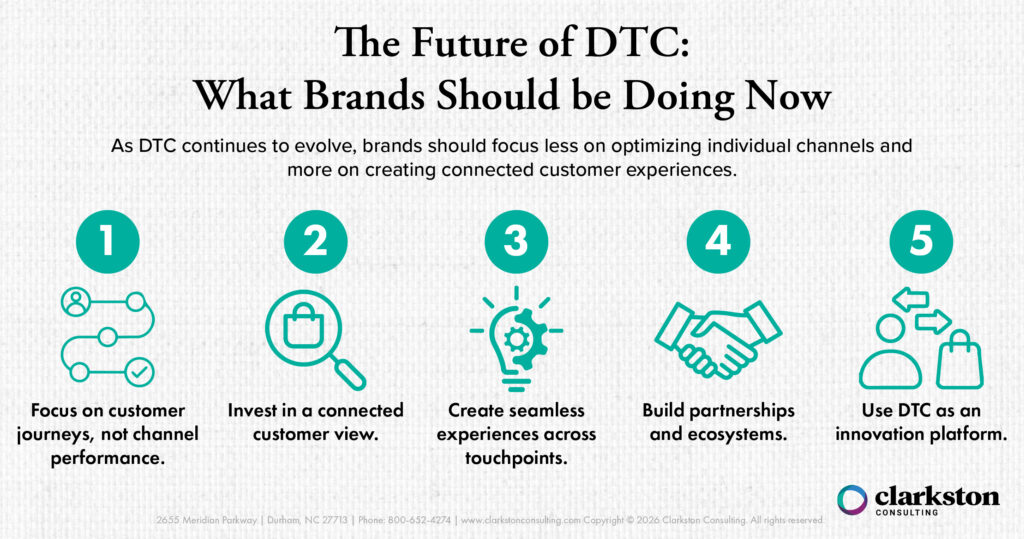
- Focus on customer journeys, not channel performance. Consumers move naturally between discovery, research, purchase, and loyalty across multiple touchpoints. Measurement strategies should reflect the entire journey rather than evaluating each channel in isolation.
- Invest in a connected customer view. If a customer purchases through retail, engages with loyalty programs, and later visits your DTC site, those interactions should contribute to a single, unified customer view.
- Create seamless experiences across touchpoints. Promotions, inventory visibility, loyalty benefits, product information, and customer service should feel consistent regardless of where a customer engages.
- Build partnerships and ecosystems. Retailers, marketplaces, and social commerce platforms should complement, not compete with, your DTC strategy. The goal is to extend reach while maintaining a connected customer experience.
- Use DTC as an innovation platform. Test new products, personalized experiences, loyalty initiatives, digital capabilities, and customer experiences through DTC before scaling more broadly across retail and marketplace platforms.
Looking Ahead
DTC isn’t disappearing. If anything, it may become even more important in the years ahead, but for a different reason than many expected. The future isn’t DTC vs. retail – it’s DTC working alongside retail, marketplaces, social commerce, and whatever comes next.
DTC helped reshape commerce by giving brands a direct connection to consumers. Today, its greatest value is the customer understanding it creates. Every interaction contributes to a more complete view of the customer and enables better decisions across every channel.
As brands navigate this shift, success will require connecting the people, processes, data, and technology that power customer experiences across the business. That’s the promise of unified commerce: connecting data, systems, and operations to create a seamless experience and meet the customer wherever they’re choosing to engage at that particular point in time.
This is also where Clarkston can help, helping brands turn omnichannel ambition into operational reality. Reach out to us today.
Subscribe to Clarkston's Insights
AI-assisted: A human led the content and final approval of this piece, with AI used to support ideation, drafting, editing, summarization, or repurposing.