Why Planning Technology Becomes “Shelfware” and How to Recover Its Value


Organizations continue to invest heavily in planning technologies with a clear objective: improve decision-making, increase efficiency, and enable teams to focus on higher-value work. Platforms like SAP IBP are designed to do exactly that, and in many cases, they can. Yet a common pattern continues to emerge.
Months (or even years) after implementation, organizations find themselves asking a difficult question: Why are we still relying on spreadsheets?
The “Shelfware” Problem Is Not About Technology
When planning systems go underutilized, the first assumption is often that the tool fell short. In reality, that’s rarely the root cause.
Leading organizations across industries successfully use these same platforms to strengthen planning and improve responsiveness. The difference isn’t the technology itself, but whether it has been integrated into how the business actually operates.
In many cases, organizations experience:
- Reversion to legacy tools (e.g., Excel)
- Declining user trust in system outputs
- Workarounds that bypass the intended process
Over time, the system becomes “shelfware”— implemented but not fully embedded in day-to-day decision-making.
What Actually Causes Planning Technology to Become Shelfware
Based on our experience, underutilization of planning technology typically stems from a misalignment across three areas:
- Process maturity: Technology may be configured around a future-state planning model, while the business continues to operate through inconsistent or evolving processes. The system reflects how planning is supposed to work, but not how it works today.
- User adoption and trust: If planners don’t understand how the system supports their work, or if outputs don’t feel reliable, they will return to the tools they know best. In many organizations, that means spreadsheets become the fallback.
- Implementation focus: Too often, transformation efforts concentrate on system configuration without spending enough time on process design, role and responsibility clarity, and change enablement. The result may be a technically sound solution that doesn’t fit the business well enough to sustain adoption.
Technology Alone Doesn’t Drive Transformation
Planning technology doesn’t drive transformation on its own. To deliver value, it has to support how decisions are made across the organization and make the work of planning easier, clearer, and more effective – not add complexity.
If these conditions aren’t met, even best-in-class tools and strongest platforms will fail to gain traction.
Recovering Value from Existing Investments
The presence of “shelfware” doesn’t necessarily mean the investment is lost. In many cases, the underlying platform remains capable of delivering significant value, if properly realigned.
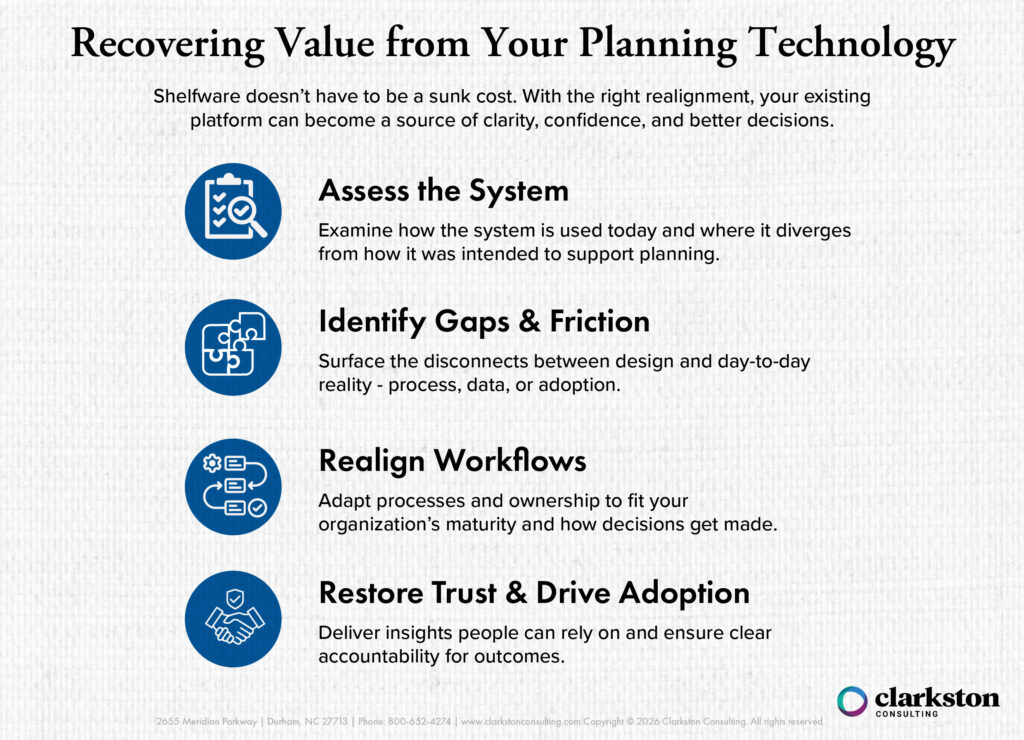
Organizations can unlock that value by:
- Assessing how the current system supports (or conflicts with) actual planning processes
- Identifying gaps between intended design and real-world usage
- Redefining workflows to better align with both system capabilities and organizational maturity
- Rebuilding user trust through improved outputs and clearer ownership
This is less about reimplementation and more about recalibration.
A Practical Starting Point
For leaders evaluating their planning landscape, a few questions can quickly surface risk:
- Are critical planning decisions still being made outside the system?
- Do users rely on spreadsheets to validate or replace system outputs?
- Is there clear ownership and accountability for planning processes?
- Can the organization explain how the system improves decision-making today?
If the answer to any of these is unclear, the organization is likely not realizing the full value of its investment.
Moving Forward
Transformation doesn’t end at go live. Lasting value comes from aligning technology, process, and people – and continuously reinforcing that alignment over time.
Organizations that address “shelfware” effectively do more than increase system usage. They make the platform a trusted part of how planning happens across the business.
Clarkston partners with organizations to assess underutilized technologies, realign planning processes, and restore confidence in system-driven decision-making. The goal is not just adoption but measurable impact from investments already made. Reach out to us today.
Subscribe to Clarkston's Insights
AI-assisted: A human led the content and final approval of this piece, with AI used to support ideation, drafting, editing, summarization, or repurposing.