What is Agentic Commerce?

Last month at NRF 2026, conversations about AI in retail matured. The focus moved past experimentation with chatbots and copilots and toward a more structural shift in how commerce itself may function. One concept surfaced repeatedly: agentic commerce.
But what is agentic commerce? At a high level, agentic commerce refers to a model in which autonomous AI agents act on behalf of consumers or businesses to discover and recommend products, evaluate options, and complete transactions within predefined constraints. While the idea may sound futuristic, the building blocks are already taking shape—with Gartner predicting that 33% of enterprise software applications will include agentic AI by 2028—and the implications for retailers are significant.
What distinguishes agentic commerce from prior waves of digital transformation is not simply better personalization or automation. It is the transfer of execution authority from humans to software. In an agentic world, the primary “shopper” may no longer be a person navigating a storefront, but an AI system interpreting intent and acting accordingly.
What is Agentic Commerce?
Agentic commerce builds upon advancements in autonomous AI systems with agents capable of planning and executing multi-step tasks without continuous human input. Unlike conversational assistants that respond to prompts or recommend products, agentic systems operate with constraints and delegated authority.
So, what does this look like in practice? Think about it like a monthly subscription taken to the next level. A consumer might instruct an agent to keep household staples stocked under a monthly budget, or a procurement team might task an agent with reordering supplies when inventory drops below a defined threshold.
From there, the agent searches available inventories, evaluates tradeoffs such as price, delivery speed, sustainability attributes, or loyalty benefits, and completes transactions using stored identity and payment credentials. The result? Commerce driven by outcomes rather than browsing.
Agentic commerce also depends on interoperability: structured product data, standardized commerce APIs, payment and identity frameworks, and clear policies governing what agents are allowed to do. Without these foundations, agents cannot reliably interpret offers or transact at scale—a theme echoed across multiple NRF 2026 research briefings, including NRF’s own perspective on owning the agentic commerce experience.
Why Agentic Commerce Matters Now
The appeal for consumers is straightforward. Shopping, particularly for replenishment or low-engagement categories, requires time and cognitive effort. Agentic systems reduce that friction by turning high-level intent into automated outcomes. Over time, agents can optimize decisions based on learned preferences, balancing cost, quality, convenience, and values with far greater consistency than a human shopper managing dozens of decisions at once.
For companies in the retail industry, the opportunity is paired with disruption. On one hand, agent-initiated transactions represent high-intent demand. When an agent places an order, it is already past discovery and consideration, which has the potential to improve conversion and demand predictability. On the other hand, agentic commerce challenges many of the levers retailers rely on today. If agents optimize primarily for price, availability, fulfillment reliability, and loyalty economics, then front-end experience, brand storytelling, and merchandising cues play a diminished role at the moment of purchase. Retailers that are difficult for agents to “read,” whether due to unstructured data or inconsistent promotions, risk being excluded from agent-driven consideration entirely.
Trust also becomes a central concern. When transactions are executed autonomously, retailers must know which agents they are interacting with, what authority those agents possess, and how to enforce policies related to discounts, substitutions, returns, and fraud. As research has noted, owning the rules of engagement in an agentic ecosystem is as important as owning the storefront was in earlier eCommerce eras.
Early Signals from The Market
Although agentic commerce is still in its early days, initial signals suggest momentum is building. AI-driven eCommerce traffic in the US grew 758% YOY between Nov. 1 and Dec. 1, while AI traffic to retail sites in the US increased 670% on Cyber Monday.
Major commerce platforms are investing in agent readiness by enabling richer, machine-readable product data and transaction flows that can be consumed by AI systems. Shopify, for example, is looking to bring commerce to agents at scale. The brand recently launched the Universal Commerce Protocol (UCP), co-developed with Google, which allows merchants to sell directly in AI Mode in Google Search and the Gemini app, and has plans to release an updated Microsoft Copilot integration for an embedded checkout experience. Similarly, PayPal has partnered with OpenAI to enable buyers and sellers alike to complete transactions directly through ChatGPT.
AI shopping assistants at leading retailers like Amazon (Alexa and “Buy for Me”) and Walmart (Sparky) are laying the groundwork, with roadmaps increasingly pointing toward greater autonomy, allowing agents to complete purchases under explicit user consent. In parallel, grocery and convenience retailers, where replenishment is frequent and preferences are stable, are actively assessing their readiness for agent-initiated shopping.
Financial analysts reinforce the scale of the shift, with Morgan Stanley projecting that nearly half of online shoppers could use AI agents by 2030, driving tens of billions of dollars in incremental U.S. eCommerce spend as automated purchasing expands beyond early adopters.
Next Steps for Retailers
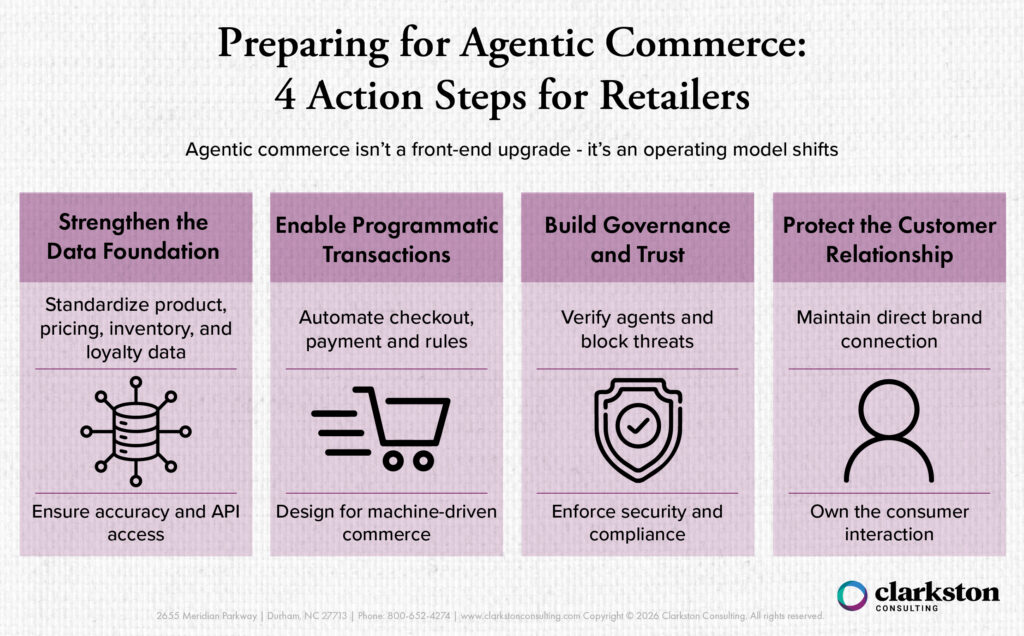
Preparing for agentic commerce is less about deploying a new front-end experience and more about strengthening foundational capabilities.
- The first priority is data, as agents cannot reason effectively over incomplete or inconsistent information. As such, product catalogs, pricing rules, inventory availability, fulfillment options, and loyalty mechanics must be structured, accurate, and accessible through APIs.
- Retailers should design for programmatic transactions. This includes supporting agent-initiated checkout flows that honor identity, payment, and loyalty without manual intervention, while also defining clear boundaries for what agents may negotiate or substitute.
- As with all AI initiatives, governance and trust cannot be an afterthought. As autonomous actors interact with commerce systems, retailers will need verification layers and enforcement mechanisms that distinguish legitimate agents from malicious automation.
- Retailers should be intentional about relationship ownership. Agentic commerce introduces the risk of disintermediation if third-party agents become the primary interface between consumers and brands.
Looking Ahead
Agentic commerce represents a fundamental shift in how buying decisions are executed, and NRF 2026 made clear that this transition is not hypothetical. Brands that invest now in data readiness and trust frameworks will be positioned to participate as agents begin placing orders at scale, while those that do not may find themselves optimized for human shoppers as commerce quietly moves on.
If you’re interested in chatting more about agentic commerce or any other emerging industry trends, connect with our retail experts today.