Clarkston Consulting https://www.facebook.com/ClarkstonConsulting https://twitter.com/Clarkston_Inc https://www.linkedin.com/company/clarkston-consulting http://plus.google.com/112636148091952451172 https://www.youtube.com/user/ClarkstonInc
Skip to content

Detecting Early ERP Project Risk Signals

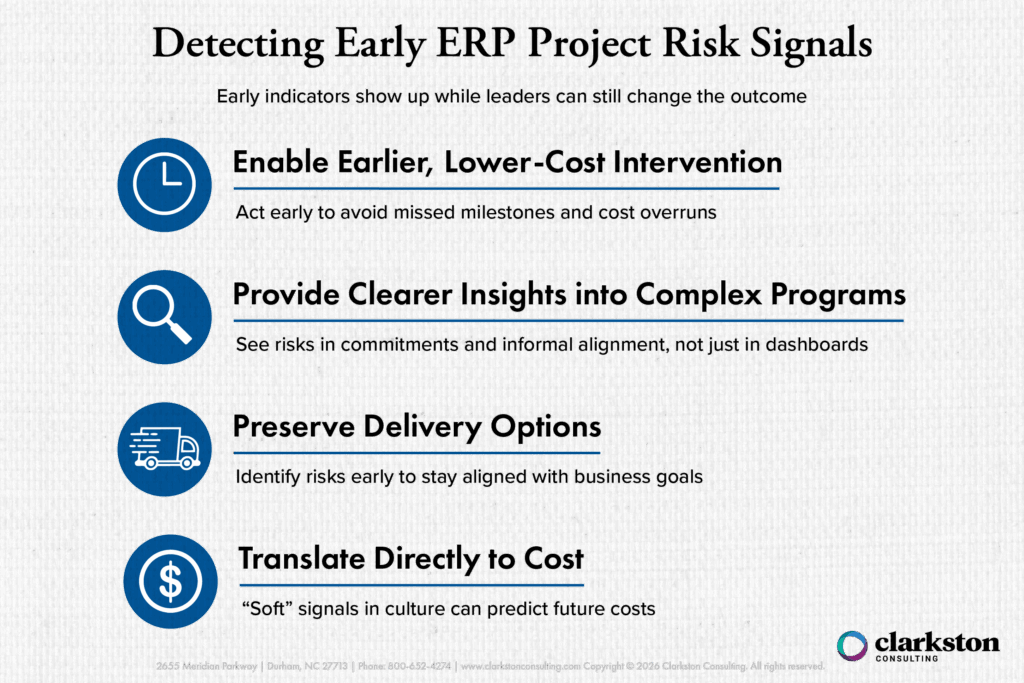
Graphic shows early ERP project risk signals, including cost overruns, missed milestones, delivery risk, and cultural warning signs

Echo vs. Impact 

Leaders who rely solely on formal reporting and project calendars are often late to recognize and respond to risk during an ERP implementation. Effective organizations are those that pay attention to behavioral and structural indicators before schedules slip, integrations fail, or downstream testing degrades.  

ERP project risk rarely begins with missed milestones or red status reports; it develops earlier and is revealed through changes in how teams communicate, how they make commitments, and how decisions are made across business and technology stakeholders.  

Early signals are the echo of future failure, while missed deadlines, poor data quality, failed testing cycles, and disrupted cutovers are the impact. When early indicators are ignored, risk accumulates quietly until it surfaces in delivery metrics, often when recovery options are constrained and trade-offs become unavoidable. Detecting early ERP project risks requires understanding which signals tend to appear first and how routine ERP project behaviors reveal underlying issues.  

Clarkston recommends a tiered risk framework based on observed warning signs across ERP programs. The tiers reflect patterns commonly seen in ERP implementations that later experience delivery challenges, while the examples and guidance draw from practical ERP project leadership experience. Together, they provide a clear, actionable perspective on how ERP risk develops and how it can be identified early, before it appears in formal status reporting.  

Tier 1: Earliest and Most Dangerous Signals (Act Immediately) 

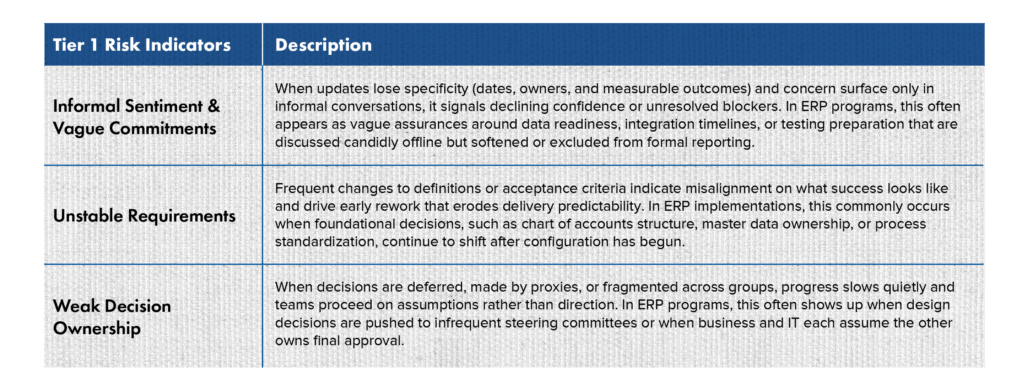
Tier 1 signals are predictive, behavioral, and quiet. They appear early, often quietly, and always cascade into later failures if left unaddressed. When Tier 1 is present, the project is already at risk, even if all formal indicators remain green. 
Tier 1 Risk Indicators  Description 
Informal Sentiment and Vague Commitments  When updates lose specificity (dates, owners, and measurable outcomes) and concern surface only in informal conversations, it signals declining confidence or unresolved blockers. In ERP programs, this often appears as vague assurances around data readiness, integration timelines, or testing preparation that are discussed candidly offline but softened or excluded from formal reporting.

Unstable Requirements  Frequent changes to definitions or acceptance criteria indicate misalignment on what success looks like and drive early rework that erodes delivery predictability. In ERP implementations, this commonly occurs when foundational decisions, such as chart of accounts structure, master data ownership, or process standardization, continue to shift after configuration has begun.

Weak Decision Ownership  When decisions are deferred, made by proxies, or fragmented across groups, progress slows quietly and teams proceed on assumptions rather than direction. In ERP programs, this often shows up when design decisions are pushed to infrequent steering committees or when business and IT each assume the other owns final approval.  


Tier 2: Structural Breakdown (Still Recoverable) 

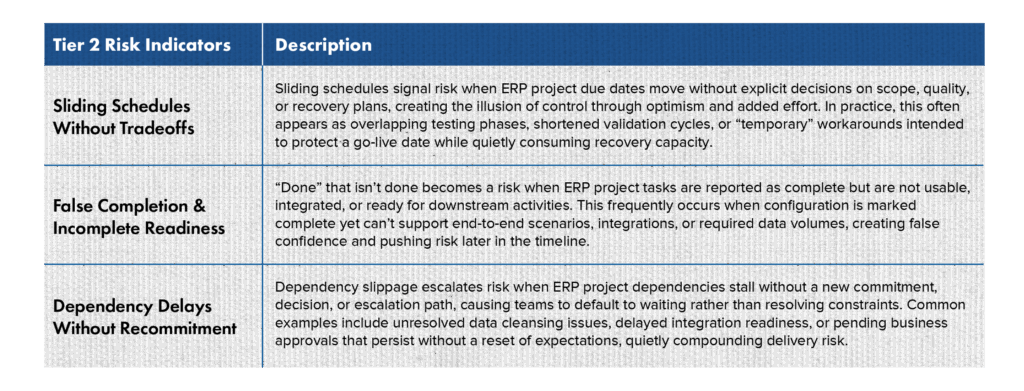
Tier 2 signals are visible but often normalized or explained away. At this stage, recovery is still possible, but only if the signals are acknowledged and addressed. Tier 2 signals indicate that the project is compensating for unresolved issues rather than addressing them directly. 
Tier 2 Risk Indicators  Description 
Sliding Schedules Without Tradeoffs  Sliding schedules signal risk when ERP project due dates move without explicit decisions on scope, quality, or recovery plans, creating the illusion of control through optimism and added effort. In practice, this often appears as overlapping testing phases, shortened validation cycles, or “temporary” workarounds intended to protect a go-live date while quietly consuming recovery capacity. 

False Completion &
Incomplete Readiness
 
“Done” that isn’t done becomes a risk when ERP project tasks are reported as complete but are not usable, integrated, or ready for downstream activities. This frequently occurs when configuration is marked complete yet can’t support end-to-end scenarios, integrations, or required data volumes, creating false confidence and pushing risk later in the timeline. 

Dependency Delays
Without Recommitment
 
Dependency slippage escalates risk when ERP project dependencies stall without a new commitment, decision, or escalation path, causing teams to default to waiting rather than resolving constraints. Common examples include unresolved data cleansing issues, delayed integration readiness, or pending business approvals that persist without a reset of expectations, quietly compounding delivery risk.  


Tier 3: Lagging Confirmation Signals (Harder to Fix) 

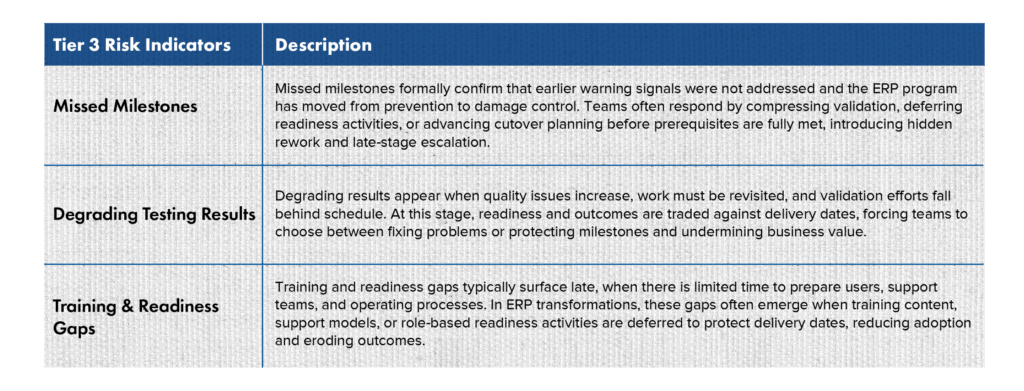
Tier 3 signals confirm issues that have been developing for weeks or months. When these indicators appear, the project has moved from risk prevention to damage control, and recovery requires explicit tradeoffs. Tier 3 signals rarely appear in isolation; they are the visible outcome of earlier Tier 1 and Tier 2 signals that went unaddressed. 
Tier 3 Risk Indicators  Description 
Missed
Milestones 
 
Missed milestones formally confirm that earlier warning signals were not addressed and the ERP program has moved from prevention to damage control. Teams often respond by compressing validation, deferring readiness activities, or advancing cutover planning before prerequisites are fully met, introducing hidden rework and late-stage escalation. 

Degrading Testing Results  Degrading results appear when quality issues increase, work must be revisited, and validation efforts fall behind schedule. At this stage, readiness and outcomes are traded against delivery dates, forcing teams to choose between fixing problems or protecting milestones and undermining business value.  
Training & Readiness Gaps  Training and readiness gaps typically surface late, when there is limited time to prepare users, support teams, and operating processes. In ERP transformations, these gaps often emerge when training content, support models, or role-based readiness activities are deferred to protect delivery dates, reducing adoption and eroding outcomes.  

Looking Ahead  

Early risk detection is about recognizing the signals that appear before outcomes are locked in. Across ERP programs, Clarkston has repeatedly observed these patterns and intervened early, often well before traditional metrics indicated risk, allowing teams to reset expectations, resolve constraints, and preserve delivery options.  

Subscribe to Clarkston's Insights

  • This field is for validation purposes and should be left unchanged.
  • I'm interested in...
  • Clarkston Consulting requests your information to share our research and content with you. You may unsubscribe from these communications at any time.

Tags: SAP ERP
RELATED INSIGHTS