How to Drive ROI on Coupons in a Digital World

Coupons have been part of CPG marketing for well over a century, reaching their peak in the early 2000s. Before digital channels became widespread, coupons gave marketers something valuable: a trackable link between an offer and a purchase. Coupons helped encourage trial and brand switching, while retailers used them to support store traffic.
Even with low redemption rates, the volume distributed gave campaigns a meaningful impact. That broad distribution also created redemption liabilities for CPG companies. Retailers continued to expect regular campaigns through free-standing inserts (FSIs), leaving brands to balance those expectations with the economics of their offers.
As newspaper circulation declined, FSIs lost a primary source of reach. Meanwhile, retailers invested in digital loyalty programs, and shoppers increasingly turned to eCommerce and mobile shopping. These changes gave marketers more targeted ways to reach shoppers. Coupons became part of a broader digital promotional mix, creating opportunities to reconsider how offers could influence purchases without unnecessary discounting.
For marketers, the question is how to use those capabilities to improve returns while keeping promotional costs aligned with business goals.
The Shift Toward Digital Coupons
Digital coupons have become a larger part of the promotional mix. Load-to-card digital offers accounted for 53.9% of all coupon redemptions in 2025. Shoppers can clip these offers in a retailer’s app and receive the discount automatically at checkout.
Unlike the broad distribution model of the past, digital coupons can be informed by shopper behavior and delivered within retail media or eCommerce environments. Offers can appear closer to the purchase decision, reducing the effort required to find and redeem them.
Demand for savings also supports their relevance. Inflation has driven many shoppers to actively seek savings, with one-third of grocery shoppers reporting more coupon usage in 2024 than in 2023. For CPG marketers, the combination of shopper demand and more precise targeting creates an opportunity to use incentives more deliberately.
The ROI Challenge for CPG Brands
Digital coupons provide more opportunities for targeting and measurement, yet many programs still operate with assumptions carried over from mass-market couponing. Brands may discount purchases that would have happened anyway or run offers separately from the broader purchase journey. The result can be unnecessary margin pressure without corresponding incremental growth.
Redemption alone doesn’t show whether a promotion changed the purchase decision. If a shopper would have purchased at full price, the coupon has subsidized existing demand rather than created new demand.
Broad targeting can compound that problem. Applying the same incentive across audiences may mean spending more than necessary to generate a purchase. Fixed coupon values also limit opportunities to learn how different shoppers respond.
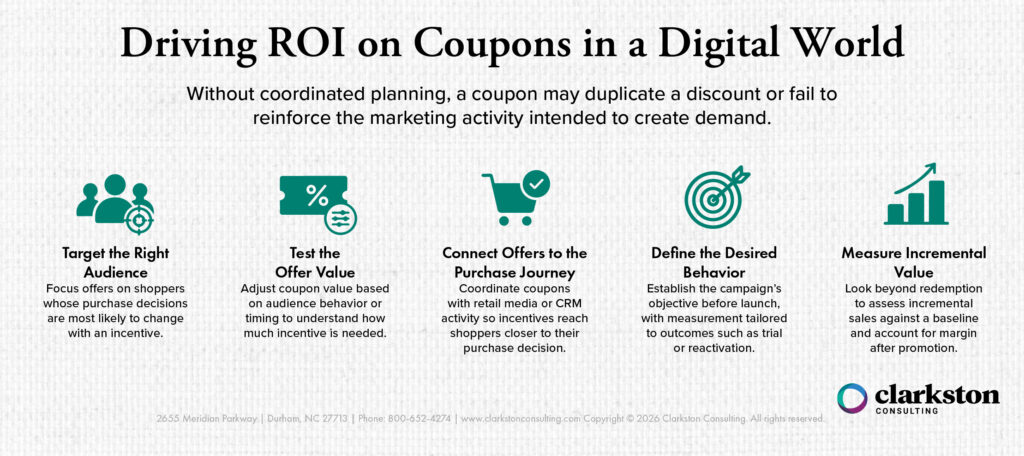
Coupons can also operate separately from the broader purchase journey. Offers may run independently from retail media or CRM programs, leaving brands with less control over when an incentive appears. Without coordinated planning, a coupon may duplicate a discount or fail to reinforce the marketing activity intended to create demand.
Improving Coupon ROI in a Digital Market
The first shift is from broad reach to audience-level decision-making. Brands can distinguish between loyal buyers and lapsed shoppers, then determine where an incentive is most likely to influence behavior. Retail media networks or retailer loyalty programs can help activate those audiences with different offers, reducing spend on shoppers who need little incentive to purchase.
Brands should also reconsider fixed-value offers. Coupon value can be tested against audience behavior or timing rather than established once for an entire campaign. A high-intent shopper may require a smaller incentive, while a shopper who has abandoned a cart may respond differently. The goal is to understand how much incentive is actually required to influence the purchase.
Coupon planning should also connect more directly with the commerce journey. Integrating offers with retail media or CRM can help brands place incentives closer to the demand those channels are creating. Teams should coordinate offer timing with other promotional activity so discounts support the intended purchase decision.
Before launching an offer, teams should agree on the behavior they want to influence. A campaign intended to encourage trial should be evaluated differently from one designed to bring back lapsed shoppers, with measurement established before distribution.
Finally, marketers need to look beyond redemption as the primary measure of performance. Redemption rate and cost per redemption explain how shoppers used an offer, but they don’t establish whether the offer created incremental value. Brands should evaluate incremental sales against an appropriate baseline while accounting for margin after promotion.
That evaluation should include coupon program costs, since the discount alone doesn’t capture the full investment. Testing different offers can then show whether higher redemption reflects stronger performance or simply a more generous discount. Results should inform the next campaign’s targeting and offer value.
The Future of Coupons in CPG
Digital couponing gives CPG brands more control over who receives an incentive and when it appears. The value of that control depends on whether the offer influences a purchase that wouldn’t otherwise have happened.
Brands can use each campaign to refine their targeting and understand which incentives justify the investment. Keeping coupons connected to the broader purchase journey helps turn those findings into better promotional decisions.
For help evaluating how digital coupons fit into your broader marketing investment, connect with Clarkston’s consumer products sales and marketing team.
Subscribe to Clarkston's Insights
Contributions from Ellie Epperson