How Localization is Reshaping Retail Store Planning


In today’s retail landscape, success depends on a retailer’s ability to create locally relevant, data-driven store plans that balance merchant judgment with analytics. When done well, retailers can improve inventory efficiency by placing the right product in the right stores without creating unnecessary excess. It also helps protect margin and reduce markdown risk.
Assortment planning has long been a core part of retail strategy, though the conversation has shifted. The modern evolution of that discipline is retail store planning, which is broader and more responsive. It draws on consumer insight and localization, then uses adaptive planning models to shape the right product mix for each store and channel. It also creates a closer link between merchandising decisions and the way customers shop across physical and digital environments.
From Assortment Planning to Store Planning
Traditional assortment planning focused on allocating seasonal styles, sizes, and colors across stores based largely on historical performance – all done to ensure the right styles are offered through the right channels at the right time.
However, today’s omnichannel environment requires a more holistic approach. Retail store planning builds on the foundation of assortment planning by accounting for local market dynamics, community preferences, and store format differences. The objective is not only to distribute product efficiently, but also to create store experiences that feel relevant to the shopper in that market.
That shift matters even more because store inventory now supports more than walk-in demand. It can also support pickup and fulfillment, which makes store-level decisions more consequential than they were in a purely brick-and-mortar model.
Localization as a Competitive Necessity
Retailers are no longer relying only on historical sales to make planning decisions. Many now use advanced analytics and clustering models to plan at the neighborhood level, aligning assortments and store experiences with local demand. This reflects a broader move away from merchandising shaped mainly by efficiency and toward retail strategies shaped by customer relevance.
“Going local” is about adapting the store to the community it serves. This might mean tailoring architecture and store layouts, emphasizing local brands, or adjusting category depth to reflect neighborhood demographics. For example, a national retailer might allocate a broader selection of outerwear to northern stores while offering lightweight apparel and resort wear in southern markets.
But localization goes beyond weather – it also requires an understanding of lifestyles and values. A store in an urban neighborhood might highlight sustainable fashion or locally sourced accessories, while a suburban location could focus on family essentials or value-driven offerings.
This localized mindset improves productivity by increasing relevance and strengthening emotional connection with shoppers. At the same time, it reduces excess inventory that may not sell and limits the need for markdowns. It also helps retailers get more value from existing square footage, which is especially important in an era when store expansion is no longer the default path to growth.
Data-Driven Store Planning
Many retailers still face inventory imbalances across their store networks. Some locations are overstocked while others face stockouts, leading to missed sales and margin erosion. This challenge becomes even more significant for retailers carrying private label products, since they hold the full inventory risk and have less flexibility when performance misses the mark. In those cases, precise store planning matters even more because weak alignment at the store level can quickly erode profit and leave the retailer holding inventory longer than planned.
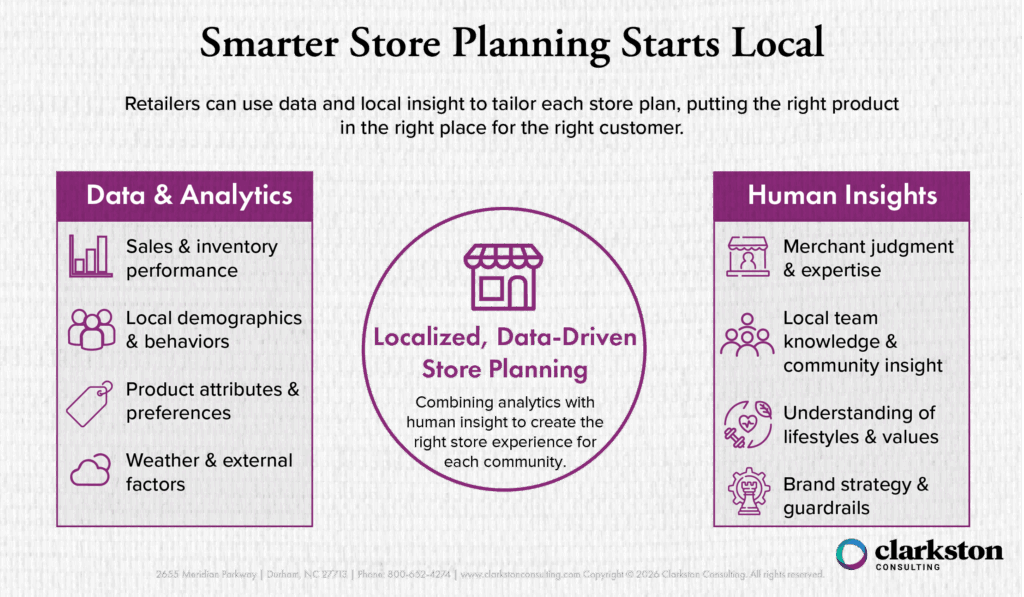
Modern store planning addresses this by combining data science with merchant intuition. Retailers are adopting advanced planning systems that bring together historical performance and predictive insight. By evaluating factors such as local demographics, product attributes, and weather patterns, planners can forecast demand more accurately and align store assortments with actual customer behavior.
When store planning incorporates real-time data, retailers can react faster to shifts in consumer demand, protect margins, and strengthen customer trust. In practice, that means plans are no longer set once and left untouched. They are reviewed throughout the season as new signals emerge, with merchants and planners working together to decide where inventory should move and where assortments should change.
The Human Element Behind Localization
Technology and data are only part of the equation. Successful localization also requires a cultural shift and an organizational belief that local insight matters.
Empowering local teams to influence store planning decisions, within the guardrails of corporate strategy, creates both agility and authenticity. When planning teams and store leaders work from shared data, they can design experiences that feel consistent with the brand while still reflecting the needs of the local market.
This also helps clarify execution. Corporate teams define the strategic framework and establish the planning guardrails, and local leaders then contribute market insight that improves decisions at the store level.
Reshaping Store Planning: Why This Matters Now
Store planning is no longer a once-a-season exercise. It’s a continuous, integrated process that bridges long-term merchandise planning with localized execution. Retailers that excel in this discipline can improve inventory productivity and store performance while building a stronger customer response.
In an increasingly digital retail environment, physical stores still matter, but only when they feel relevant to the people who shop there. By combining advanced analytics with flexible planning systems and local insight, retailers can ensure their stores do more than hold product. They can become localized assets within a broader omnichannel network, supporting both brand experience and profitable growth.
At Clarkston, we help retailers transform store planning from a static exercise into a dynamic, insight-driven exercise. If your organization is looking to modernize its approach, reach out to our team.
Subscribe to Clarkston's Insights
Contributions from Jensen Smith
AI-assisted: A human led the content and final approval of this piece, with AI used to support ideation, drafting, editing, summarization, or repurposing.