5 Considerations When Implementing TPM for Foodservice

Implementing a Trade Promotion Management (TPM) system for foodservice requires thoughtful adaptation that looks very different from traditional retail, although the approach may depend on the client’s business mix. Whether you are a foodservice-only business, looking to consolidate both foodservice and retail within a single solution, or implementing separate systems for each, you must account for the unique needs of foodservice.
These nuances involve multi-layered distributor networks and contract-based pricing that shape how promotions for foodservice are structured, funded, and tracked. By focusing on strategies for foodservice-specific processes and functionalities, manufacturers can optimize trade spend and strengthen operator and distributor relationships.
5 Key Considerations
When implementing TPM for foodservice, we’ve outlined the below considerations for your approach.
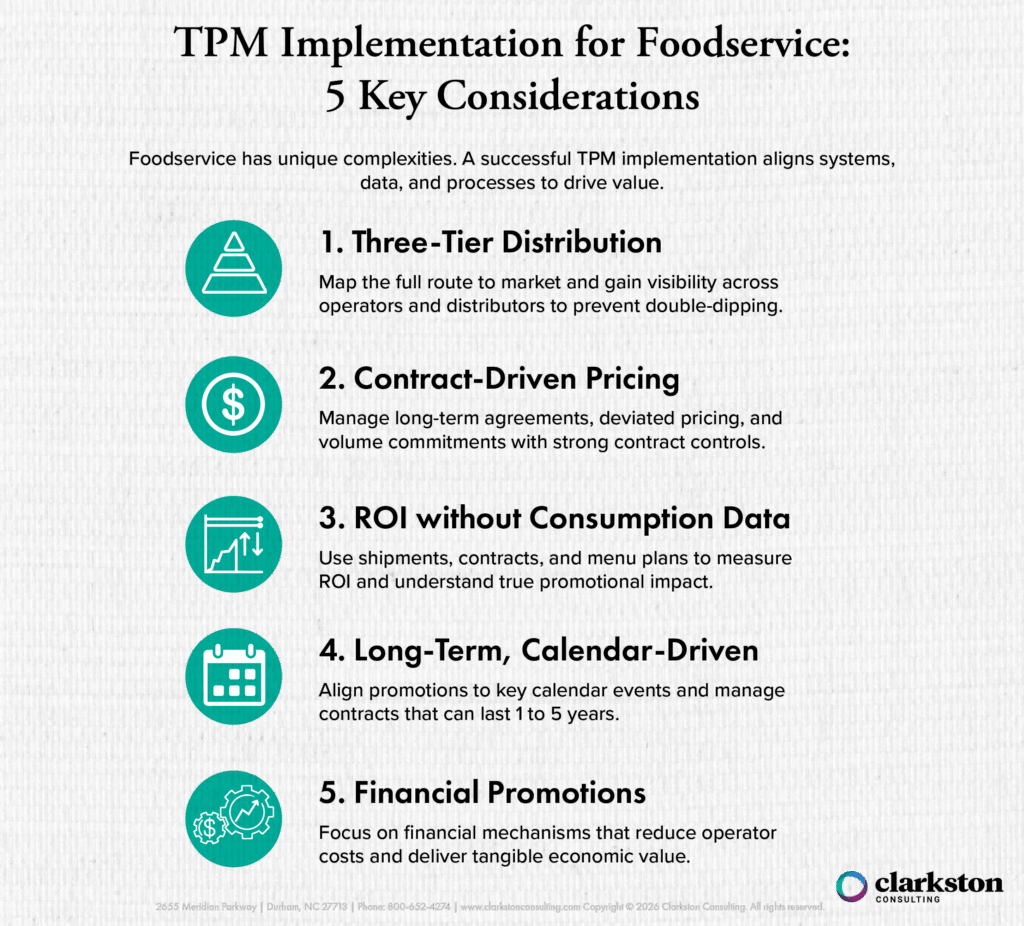
1. Navigating Complexities with a Three-Tier Distribution
One of the most notable features of a foodservice business is its multi-tiered supply chain. Pricing and terms can often be negotiated with the operator (i.e., the location that buys, prepares, and serves food), even though the sale itself flows through the distributor, meaning the “customer” is two or three layers deep.
It’s important to utilize a TPM solution with the capabilities to map the entire route-to-market, capturing which promotions apply to which operators and which distributors are fulfilling the orders. To improve this visibility across distribution channels, a robust TPM system should allow for integration of multiple data sources across tiers. This structure also reduces the risk of double-dipping, which is a frequent foodservice issue where more than one customer (operator or distributor) unintentionally claims the same promotional dollars.
2. Accommodating Contract-Driven Pricing
Unlike retail, where pricing can change frequently and is often more event based, foodservice pricing is largely contract driven. Agreements may include bid pricing, deviated pricing (a special reduced price negotiated for a specific operator or account and funded by the manufacturer), “buy one get one free” discounts, and volume commitments. A strong TPM system should provide extensive contract administration functionalities that accommodate these pricing structures, like storing bid and deviated pricing agreements with start and end dates, enforcing eligibility rules, and tracking off-invoice allowances.
3. Tracking ROI Without Reliable Consumption Data
In foodservice, consumption is driven by menu placement and contract commitments, not by shopper demand or household brand loyalty. Operators commit to volume based on factors like planned meals, serving size, and menu rotation, which makes forecast accuracy more stable for contracted items but also means direct consumption data is more limited. Manufacturers typically see distributor shipments rather than operator-level depletions, which limits their ability to understand true end-use demand and precisely attribute promotional impact.
An effective TPM system should provide visibility by operator, contract, and menu program, even when underlying data comes primarily from distributors. It should have the functionality to integrate sales and shipment data from multiple sources and layer in assumptions tied to contracts and menu plans to measure ROI as accurately as possible.
4. Managing Long-Term Promotions and Fewer Promotional Windows
Foodservice promotional timing is largely structural and calendar driven rather than by short-term shopper demand. Volume patterns are shaped by factors such as school calendars, institutional meal programs, tourist seasons, and large event contracts, which means there are fewer, but more predictable, windows to influence demand. Pricing is also “locked in” more often than in retail, with contract terms that can extend from one to five years.
Effective TPM design should therefore support long-term bid and contract management, align promotions to key calendar milestones, and provide tools to periodically reassess pricing and performance within those longer cycles. Having this TPM ability enables manufacturers to make intentional and forward-looking decisions about where to invest, rather than reacting to short-term volume fluctuation.
5. Understanding the Financial Nature of Promotions
Unlike retail, foodservice doesn’t typically rely on circulars, endcaps, or temporary price reductions on the shelf. Instead, promotions are primarily financial mechanisms such as off-invoice allowances, deviated (discounted) pricing, operator rebates, limited-time menu support (LTOs), and back-of-house savings programs. These programs focus on reducing the operator’s overall operating costs, such as through pre-cut or ready-to-use ingredients that save labor, concentrated cleaning products that reduce storage and usage costs, or bulk packaging that lowers cost per use. Because of this, promotions in foodservice are less about merchandising visibility and more about creating tangible economic value for operators, which TPM systems must be able to model, fund, and reconcile through claims.
Next Steps for Implementing TPM for Foodservice
An effective TPM approach for foodservice recognizes that trade investments are a strategic lever to deepen operator relationships and maximize trade spend. By not only aligning systems, but also the data and processes required to accommodate the complexities of contract pricing and multi-layered distributor channels, manufacturers can turn the needs of foodservice into a source of competitive advantage.
However, the right foodservice TPM strategy is not a one-size-fits-all – especially for a business that supports both retail and foodservice, as they must decide whether streamlining processes into a single TPM system or having separate solutions with more flexibility to support each channel’s needs is the best approach. Making deliberate decisions that accommodate the organizational structure and business mix helps ensure that they are making a TPM investment that delivers the most value.
To explore how a tailored TPM roadmap could support your organization’s foodservice strategy, connect with our team to begin a focused assessment of your current capabilities and future-state opportunities.
Subscribe to Clarkston's Insights
AI-assisted: A human led the content and final approval of this piece, with AI used to support ideation, drafting, editing, summarization, or repurposing.