5 Change Management Best Practices for AI Adoption

When it comes to rolling out a new AI-based system, many organizations are discovering that deploying the application itself is often the easiest part. The more difficult task is the change management piece, which is an ever-evolving process that looks a little different in an AI-based system.
AI-based change management involves things like helping employees build trust in AI and integrate it into their daily decision-making. We’re finding that organizations that can tailor their change management approach to these specific nuances early will be in a better spot to see value quickly from their AI investments later on.
Let’s jump into change management best practices for AI adoption.
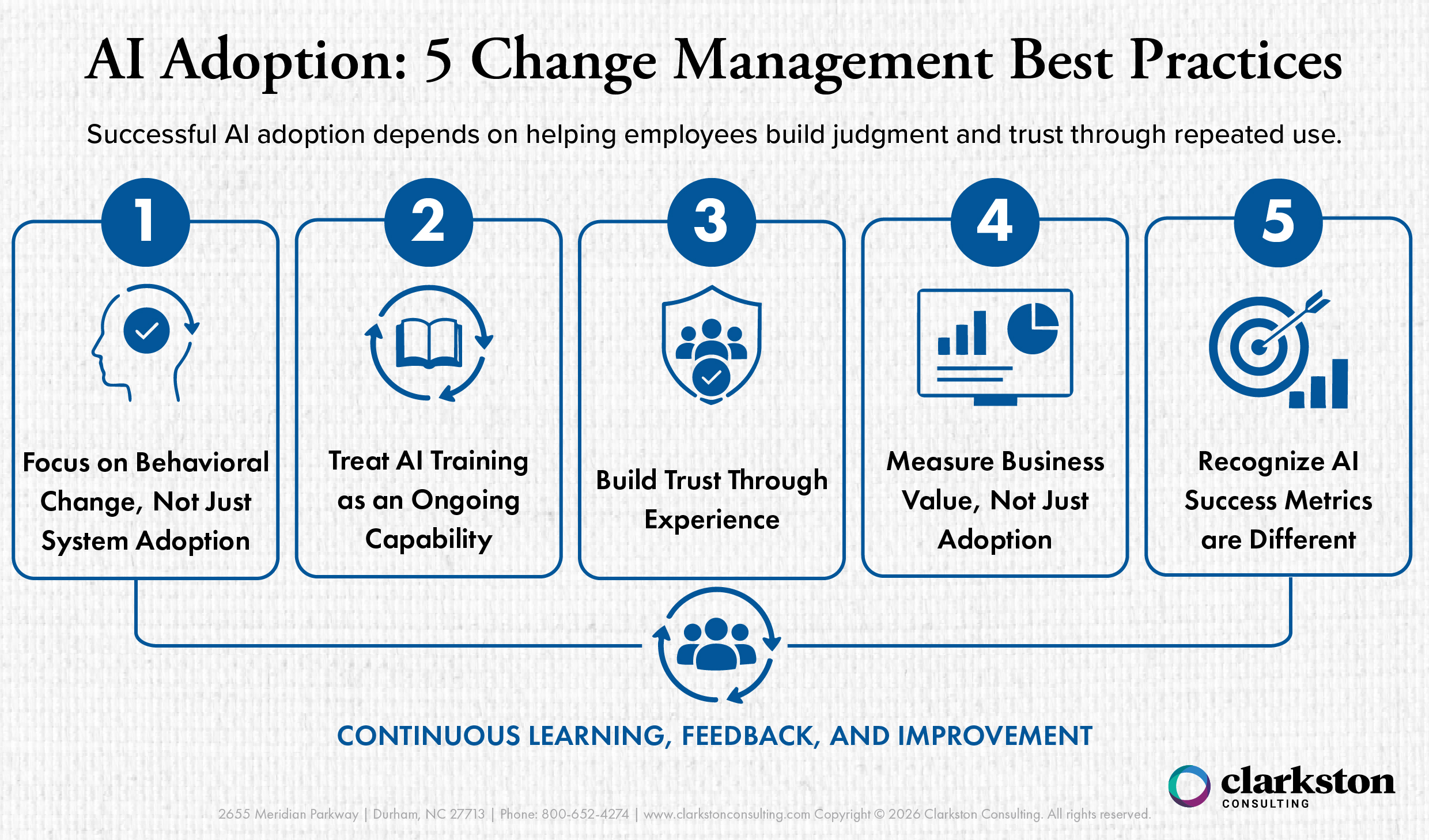
1. Focus on Behavioral Change, Not Just System Adoption
Organizations investing in AI are finding that some of the biggest challenges are often behavioral and organizational rather than technical. For AI-enabled system rollouts, the questions we hear are rarely about the technology itself; they’re more geared toward how employees should change their behavior.
For example, a quality leader might ask whether they can rely on an AI-generated claim correction when the ultimate accountability still remains with them.
We know questions like this are fundamentally different from learning a new system. They require employees to develop confidence in when to leverage AI, when to challenge it, and how to incorporate it into existing decision-making processes.
When starting an AI technology rollout, leaders need to stay mindful that employees aren’t just learning how to use a new tool; instead, they’re learning how to work alongside AI and exercise judgement about when to build on, validate, or challenge AI outputs.
2. Treat AI Training as an Ongoing Capability
Another challenge that organizations encounter when it comes to change management for AI-based systems is the nature of the technology itself constantly changing and evolving. While traditional systems are generally rule-based, with deterministic outputs and fixed functionality, AI-based systems are constantly learning over time. From a rollout and change management perspective, this creates some unique opportunities.
For rollout and training, it’s important for businesses to not just rely on a single training session and a one-and-done approach. Instead, they should focus on continuous, people-centered learning.
What does this look like in action? Training should shift from a focus on teaching the process to teaching judgement around AI. This helps users build more proficiency over time as they gain repetition with real-world scenarios versus just a single process training. Clarkston has seen organizations achieve stronger adoption when training is tied directly to real business scenarios rather than generic system demonstrations.
For example, a supply chain team may spend a short weekly session reviewing how AI-generated forecasts compared to actual demand and discussing when planners chose to override recommendations. In commercial organizations, teams may review examples where AI surfaced customer insights that influenced promotional decisions. These conversations help employees build judgment through repetition and experience and increase AI literacy, which is more valuable than additional process training.
When it comes to AI-enabled systems, businesses that treat training as an ongoing capability-building effort instead of just a launch activity will generally be better positioned to sustain adoption over time.
3. Build Trust Through Experience
Trust has always been a critical component of a successful technology adoption, but the way trust is established is vastly different between traditional systems and AI-enabled solutions. Historically, organizations build trust in traditional technologies through rigorous testing and validation, compliance-driven acceptance processes, and confidence in predictable system behavior. Once a system is proven to perform as designed, users can generally rely on it to continue performing.
Because AI systems generate recommendations and outputs that can vary based on context, trust is not established once and maintained indefinitely. Trust must be built and reinforced through repeated interaction and experience over time.
As part of this ongoing process, continuous user training plays a critical role. Transparency is equally important, as helping users understand how recommendations are generated enables them better determine when additional human judgement and oversight should be applied.
For organizations implementing AI-based systems, this means trust requires active investment. We know confidence in AI is dynamic, evolving as employees build proficiency and confidence as well as observe the quality and reliability of AI-generated outputs in real-world situations. Successful AI adoption requires organizations to support ongoing trust calibration, enabling employees to appropriately rely on AI while maintaining accountability and critical thinking.
4. Measure Business Value, Not Just Adoption
Another challenge we see in organizations is that traditional governance models are not designed for systems that continuously evolve. For large system implementations, governance is typically focused on solution design and go-live, where organizations can establish controls upfront and then review them on a regular basis. This looks a little different for AI-based systems, because they introduce both new use cases and new risks as adoption grows.
When we think about governance best practices from a change management perspective, it means always having a pulse on how AI is being used across the organization and maintaining continuous oversight, while regularly updating guidance based on emerging behaviors and lessons learned.
Clarkston has seen organizations achieve the strongest outcomes when governance teams work closely with business stakeholders to monitor adoption trends, identify unintended uses, and refine guardrails over time. This might include reviewing AI tool usage metrics regularly with the frequency scaling up or down alongside the sensitivity of use cases, or identifying areas where employees are getting stuck in the process. This creates a feedback loop where governance informs adoption efforts, and employee experiences help shape governance decisions.
5. Recognize AI Success Metrics are Fundamentally Different
A final challenge that organizations face is how to best measure the overall success of AI-enabled system implementations. AI is designed to influence our decision-making and change our ways of working, so success metrics need to reflect those behavioral changes and challenges.
Where traditional system success is measured with system uptime and process adherence, AI-enabled success needs to rely on broader measures. Organizations should look at indicators such as workflow integration, decision quality, trust in AI recommendations, and override rates or how often employees choose to modify or reject AI-generated recommendations. These measures provide greater insight into how effectively AI is being incorporated into day-to-day work and whether it is delivering meaningful business value.
For organizations investing in AI, high usage alone should not be considered evidence of success. Employees may interact with AI frequently without improving outcomes or changing behaviors. Alternatively, override rates aren’t inherently negative, and in many cases, employees challenging AI recommendations reflects healthy human oversight and critical thinking. Effective AI measurement focuses not only on adoption, but on how AI improves decisions, supports workflows, and enables better business outcomes.
Looking Ahead: Change Management as an Accelerator of AI Adoption
As AI becomes more deeply embedded in business processes, traditional approaches to system change are no longer enough. AI-enabled systems require continuous learning, adaptive governance, trust-building, and new patterns of human-machine collaboration.
Organizations that tailor their change management strategies to these unique dynamics will be better positioned to accelerate adoption, realize value, and scale AI successfully across the enterprise. To explore how to leverage change management for AI at your organization, reach out to our AI Organizational Change Management (OCM) team.
Subscribe to Clarkston's Insights
Contributions by Allie Wright
AI-assisted: A human led the content and final approval of this piece, with AI used to support ideation, drafting, editing, summarization, or repurposing.