How Business Translators Enable AI Transformation


Organizations have invested billions in data, analytics, and AI. Yet many initiatives still struggle to deliver measurable business outcomes. Technology is rarely the problem. More often, the gap lies between business ambition, technical execution, and organizational adoption. Without someone translating across these worlds, even the most sophisticated solutions fail to create value.
A business translator is the bridge that can translate technical capabilities into practical strategies. They don’t just speak the language of data science; they align it with organizational goals, making sure analytics initiatives deliver real business value. In this article, we explore the challenges of implementing advanced analytics and AI, the critical role of business translators in the process, and how this role help organizations navigate complexities to drive successful transformations.
What is a Business Translator?
Successful data and AI initiatives aren’t just about implementing new technology. Even the most advanced tools will struggle to deliver results if employees do not understand how to use them or leadership lacks clarity on expected outcomes. These efforts require the right combination of tools, people, and communication to ensure the transition is smooth and creates positive impact.
A business translator sits at the intersection of business strategy, technology, and change. They help leaders define the business problem worth solving, translate those priorities into technical requirements, and ensure solutions are implemented in ways people can understand and adopt. Rather than replacing project managers, data scientists, or change managers, they connect their work so that investments produce measurable business value.
How a Business Translator Helps
In data transformation projects, a business translator serves as the critical link between strategic intent and technical execution.
They ensure that complex technologies, such as analytics platforms or AI solutions, are clearly understood by business leaders by articulating capabilities, limitations, and trade-offs in practical, business-oriented terms. This clarity enables more informed decision-making at the executive level and reduces the risk of misaligned investments. Without this understanding, 60% of companies’ AI projects fail due to poor data.
At the same time, business translators take high-level objectives and convert them into structured, actionable requirements that data engineers and analysts can deliver against, ensuring that technical work remains grounded in real business needs.
By continuously connecting business priorities with technical delivery, business translators help prevent common pitfalls such as unclear requirements, rework, and underutilized solutions. They help organizations prioritize effectively and realize stronger ROI from analytics and AI investments, making them indispensable drivers of successful transformation.
The Business Translator in Change Management
Change management often focuses on helping people adopt a new way of working. Business translation ensures the change itself makes sense before asking people to embrace it.
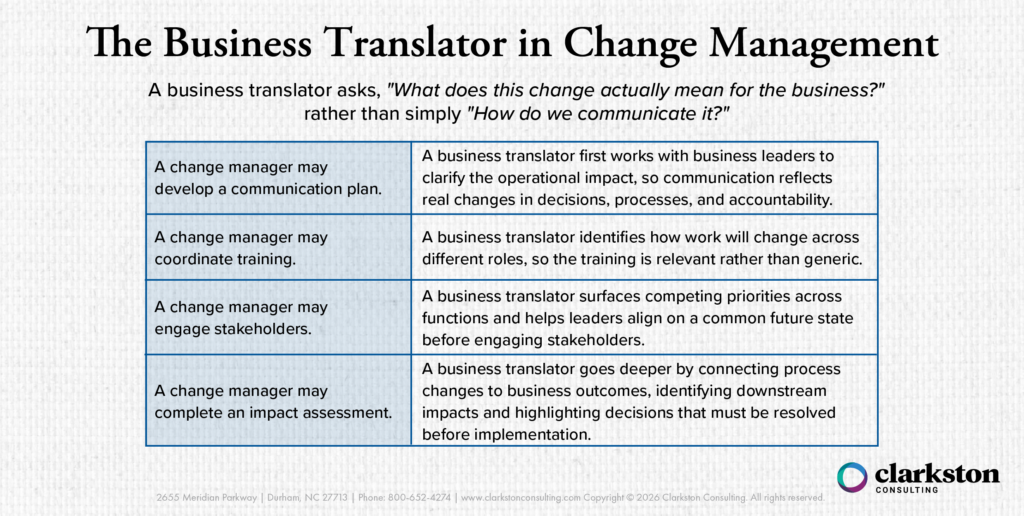
A business translator asks, “What does this change actually mean for the business?” rather than simply “How do we communicate it?”
Many organizations ask change managers to perform business translation in addition to their core responsibilities. While experienced practitioners often do this naturally, business translation deserves explicit attention because it requires a different lens.
The differences in roles can be best seen through examples:
What Happens Without Business Translation?
Without business translation, change management can still drive adoption, but the challenge is that people may adopt a solution that was never fully aligned with the actual business need.
As a result,
- Communications are timely but answer the wrong questions.
- Training teaches new processes without explaining why they matter.
- Stakeholder engagement gathers feedback without resolving underlying business decisions.
- Impact assessments identify affected groups without exposing operational risks.
- Adoption metrics show participation while business value remains unrealized.
The result is a workforce that understands how to change but remains uncertain about what they are changing toward and why it improves the business.
Business translation ensures that change management is not only people-centered but also business-centered. It connects strategy to execution so that adoption leads to measurable business outcomes rather than simply compliance.
Driving Adoption Through Literacy
Business translators can also strengthen adoption by improving technology literacy and AI literacy, helping create a culture where data and AI can thrive.
Businesses need employees who not only know how to use new tools but also understand the basics of how these systems generate content, reach conclusions, make suggestions, and support decision-making. Without this foundation, trust in AI output can falter, limiting not only adoption but an organization’s ability to embed data-driven decision-making into everyday work. This lack of understanding has led to more than 90% of AI projects seeing no return.
Business translators help move organizations beyond implementation by building the understanding and confidence needed for lasting behavioral change. Clarkston recently showcased how to drive digital engagement and the results of this transformative change. By building AI literacy and confidence across the organization, business translators help create a culture where employees can continuously adapt as technologies evolve and business needs change.
Subscribe to Clarkston's Insights
Contributions by Jacob Gallagher
AI-assisted: A human led the content and final approval of this piece, with AI used to support ideation, drafting, editing, summarization, or repurposing.