3 Considerations When Embedding AI Into Your MLR Review

Medical, Legal, and Regulatory (MLR) review teams are facing growing complexity in how content is reviewed and approved. Review cycles are tightening while expectations for accuracy and compliance remain unchanged. At the same time, the volume of content moving through review continues to rise across digital channels and global markets. This increasing demand is putting sustained pressure on review teams and exposing inefficiencies in traditional processes.
It’s no secret that AI is often positioned as a solution to these challenges – it offers the ability to accelerate reviews, identify risks earlier, and reduce manual effort. Those benefits are real, but they aren’t automatic.
Organizations that see lasting impact approach AI differently. They embed it within existing governance structures and treat it as a support layer rather than a replacement for established controls. Without that discipline, AI can create as many challenges as it solves. In this piece, we break down three considerations when embedding AI into your MLR review.
Embedding AI Into Your MLR Review
1. Design for Human-in-the-Loop Decision-Making
AI is already delivering value in early stages of the MLR process. It can extract claims and highlight potential compliance risks before content reaches formal review. Some tools can identify missing safety language and flag statements that may not align with approved labeling.
Even with these capabilities, accountability is critical. In regulated environments, decision-making remains with human reviewers. Medical, legal, and regulatory stakeholders are responsible for ensuring that content is accurate and compliant.
That’s why AI should be designed to support human judgment, not replace it. It can guide attention toward higher risk areas and reduce time spent on manual checks, but it shouldn’t be positioned as the final authority. A key question for organizations is whether AI-enabled workflows make ownership clearer. If decision rights become ambiguous, the risk of audit issues increases and confidence in the process declines.
2. Start with Crawl Walk Run, Not Enterprise Automation
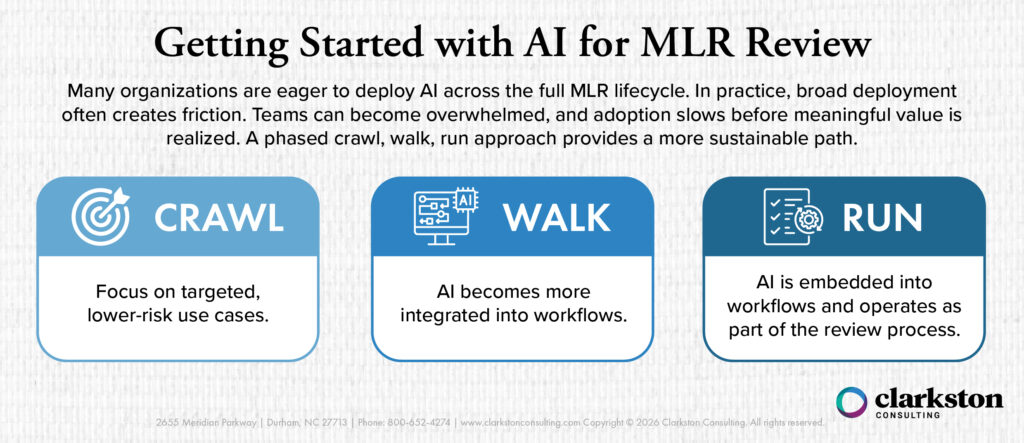
Many organizations are eager to deploy AI across the full MLR lifecycle. In practice, broad deployment often creates friction. Teams can become overwhelmed, and adoption slows before meaningful value is realized. A phased crawl, walk, run approach provides a more sustainable path.
Crawl
In the crawl phase, organizations focus on targeted use cases with lower risk. Claims extraction and version comparison are common starting points. These activities are repetitive and time intensive, which makes them strong candidates for automation. AI can reduce manual effort in these areas and improve efficiency without introducing significant risk. At this stage, human oversight remains high as teams validate outputs and build confidence.
Walk
In this next phase, AI becomes more integrated into workflows. Outputs begin to inform how content is routed and reviewed. Feedback loops are established to improve performance over time, and organizations start to measure impact on cycle time. Many teams begin to see measurable improvements in review speed and consistency as adoption grows.
Run
The run phase represents a more mature state. AI is embedded directly into MLR workflows and operates as part of the review process rather than alongside it. It supports reviewers in real time by identifying risks and suggesting changes as content moves forward. Users engage with AI outputs as a normal part of their daily work and rely on them to guide decisions.
Even in this state, human reviewers remain accountable for final approval. AI enhances speed and consistency, but it doesn’t replace oversight. Scaling should only occur once governance is clearly defined and adoption is stable. Escalation paths and performance metrics also need to be in place. Taking an incremental approach is essential when scaling AI in regulated environments, as moving too quickly can result in rework and introduce compliance gaps that are difficult to unwind.
3. Treat AI in MLR as a Change Management Initiative
The main barrier to success with AI in MLR review isn’t the technology: it’s adoption. MLR processes are complex and involve multiple stakeholders, which makes change difficult to implement. Introducing AI affects how teams interact with content and how decisions are made throughout the review process.
Organizations that succeed focus on how people work, not just on what tools are deployed. They align workflows with new capabilities and define clear roles so that responsibilities remain understood. When AI is integrated effectively, it can reduce manual effort and improve efficiency across the content lifecycle.
Support during rollout plays an important role. Teams need time to build confidence in AI outputs and understand how to use them effectively. Trust develops gradually as users see consistent results that align with their expectations. Without a structured approach to change, even well-designed AI solutions can struggle to gain traction.
Getting Started
AI presents a meaningful opportunity to improve the efficiency of MLR review without compromising compliance. To realize this value, organizations should begin with targeted use cases that address clear pain points. Governance should be established early and reinforced as adoption expands, and progress must be measured to ensure that improvements are sustained.
When implemented thoughtfully, AI becomes a natural part of the MLR workflow. It enables faster reviews while maintaining confidence in regulatory standards. To continue the conversation, contact Clarkston’s team of experts today.
Subscribe to Clarkston's Insights
Contributions from Hannah Yang
AI-assisted: A human led the content and final approval of this piece, with AI used to support ideation, drafting, editing, summarization, or repurposing.