How to Think About AI Strategy to Realize Business Value

Realizing business value with AI is nearly impossible without a robust and adaptive AI strategy. The number of ways AI can improve a business’s decision-making, operational efficiency, productivity, product quality, and sales conversion are virtually limitless. Given the possibilities combined with all the buzz in the media, business leaders are easily tempted to rush to implement enterprise AI solutions, yet few are realizing a return on investment (ROI).
Start With Building Foundations and Small Wins
The problem is rarely the technology itself, but rather the failure to account for the strategic foundations that enable success. Overlooking any of the below factors can result in inconsistent outcomes at best and wasted investments, or inaccurate business decisions at worst. A well-aligned AI strategy is supported by six key pillars:
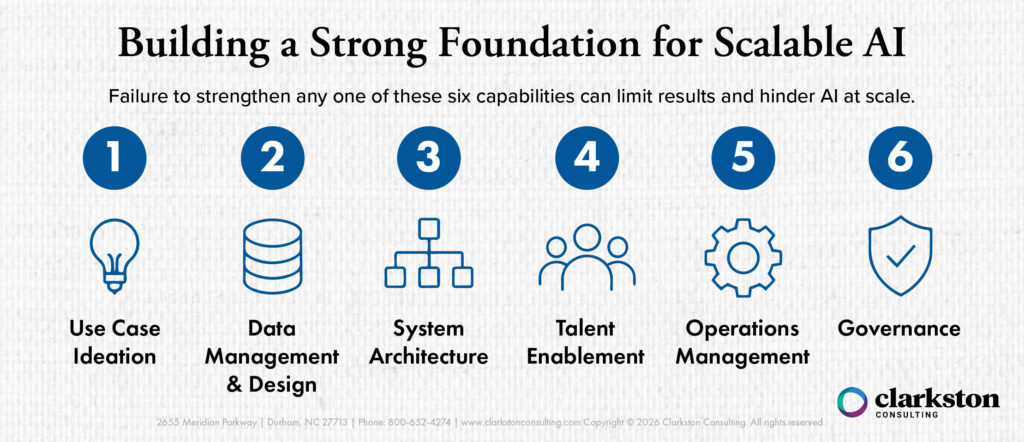
1. Use Case Ideation
While it’s worthwhile to craft and work toward a vision for enterprise-wide, AI-driven decisions and operations, it shouldn’t be the immediate goal. Instead, we recommend targeting two or three high-value use cases that can be implemented to build trust, familiarity, and momentum.
These use cases should be identified by answering questions such as: What decisions or processes do you want AI to support? What are your greatest pain points? What data do you currently have (or could easily acquire) to be leveraged with AI? What use cases are aligned to your values, goals and business KPIs?
Selecting small, targeted use cases that advance the organization’s priorities and celebrating “quick wins” helps to set a precedent for larger, more advanced ideas to come.
2. Data Management & Design
AI is not magic, and it does not automatically fix the flaws in your data. Instead, it exposes them. Beyond using off-the-shelf platforms such as ChatGPT, Copilot, or Claude, AI only provides value if it has clean, well-structured underlying data to drive deeper insights or process improvements.
Small wins can be achieved by leveraging existing data stored in isolated or unsophisticated architectures as long as the data is well-prepared. As use cases become more advanced, integrated, and widespread, it’s critical that data sources are properly modeled, integrated, and maintained according to best practices.
3. System Architecture
The implementation of AI use cases depend on proper data management and design and must be supported by the right platforms and tools to ensure security and reliability. For basic or early use cases, this can be as simple as well-maintained local file structures, SharePoint pages, Google drives, or other lightweight data storage and organization platforms. At the other end of the spectrum, advanced AI capabilities require integration across multiple data sources, orchestration of data migration and transformation, failure monitoring and remediation, and data architectures that are accessible and reliable – all of which can largely be automated.
4. Organization Design & Talent Enablement
How are tools and automated processes going to be maintained? Who is going to do it? Does it make the most sense for your data, analytics, and AI capabilities to be centralized, decentralized, or a hybrid of both? The answers to these questions are often dependent on the talent available or that you are willing to hire.
Moreover, it’s critical to align the necessary skillsets for data management, system architecture, and use case deployment, and maintenance with how data and AI are intended to be used within the organization and the talent available to support them.
5. Operations Management
Closely related to organizational design are the decisions surrounding operations. Data and AI products intended to be used cross-functionally require different approaches to management than products that are siloed by business functional area.
Regardless of structure and intended use, operations must align with company values, prioritization, and collaborative capabilities, and metrics, values, and goals must be consistent across functions to ensure stakeholders throughout the organization are working toward common goals.
6. Governance
Finally, well-crafted AI governance policies and procedures are the glue that brings all the other pillars together. Proper, enforced governance ensures data quality, system and tool maintenance, tool and data access for the proper users, compliance, issue escalation, and minimization of failures and down time.
Furthermore, policies, procedures, and documentation are never “shiny objects” that get people excited, but without them, it’s only a matter of time before minor issues become systemic and catastrophic.
Change is Hard
Managing change is frequently challenging no matter what that change entails, even if it’s positive for all stakeholders. Unique aspects of AI technology make change even more of a challenge, from hallucinations and misaligned expectations to job security concerns, technological misunderstandings, and transparency.
When working with clients in life sciences, CPG, or retail, we initiate change management from day zero. The prospects for AI success are limited if stakeholders aren’t aligned on expectations from top to bottom, users don’t have the skills to work effectively with the technology, upstream and downstream processes aren’t adapted around the technology, and clear channels for feedback, issue escalation, and iteration aren’t well-established early and reinforced often.
Iterate and Adapt
Business leaders, functional managers, and consultants alike love a well-thought-out, step-by-step roadmap. Having a vision with realistic ideas for how to get there is invaluable. However, a mindset and approach that is frequently uncomfortable to these stakeholders is required to enable AI success. As such, AI strategies must be iterative and adaptable, meaning rarely treating any initiative as “done” and instead working through cycles of continuous improvement.
AI technology is evolving faster than even most experts in the space can keep track of. Every day, new tools, capabilities, and best practices emerge, while business leaders are constantly imagining ways that AI can move them closer to their business goals. Plans, roadmaps, and goals should be treated as fluid, and stakeholders throughout each business must adopt an iterative, “fail fast” mindset to enable experimentation. Try things, then succeed and scale, or fail quickly and move on. While this may seem like wasted time or investment, enabling this culture of experimentation is often the source of the most innovative ideas.
Scaling to Become an AI-Driven Enterprise
The value of achieving small but high-value and high-visibility successes with AI cannot be understated. By starting with manageable use cases, stakeholders get repetitions working through best practices, learning what works and what doesn’t, identifying gaps, and finding hidden strengths. They also build a culture of trust, demonstrating that AI technology can be accurate, reduce frictions, and empower users to spend more of their time managing relationships, improving products and services, and focusing on the human side of the business.
With this experience, scaling enterprise AI becomes more realistic and less daunting. The picture has become clear surrounding the talent, technology, operations, and governance required to enable advanced solutions.
This is not to say that enterprise scaling is easy, because it isn’t. Scaled AI use exposes new vulnerabilities, amplifying the consequences of failures or lack of oversight. However, the experience gained in the earlier stages of AI maturity allows stakeholders to more easily anticipate failure points, have repetitions in issue resolution, and generate increasingly innovative ideas to drive the business forward.
Completing the Puzzle
Forming and executing an AI strategy and managing change present a massive challenge for any organization. Most organizations have stakeholders who excel in just one or two of the critical competencies for achieving success with AI. The relative newness and proliferation of Generative and Agentic AI mean that best practices are almost never well-established within most organizations.
At Clarkston, we have guided multiple clients from ambition, to strategy, to small implementation, to enterprise scaling with AI, all while ensuring organizational alignment, managing change, and maintaining governance. Reach out to us today if you’re ready to explore what’s possible for your business with AI and do so in a realistic and strategic manner to optimize your chances of success.
Subscribe to Clarkston's Insights
AI-assisted: A human led the content and final approval of this piece, with AI used to support ideation, drafting, editing, summarization, or repurposing.