How the RAM Shortage is Impacting Supply Chains

The rapid expansion of artificial intelligence (AI) is placing pressure on the global chip supply chain, driving a growing shortage of RAM. AI servers rely heavily on High-Bandwidth Memory (HBM), which is more complex to produce and has created bottlenecks along the semiconductor supply chain. At the same time, the global Dynamic Random Access Memory (DRAM) market is highly concentrated, with only three companies controlling 93% of the supply.
All three of these manufacturers are investing in new fabrication facilities; however, due to concerns that demand drivers will peak before they can bring new facilities online, all three have decided to focus on returns rather than risking overproduction that could lose them money later on, especially given the significant capital outlay required to build new facilities.
As AI demand accelerates and the supply chain continues to struggle to keep up, RAM prices are expected to rise and remain elevated through 2026. Some experts are projecting the shortage will persist until 2028 as memory makers are prioritizing AI demand. This tightening memory supply is likely to ripple out across global technology supply chains, affecting a range of industries from consumer products to cloud computing.
RAM Shortage Impact on Supply Chain
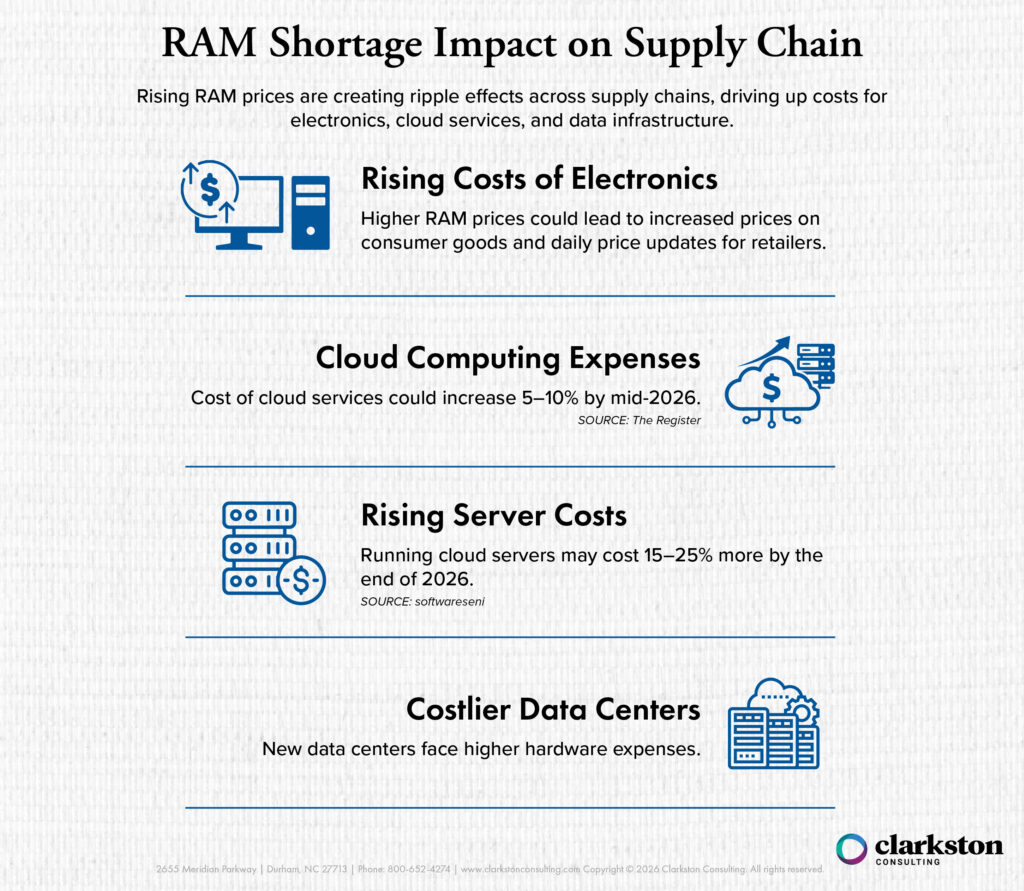
The effects of the RAM shortage and the higher costs are likely to squeeze margins, resulting in upward pressure on the price of finished goods. As RAM prices increase, firms should consider whether they can absorb the increased costs or pass them on to consumers in the form of higher prices. Consumer electronics are likely to see price hikes, and some retailers may need to update prices daily.
The upward pricing on RAM is also likely to contribute to an increase in cloud computing costs if the shortage persists. DDR5 RDIMM, hardware essential for cloud computing, may surge in price by up to 100% by the end of 2026. This can roll over into cloud prices. Cloud service providers like OVH Cloud are already forecasting 5-10% prices increases by mid-2026, as equipment becomes more expensive.
For businesses that rely on cloud computing, their current server could cost 15-25% more to run by the end of 2026, and that’s prior to any increase in usage. Additionally, new data centers coming online would see increased hardware costs. Businesses that rely heavily on DRAM storage or cloud computing should act now to lock in pricing or adjust their infrastructure as DRAM supplies remain uncertain.
Policy Responses
Governments have been implementing a range of policy changes to help combat the effects of the RAM shortage. For example, the U.S. CHIPS Act offers manufacturing incentives for more semiconductors and a 25% federal income tax credit for qualified investments in facilities that manufacture semiconductors or semiconductor manufacturing equipment in the U.S. This demonstrates a push for increased RAM production, particularly localized production that can help reduce reliance on foreign supply chains. However, the Trump Administration’s current goals to up the global tariff rate to 15% on all imports may further exacerbate pricing on RAM and other hardware chips.
Considerations for Organizations During the RAM Shortage
Despite the policy attempts to combat the shortage, organizations will still need to adopt a range of strategies to manage the shortage and its effects on supply chains. One approach is forming strategic alliances with semiconductor suppliers through long-term contracts or prepayment agreements to secure supply. For example, Apple has a long-term NAND partnership with Kioxia.
However, these types of arrangements are often only feasible for larger corporations that can afford the significant upfront costs. Small to mid-sized businesses will likely need to combat these challenges by finding ways to reduce RAM usage through restructuring software and workflows.
For example, optimizing workloads, redesigning processes to be more memory-efficient, scaling AI models to smaller parameter sizes, and using caching hierarchies more strategically can all help cut a company’s overall RAM usage. Delaying product launches or automation upgrades until conditions stabilize can also help minimize RAM usage. Additionally, hybrid workloads that strategically blend public cloud and on-premise systems can help get the most out of available RAM. However, this can sometimes require lowering performance standards.
For CPG and retail companies, partnerships can create opportunities to share data infrastructure, which reduces RAM demands by limiting redundant processes. Companies can further ease those demands by prioritizing products that need less automation or IoT support during production. It may also make sense to reduce emphasis on lower-margin items that consume a disproportionate amount of RAM, allowing resources to be used more efficiently.
Moving Forward
As RAM availability remains uncertain, organizations should do their best to prepare. A proactive approach to managing RAM resources through strategic partnerships and improvements in operational efficiency will be critical to maintaining the best performance standards and minimizing costs.
Our team at Clarkston can help navigate this shift by identifying opportunities to reduce memory dependence and redesign data and AI architectures for greater efficiency. Organizations that act early to strengthen their technology strategies will be better positioned to mitigate risks from the RAM shortage. Contact our team today.
Subscribe to Clarkston's Insights
Contributions from Natalie Pollock
AI-assisted: A human led the content and final approval of this piece, with AI used to support ideation, drafting, editing, summarization, or repurposing.