2026 Sustainability Trends

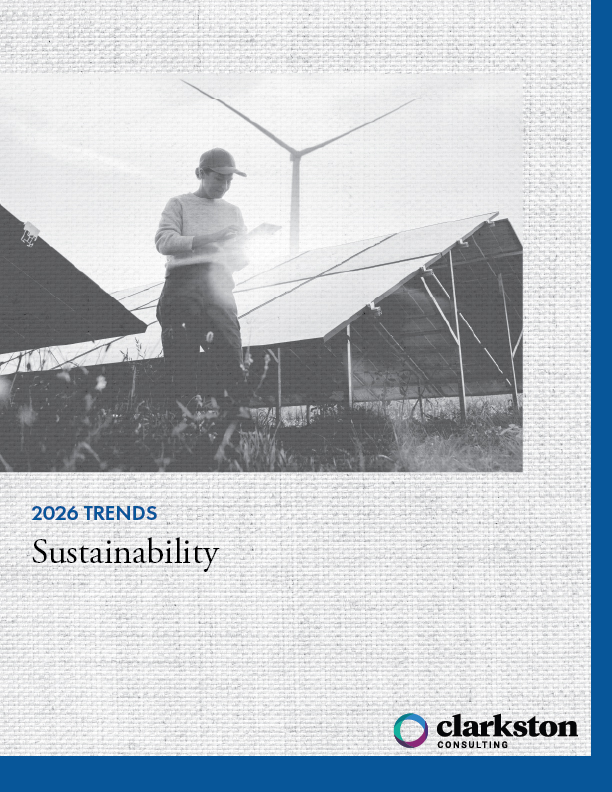
Download the full 2026 Sustainability Trends Report here.
This free industry report outlines industry perspectives and expert advice from our team of consultants. You can view an excerpt of the report below, and if you’d like to discuss any of the trends or other challenges in the sustainability and ESG space, connect with our team today.
Key Sustainability Trends
Over the past few years, regulatory pressures, investor expectations, and consumer demands have all accelerated the need for more sustainable business practices. Looking ahead, organizations must move beyond reactive compliance and proactively integrate sustainability strategies into their operations to be better positioned to meet investor and consumer expectations.
Companies that set clear sustainability goals, adopt transparent reporting, and invest in scalable solutions – from circular supply chains and responsible AI to renewable energy and biodiversity protection – will be better positioned to adapt, manage risk, attract investment, and build lasting brand trust in the years to come.
Clarkston’s sustainability & ESG consultants have highlighted the top sustainability trends that businesses should consider and keep top-of-mind throughout the year:
- Demonstrate ESG Impact
- Circular Economy
- AI Applications for Sustainability
- Renewable Energy
- Biodiversity Protection
Trend 1:
Demonstrate ESG Impact
Moving into 2026, the U.S. requirements for ESG disclosure have loosened under the current administration. In March 2025, the SEC ended its legal defense of its climate disclosure rules, no longer requiring companies to report on climate risks and greenhouse gas emissions. Despite declining U.S. regulations, maintaining strong ESG disclosure remains critical. Businesses that continue to quantify and report ESG impact can strengthen stakeholder trust and, in turn, improve their odds of securing funding.
ESG disclosure remains critical for investor confidence. Investors increasingly rely on ESG data to evaluate long-term risk and resilience. A Capital Group survey of 1,130 institutional and wholesale investors across 19 global markets found that 89% of investors consider ESG issues in some form as part of their investment approach. Companies whose initiatives fail to align with investor ESG priorities may struggle to attract or retain capital.
Consumers are also placing greater emphasis on ESG when making purchasing decisions. Many actively seek brands that align with their personal values, with 82% of shoppers saying a consumer brand’s values should reflect their own. For example, Seventh Generation focuses on plant-based, non-toxic cleaning products that come in recycled packaging and is the largest eco-friendly cleaning supplier in the U.S. Additionally, Allbirds has focused on sustainable shoes made from natural fibers like merino, wool, and eucalyptus. Even with reduced government enforcement, voluntary ESG reporting remains an important tool for maintaining consumer trust.
While U.S. regulations have softened, sustainability requirements are tightening globally. The EU CSRD requires companies to disclose sustainability impacts, risks, and opportunities. If businesses continue to disregard ESG data disclosure under the current administration’s regulations, they may miss out on international partnerships and investors that require stricter ESG goals.
Looking ahead, the regulatory landscape for sustainability is tightening globally. Despite relaxing ESG standards in the U.S., companies that maintain strong ESG goals will be better aligned with investor expectations and international requirements. By quantifying ESG data and translating it into measurable ROI and cost savings, businesses can clearly demonstrate value while positioning themselves to manage long-term risk in increasingly interconnected global supply chains.
Trend 2:
Circular Economy
In 2021, circular supply chains were not a priority, with only 40% of businesses considering circularity important. Today, 75% of businesses see circularity as important and that number is expected to grow to 95% in the next three years. Looking to 2026, circular economy strategies have started to become embedded in core business models rather than treated as sustainability add-ons.
The principles of reduce, reuse, and recycle are increasingly shaping product design and sourcing decisions. Many organizations are incorporating recycled materials into their products, with brands such as Adidas (in 2019) leading early adoption by producing roughly 11 million pairs of shoes using recycled plastics.
Sustainable supply chains and ethical sourcing have also become a priority customers, regulators, and investors demand greater transparency. Consumers want clearer insight into how products are made and where materials originate, particularly in industries such as beauty, where 86% of shoppers say they want more information from brands about where product ingredients come from. In this way, supply chain transparency can help gain consumer trust while also supporting compliance with evolving expectations.
Many companies are reinforcing transparency and circularity by integrating reuse and recycling programs across the product lifecycle. For example, Ikea offers furniture leasing, buy-back policies, and assistance for customers to help extend the lifetime of their products. Adidas has similarly advanced circular design through its “Made to Be Remade” initiative, alongside sneaker cleaning, rental, and take-back programs that keep products in use longer.
By 2026, circular supply chains are emerging as a strategic advantage. Beyond enhancing brand reputation, circularity can reduce material costs and improve supply chain resilience in an increasingly interconnected global economy. Organizations that assess circular opportunities across the full product lifecycle and expand reuse and take-back programs will be better positioned to meet evolving consumer expectations and support long-term business success.
Continue reading by downloading the full report below.
Download the Full 2026 Sustainabilty Trends Report Here
Read last year’s Sustainability Trends Report here.
Subscribe to Clarkston's Insights
Contributions from Drake Jaglowski and Natalie Pollock
AI-assisted: A human led the content and final approval of this piece, with AI used to support ideation, drafting, editing, summarization, or repurposing.