Key Considerations for Creating a More Circular Retail Supply Chain

Retailers are facing pressure from several directions at once. Supply chains remain volatile. Material costs are still a concern. Regulatory expectations continue to evolve. At the same time, shoppers are paying even closer attention to how products are made, used, returned, and recovered.
As a result, the industry is accelerating toward circular economy strategies that extend product life, reduce waste, and unlock new sources of value. And at the center of this transformation are two powerful enablers: reverse logistics and upcycling.
Circular Retail Moves Beyond Recycling
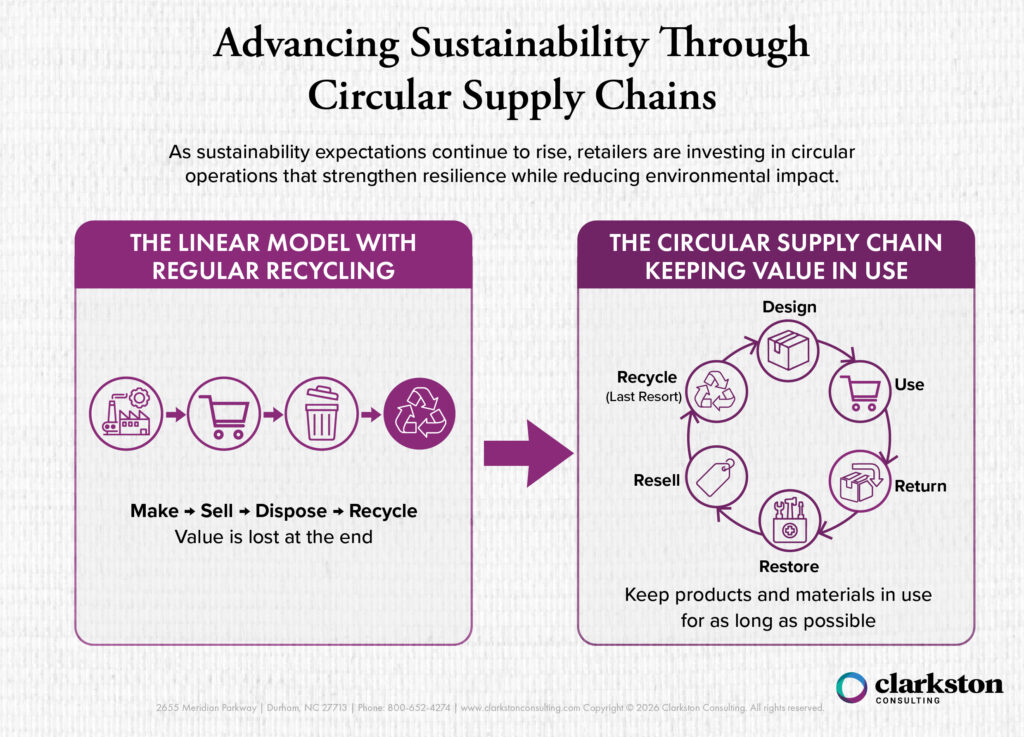
Circular retail is built on the idea that products, components, and materials should remain in use for as long as possible. Rather than a linear “make–sell–dispose” model, circularity emphasizes reuse, repair, refurbishment, recovery, and recycling.
For retailers, this approach delivers more than environmental benefits. Circular supply chains reduce dependency on virgin materials, mitigate supply risk, lower operating costs, and better align growth with long-term sustainability goals.
As a result, circular practices are increasingly being embedded directly into retail operations from product design and sourcing, to fulfillment, returns, and resale.
Reverse Logistics Becomes a Growth Engine
Reverse logistics has evolved well beyond traditional returns management. Retailers are now using structured reverse flows to support repair and refurbishment programs, trade-in and take-back initiatives, recommerce and resale channels, and donation and responsible recycling pathways.
These programs redirect products away from end-of-life disposal and back into the value chain. What was once a cost center is becoming a value-generating ecosystem, reducing landfill fees while creating incremental revenue streams.
Equally important, circular programs deepen customer engagement. Repair services, resale platforms, and trade-in offers extend the relationship well beyond the initial sale — strengthening loyalty while providing valuable insight into product performance and lifecycle behavior.
Upcycling Gains Momentum as an ESG Lever
Upcycling is also becoming one of the most measurable and scalable sustainability levers in retail, particularly in packaging. Major global brands are investing heavily in recycled and upcycled materials to meet aggressive ESG commitments.
Companies like Patagonia are advancing sustainable packaging by embracing upcycled and non-tree-based materials. Since September 2024, the brand has committed to eliminating packaging sourced from endangered forests, such as delivery boxes, hang tags, and shoeboxes by shifting to alternatives like agricultural waste fibers and recycled paper, ensuring none of its packaging contributes to deforestation.
Key trends shaping the market include smart packaging integration (using QR codes and NFC tags to improve transparency and end-of-life guidance), refillable and reusable systems (bulk formats and refill stations), improving recyclability, and cross-industry collaboration to bring brands, NGOs, and suppliers together around circular models.
Innovation Reshaping Retail Operations
As circular programs grow, execution becomes more important. Circularity is also influencing how products are manufactured and restored.
Retailers need a way to assess returned goods consistently, direct products into the right recovery path, and capture the data needed to improve over time. That is where technology can make a measurable difference.
Better product tracking, stronger data capture, automation, and AI-enabled sorting can all support faster routing decisions and better recovery outcomes. Real-world initiatives, such as Spain’s Upcycling the Oceans program that converts marine debris into fashion yarn, also demonstrate how circular strategies can deliver both environmental impact and economic opportunity.
These capabilities all help circularity become more repeatable. Instead of relying on manual workarounds or isolated programs, retailers can begin to build processes that are easier to scale across channels, categories, and fulfillment networks.
A Structural Shift, not a Passing Trend
Circularity is still closely tied to sustainability goals, but that is no longer the full story. For retailers, it’s increasingly a supply chain question and an operating model decision – particularly with global waste volumes projected to rise sharply by 2050 and sustainability regulations expanding worldwide.
Organizations that invest in reverse logistics, material recovery, and more structured circular processes may be better positioned to reduce waste, protect margin, and respond more effectively to disruption. Just as important, they can create a more deliberate approach to managing product value beyond the first sale.
For retailers evaluating the next phase of supply chain transformation, circularity is worth viewing through that lens. Not as a side program, but as a practical capability that can support stronger operations over time.
Subscribe to Clarkston's Insights
AI-assisted: A human led the content and final approval of this piece, with AI used to support ideation, drafting, editing, summarization, or repurposing.