2026 Wine, Spirits, and Beer Industry Trends

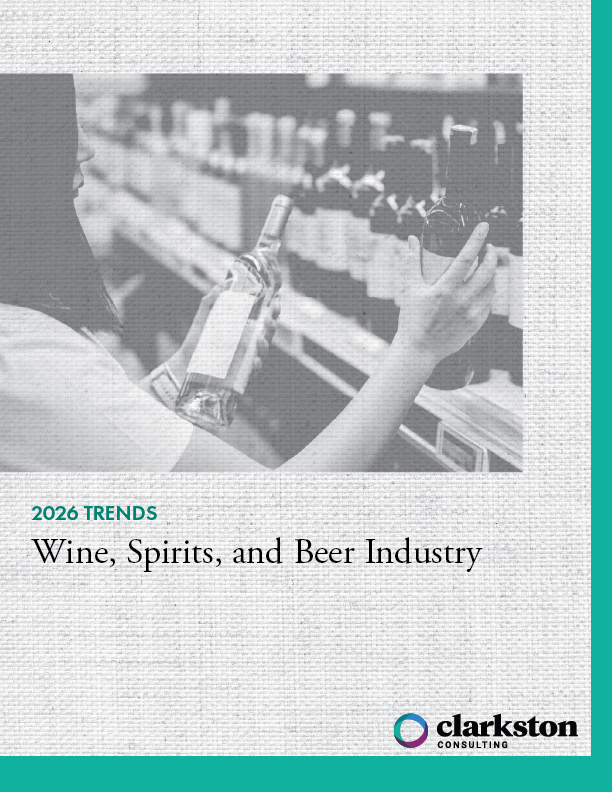
Download the full 2026 Wine, Spirits, and Beer Industry Trends Report here.
This free trends report outlines industry perspectives and expert advice from our team of CPG consultants. You can view an excerpt of the report below, and if you’d like to discuss any of the trends or other challenges in the wine, spirits, and beer industry, connect with our team today.
Key 2026 Wine, Spirits, and Beer Industry Trends
With fewer people drinking and more questioning the health impact of “moderate” consumption, the wine, spirits, and beer category is being reshaped by who participates, how often they drink, and what they choose when they do. Economic pressure is amplifying this shift: tighter discretionary income makes shoppers more price-sensitive, while tariff-driven cost volatility adds friction that can gradually change baskets and brand loyalty.
Demand signals are also being influenced by forces outside the category’s traditional playbook. Generational norms are evolving around occasions and identity, and GLP-1 adoption is emerging as a potential behavioral accelerator. In parallel, disruption is moving through the system: distributor realignment is changing how brands get to shelf, international spirits are gaining momentum, and potential limits on hemp-derived THC beverages could reshape the adjacent competitive set. Moving forward, growth in this market will depend less on expanding consumption and more on capturing the right occasions and consumer segments.
Clarkston’s wine and spirits consultants have highlighted the top industry trends that businesses should consider and keep top-of-mind throughout the year:
- Cultural Shifts: Redefining Participation and Preference
- Health-Driven Demand: Behavior Change Beyond Choice
- Economic Pressures: Price Sensitivity Meets Cost Volatility
Trend 1:
Cultural Shifts: Redefining Participation and Preference
A shift in generational differences
The generational shift is less about abandoning alcohol altogether and more about redefining what “drinking” looks like. Gallup shows only 54% of U.S. adults say they drink, and 53% now believe moderate drinking is bad for health, signals that cultural norms are shifting, especially among younger adults. This mindset shows up in consumption that is more intentional, with choices shaped by occasion, perceived wellness impact, and value.
It’s also showing up in financial markets: as a Bloomberg-tracked view of the W&S sector links evolving habits to roughly $830 billion in market value erosion across major alcohol companies. The implications are now tangible at the production level: California wineries are closing facilities and laying off workers, with major players like Gallo shuttering sites and cutting nearly 100 jobs as demand softens and younger consumers opt for alternatives like RTDs or abstention. Younger consumers aren’t just looking at this from a lens of simply “less” alcohol, but “alternatives,” with winners tied to relevance and fit.
Rise of international spirits
International spirits are benefiting from consumers who want more cultural storytelling and more distinctive flavor cues, often aligned with moderation. Soju is a clear example: one market estimate values the North America soju market at about $255 million, alongside broader momentum tied to Korean cultural influence and metropolitan demand. Soju’s typically lower ABV (often cited between 15–20%) also fits an “intentional drinking” mindset while still delivering discovery.
Beyond soju, interest in globally inspired flavors is expanding the repertoire consumers expect across spirits and RTDs, raising the bar for innovation and authenticity. This trend is as much more about experience and identity as it is about liquid profile.
Potential ban on cannabis drinks
Regulation is threatening to redraw the boundaries of the “alternative beverage” set. A federal measure included in a proposed government funding package would impose a strict 0.4 mg total THC per container limit, with reporting indicating it would take effect in November 2026. If implemented as described, the threshold could effectively wipe out many hemp-derived THC drink formulations currently on the market, creating abrupt winners and losers across an emerging category.
For alcohol, the significance is competitive as well as regulatory: the growth of THC beverages has overlapped with moderation trends, and a clampdown would change how consumers navigate between alcohol, no-alc, and cannabis-adjacent options. This is a space to watch, as regulatory outcomes could quickly reallocate share across adjacent categories.
Trend 2:
Health-Driven Demand: Behavior Change Beyond Choice
Rise in GLP-1 usage
GLP-1 medications are introducing a new, non-traditional demand variable. Semaglutide (the active ingredient in Ozempic and Wegovy) has been associated with reduced alcohol craving and consumption for some users, where a randomized clinical trial found semaglutide reduced alcohol consumed in a laboratory self-administration setting relative to placebo. At the population level, adoption is high: about one in eight adults (12%) report currently taking a GLP-1 drug, even with high costs remaining a concern. Investors are actively debating how much moderation is being reinforced by GLP-1 intake alongside broader health priorities.
For alcohol consumption, this means changes in frequency and intensity may reflect both biological factors and shifting attitudes. If sustained, this introduces a demand headwind that is less cyclical and more structurally embedded.
Continue reading by downloading the full report below.
Download the Full 2026 Wine, Spirits, and Beer Industry Trends Report Here
Read last year’s Wine, Spirits, and Beer Industry Trends Report here.