AI Readiness in Retail: Why Data Teams Lag and How to Catch Up

Artificial intelligence has become a board-level topic in retail. Executives hear daily about demand forecasting powered by machine learning, personalized offers driven by AI, agentic commerce, and autonomous supply chains that react in real time. Yet despite heavy investment and strong intent, many retail organizations struggle to move beyond pilots and proofs of concept.
In retail technology specifically, nearly 85% of organizations are running pilots, but just 15–20% have successfully scaled them into meaningful production use. The issue is rarely the algorithms themselves. More often, it’s the readiness of the data foundations and the teams that manage them.
A consistent pattern emerges across retail organizations failing to implement AI capabilities. Most teams aren’t failing because they lack ambition or intelligence. They’re failing because their data environments, operating models, and incentives were built for reporting and hindsight, not for learning systems that operate at scale. Understanding why this gap exists is the first step toward closing it.
AI Amplifies Existing Data Problems
AI doesn’t magically fix data issues; rather, it magnifies them.
Retail data environments are often the result of years of incremental growth. New systems were added to support eCommerce, loyalty programs, promotions, and supply chain optimization. Each system brought its own data model, refresh cadence, and definition of core concepts such as customer, product, or order. Over time, data teams learned to reconcile these differences well enough to produce dashboards and monthly reports.
AI requires much more. Models depend on consistent, well-defined, and timely data. While minor inconsistencies in traditional reporting may result in slightly misstated metrics or small reconciliation issues, AI and advanced analytics amplify those same imperfections.
Machine learning models rely on patterns in the data to generate predictions and recommendations. Missing values, delayed updates, or ambiguous business rules not only create confusion but they also shape how the model learns. As a result, small data quality issues that might be tolerable in a static report can materially degrade model performance, leading to inaccurate forecasts, flawed trend analysis, and misaligned strategic decisions.
Many retail teams discover this too late. They invest in data science talent or external AI tools, only to find that most of the effort goes into data cleanup and manual workarounds. The problem isn’t that the data scientists are ineffective. The problem is that the underlying data platform was never designed to support AI.
Most Retail Data Teams Are Optimized for Hindsight
Traditional retail analytics answers questions like: What happened last week? How did sales compare to last year? Which stores underperformed?
These questions are important, but they rely on historical, aggregated data. AI expands the focus beyond static reporting to deeper insight generation, pattern recognition, and sometimes prediction and decision support.
While not all AI applications are predictive, they enable organizations to analyze what has already happened in ways that go beyond the constraints of predefined, templated reports. By identifying hidden relationships, surfacing anomalies, and uncovering drivers of past performance, AI helps teams move from simply describing outcomes to better understanding and acting on these outcomes. The questions are now: What will happen next? What should we do now? What is likely to happen if we change this price or promotion?
To support these questions, data must be granular, timely, and trustworthy. Yet many data teams are measured primarily on report delivery, not data quality or readiness for advanced use cases.
Success is often defined as delivering accurate, reconciled numbers by a set reporting deadline. In traditional reporting environments, there’s typically some tolerance for minor data gaps, manual adjustments, or late-arriving updates, especially if they don’t materially change the overall story the report tells. However, those same tolerances become far more consequential in AI and advanced analytics use cases, where even small inconsistencies can distort patterns, influence model training, and impact downstream insights.
Additionally, an incentive structure focused on timely delivery can create technical debt. To meet deadlines, teams may introduce manual workarounds or hard-coded logic that solve immediate needs but aren’t designed to scale. Over time, these shortcuts accumulate, leading to inconsistent definitions, fragile pipelines, and hidden data quality issues. These risks become significantly more problematic in AI and advanced analytics use cases.
Data Ownership is Often Unclear
Another common challenge is unclear ownership of data assets. In many retail organizations, data is treated as a shared byproduct rather than a product with accountable owners.
Retail data is often fragmented across organizational boundaries, with different teams responsible for managing distinct portions of the data ecosystem. Central data teams are asked to stitch everything together, often without authority to enforce standards or resolve conflicts.
AI initiatives benefit from clearer and more consistent data ownership. Models need stable inputs and clear definitions. When data changes unexpectedly, models break. Without clear accountability governed by well-defined processes, it becomes difficult to manage change in a controlled way. This leads to a lack of trust in AI outputs, even when the models themselves are sound.
Skills Gaps are Real, but Often Misunderstood
Retail leaders often assume the primary barrier to AI is a shortage of advanced data science skills. While talent gaps do exist, they’re not usually the main constraint.
Gaps in modern data engineering and data management practices, including data governance, are also often significant factors. Many teams lack experience with scalable data modeling, data versioning, feature reuse, and automated data quality checks. These capabilities are essential for production-grade AI but are less visible than model development.
Without them, AI engineers and data scientists spend most of their time preparing data rather than improving models. This slows progress and creates frustration on all sides.
How to Fix It: Build AI Readiness, not Just AI Solutions
The good news is that these problems are solvable. Becoming ready for AI requires that data teams evolve in how they think about their role.
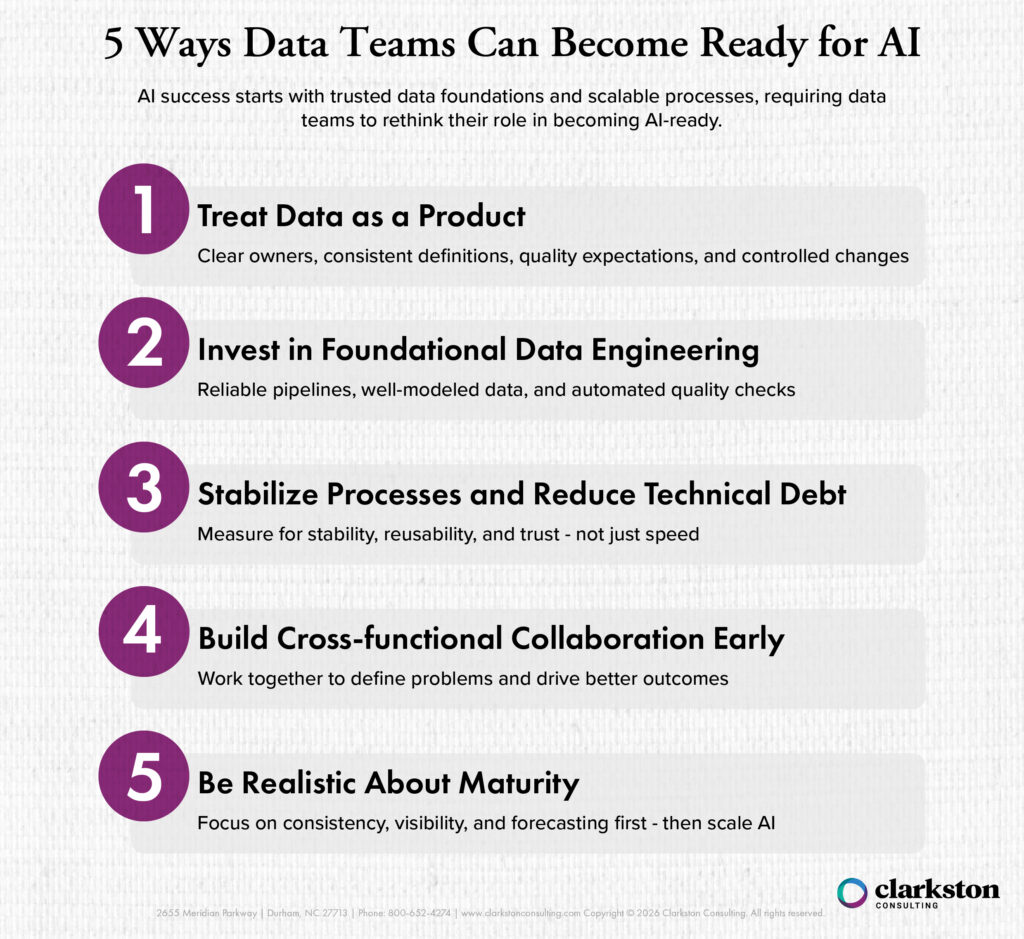
First, treat data as a product. Core datasets should have clear owners, documented definitions, and explicit quality expectations, and be aligned across systems. At a minimum, they should be consistently aligned within the reporting and modeling layers where they are used. Changes should be intentional, documented, and communicated. This discipline benefits reporting and AI alike.
Second, invest in foundational data engineering. Reliable ingestion, well-modeled data, and automated quality checks aren’t glamorous, but they’re critical. AI initiatives should start with assessing whether the data pipeline can support learning systems over time, not just selecting the model.
Third, focus on stabilizing data processes and minimizing technical debt in areas that support AI. Data teams should be measured not only on delivery speed, but also on stability, reusability, and trust in the underlying data. Prioritizing efforts that reduce manual work, standardize logic, and improve data quality help create a more reliable foundation for reporting, analytics, and AI.
Fourth, build cross-functional collaboration early. AI use cases touch merchandising, marketing, supply chain, and operations. Data teams should work closely with these groups to define problems, not just deliver outputs. This shared understanding improves data quality and increases confidence in AI-driven decisions.
Finally, be realistic about maturity. Not every retail organization needs cutting-edge AI today. Many will see greater returns from improving data consistency, near-real-time visibility, and basic forecasting. These steps build the foundation on which more advanced AI can succeed.
Final Thoughts
Most retail data teams aren’t unprepared for AI because they lack vision or effort. They’re unprepared because their data foundations were built for a different era. AI exposes weaknesses that were previously manageable and demands a higher standard of data quality, ownership, and engineering discipline.
Retailers that succeed with AI will not be the ones that chase the latest algorithms. They will be the ones that invest patiently in their data platforms and teams, align incentives with long-term value, and treat data as a strategic asset rather than a reporting byproduct.
AI is a multiplier – not a shortcut or replacement. When the foundation is strong, it accelerates insight and impact. When it’s weak, it may not create the desired value. For retail data leaders considering AI, success depends less on the decision to adopt it and more on the strength of the data foundation behind it.
At Clarkston Consulting, we work with retail organizations to strengthen the data foundations required for AI-ready analytics. Contact us today for a comprehensive analysis of your organization’s AI readiness.
Subscribe to Clarkston's Insights
AI-assisted: A human led the content and final approval of this piece, with AI used to support ideation, drafting, editing, summarization, or repurposing.