How the Role of AI in Category Management Strategy is Evolving

The heavy reliance on reviewing large data sets and turning them into reports and analytics makes category management ripe with opportunities to leverage AI for greater efficiency and better decision-making.
Many category management processes today are inefficient and outdated. Answering a single business question often requires pulling data from multiple tools and systems, then building reports by hand.
Today, category management depends on both depth and breadth across multiple platforms to be effective. Many organizations are already using AI to automate routine work, while others are beginning to explore more advanced applications like generative and agentic AI that can support decision-making with less manual intervention.
We believe AI has significant potential to strengthen category management by helping teams work more efficiently and make more informed decisions. Below, we explore five category management functions where AI can provide meaningful support and outline practical considerations for getting the most value from each, whether you’re a seasoned category captain or just starting out.
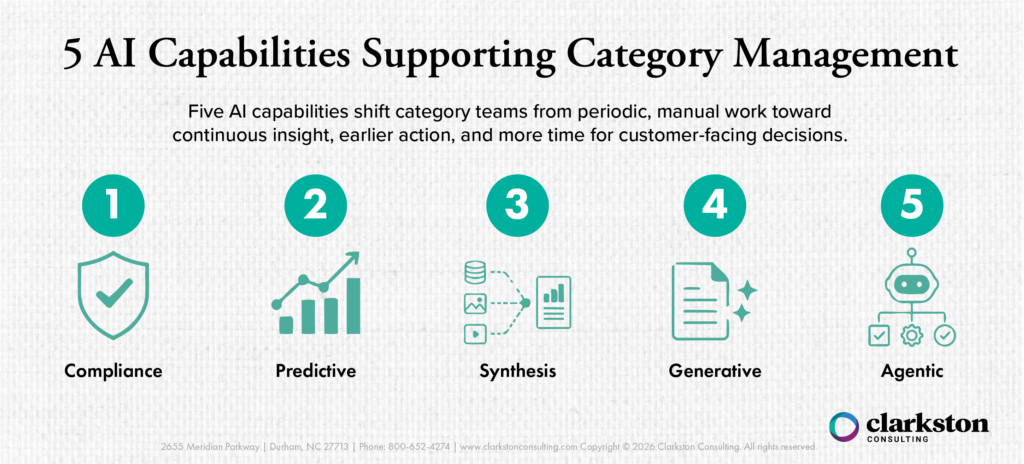
5 AI Capabilities Supporting Category Management
AI innovation in category management is broader than just generative and agentic use cases. There’s also meaningful value in more accessible capabilities, like compliance, predictivity, and synthesis. Collectively, these five AI capabilities support category management functions in a variety of ways:
Compliance
Category management performs many functions within a CP organization, one of the most critical being compliance, including planogram (POG) compliance, shelf rules and guidelines, audits, and must-carry lists. Many organizations still rely on periodic checks, static documents, manual interpretations of rules and guidelines, human-performed POG checks, scheduled store visits, and reactive compliance.
AI shifts compliance from periodic validation to continuous monitoring. Rather than identifying after the fact, organizations can use AI-enabled policy engines to interpret merchandising rules and apply them consistently across stores.
For POG checks, advanced tools use sensors, shelf robots, and cameras for continuous monitoring and feedback, allowing merchandising teams to focus on in-store opportunities rather than compliance alone.
AI also enhances store audits. By combining POS data, shelf images, and IoT sensors, organizations can continuously monitor and identify phantom inventory, pricing violations, and expired promotions, among others. During store visits, merchandisers can capture shelf images with a mobile device while AI quickly compares them to POG or the applicable merchandising rules, allowing for efficient real-time correction.
For must-carry lists, AI enables predictive compliance. Instead of measuring whether a store is carrying the correct stock of an item after the fact, AI allows retailers to predict whether a store is likely to fall out of compliance and recommends actions before issues affect shoppers.
Successful adoption requires clear governance. Organizations should establish decision rules, maintain traceability for AI-generated recommendations, require human review when exceptions occur, and regularly evaluate model performance as business requirements change.
Predictive
Category management teams are constantly asked to forecast and predict future events. Traditionally, companies use time-series forecasts based on historical sales to predict demand and manually analyze past or similar customers for future opportunities.
AI expands forecasting by incorporating real-time signals alongside historical performance. Rather than relying only on past sales, models can account for shopper behavior, local demand, competitor data, customer preferences, and more. These capabilities improve assortment planning by forecasting future demand and identifying potential substitutes before market shifts occur.
AI can also strengthen customer planning through more sophisticated clustering models that identify similar retailers and offer next-best opportunity recommendations, replacing segment-based analysis and manual benchmarking.
Organizations should validate predictive models before deployment and monitor accuracy over time. They should also establish clear thresholds for when human approval is required before acting on AI-generated predictions.
Synthesis
AI can play a significant role in synthesizing the large volumes of data in category management, including tools that can integrate complex data sets, analyze images and video, and find patterns and opportunities. Today, this capability requires a category manager to manually look over reports, images, videos, and data – digesting information and meaning to create narratives based on findings. This process can take days or even weeks in a manual environment, going back and forth between different platforms and data sets.
The category review is a common example. Teams often spend weeks pulling together the reports for an annual category review. Using AI-powered synthesis, teams can bring together disparate sources, run comprehensive analysis, generate summaries, and surface potential opportunities. This allows category managers to spend more time refining recommendations and collaborating with customers instead of assembling data.
AI can also analyze shelf images and store videos to identify merchandising opportunities or uncover buying patterns, such as products that are frequently purchased together or regional shifts in demand. Replacing this manual work allows category teams to spend more time reviewing emerging trends and next-best actions.
Successful implementation begins with strong data quality. Organizations should establish standards for source data, identify conflicting information automatically, and maintain traceability to original data sources. These efforts help ensure AI-produced insights remain accurate and evidence-backed.
Generative
Generative AI helps category management teams produce materials that often require days or weeks of manual work. From category reviews to building planograms, shelf grams, and space management standards, category management teams are among the most tapped and resource constrained. As a result, many ideas and initiatives never see the light of day because teams lack the time to compile and deliver the required analysis.
Once AI has synthesized the underlying data, generative AI can transform those insights into presentation-ready deliverables. For example, AI can draft category reviews, create presentation materials, identify whitespace opportunities, and develop initial recommendations for team review. Rather than replacing category managers, it accelerates the creation of work products so teams can focus on validating recommendations and tailoring them for customers.
Generative AI can also keep materials current by incorporating refreshed data automatically, reducing the need to rebuild presentations whenever information changes.
Readiness for generative AI integration into workflows requires strong quality standards and consistent governance. Approved prompts, standardized templates, and clear review processes help maintain consistency while ensuring generated content meets business expectations.
Agentic
Agentic AI introduces another level of automation by executing routine work on behalf of category managers. Today, category managers must somehow find time to complete administrative tasks, such as refreshing dashboards and collecting data from multiple systems, even though the real value lies in the insights, opportunities, and relationships they can build. We often hear from category management teams that day-to-day demands leave little time for analysis or action, and that they are stretched too thin to give every account and category the same level of attention. As a result, opportunities are often left on the table.
Agentic AI operates as a digital assistant that manages defined workflows within established governance rules. Agents can collect information across systems, assign work, monitor approvals, follow up on outstanding tasks, and update project status automatically. Automating these workflows allows category managers to focus on interpreting the insights, strengthening relationships with retailers and manufacturers, and identifying white space and trend opportunities.
Because agentic AI can execute actions instead of simply generating recommendations, organizations should clearly define approval thresholds and establish guardrails around autonomous decision-making. As the agent executes processes, category managers should oversee the system to ensure alignment with business strategy and compliance with regulations.
The Impact of AI on Category Management Moving Forward
Looking ahead, AI offers a real opportunity to streamline category management work and give teams more time to focus on the insights, actions, and relationships that matter most. As you think about AI strategy for your category management team, consider how it can support compliance, forecast demand, synthesize data from multiple sources, generate content, and automate workflows through agents.
You don’t need to do it all at once. Each capability outlined above can play a pivotal role in supporting your category management team, enhancing your ability to respond to ever-changing market conditions and strengthening your position as a trusted advisor on category, assortment, and space management, both internally and externally.
Learn more about our category management consulting services.
Subscribe to Clarkston's Insights
Contributions from Spencer Simco
AI-assisted: A human led the content and final approval of this piece, with AI used to support ideation, drafting, editing, summarization, or repurposing.