Cloud vs. On-Premises GxP Systems: What Pharma and Biotech Firms Should Consider

For life sciences organizations, selecting the right deployment model for GxP systems requires balancing business priorities with regulatory requirements. As organizations modernize their technology environments, many are deciding whether regulated applications should remain on-premises or move to cloud-based platforms.
The right choice depends on each system’s intended use and risk profile, along with its integration requirements. Understanding how responsibilities are divided between providers and regulated companies helps organizations plan for compliance throughout the system lifecycle.
Understanding the Deployment Models
On-Premises Systems
On-premises systems are hosted within an organization’s infrastructure, with support provided by internal teams or contract service providers. The organization controls the environment and remains responsible for infrastructure qualification and maintenance.
Local hosting may suit applications with equipment integrations or legacy technology constraints. It can also provide greater infrastructure control, provided the organization has the resources to sustain that environment.
Key considerations include:
- Greater control over system configuration and data
- Higher internal resource requirements for infrastructure support
- Responsibility for qualifying and maintaining infrastructure that supports GxP applications
- Secure remote access through VPN or enterprise network solutions, where needed
Cloud-Based Systems
Cloud-based systems use computing resources delivered as a service. In externally hosted arrangements, providers such as Microsoft Azure or Amazon Web Services (AWS) manage the cloud infrastructure. Depending on the service model, the provider assumes responsibility for portions of the underlying infrastructure or application.
Compared with on-premises deployments, cloud solutions may provide several advantages, including:
- Faster deployment and easier scalability
- Reduced infrastructure management requirements
- Access to provider-supported resiliency and disaster recovery capabilities
- Provider-managed platform updates, depending on the service model
Regardless of the deployment model, cloud adoption doesn’t change regulatory accountability. The regulated company remains responsible for GxP compliance and needs to define which activities its providers will perform.
Cloud Deployment Models and Shared Responsibility
Deployment models describe how cloud infrastructure is made available to organizations, while service models describe what the customer receives and manages. Public and private cloud are deployment models; Software-as-a-Service (SaaS) and Infrastructure-as-a-Service (IaaS) are service models. Private cloud and IaaS aren’t interchangeable: IaaS can be delivered through either public or private cloud infrastructure.
Public Cloud
Public cloud services use provider-operated infrastructure made available to multiple organizations. Shared resources rely on isolation mechanisms and access controls to protect customer environments and data.
GxP applications can be delivered as SaaS solutions running on public cloud infrastructure. In those arrangements, the application provider typically manages the underlying infrastructure and application maintenance, while the customer manages its use of the solution within the agreed service boundaries.
Organizations often choose public cloud deployments to:
- Reduce upfront infrastructure investment
- Scale resources as business needs change
- Access managed platform services
- Reduce ongoing infrastructure management
Private Cloud
Private cloud infrastructure is provisioned for the exclusive use of a single organization and may be located on-premises or hosted externally. It may support greater environmental control, although that control depends on the service arrangement.
Across cloud arrangements, operational responsibilities depend on the service model and contract. For an application running on IaaS, for example:
- The infrastructure provider manages the underlying physical infrastructure and physical network.
- The customer or its contracted service provider manages the operating system and virtual network configuration.
- The application vendor may install and configure the software.
- The regulated company retains responsibility for validation and system lifecycle activities.
The division of operational duties between the provider and the organization is commonly referred to as the shared responsibility model. It applies across cloud arrangements, with the boundaries changing according to the service model and contract. Documenting those boundaries helps prevent gaps in system support or compliance oversight.
What Changes for Validation and Compliance?
Moving to the cloud changes how validation activities are executed—not who is accountable. The regulated company still needs to demonstrate that its GxP systems are fit for their intended use and maintained in a compliant state.
ISPE’s GAMP 5 guidance supports a risk-based approach for patient safety and product quality, with data integrity central to maintaining trustworthy records. Appropriate supplier evidence can support validation, but organizations must assess whether it addresses their configured functionality and business processes.
The FDA’s Computer Software Assurance (CSA) guidance also describes risk-based assurance methods, but its scope is software used in medical device production or quality management systems. Pharma and biotech organizations should assess its applicability to their systems rather than assume it covers all GxP applications.
Formal agreements should define provider responsibilities, with supplier assessment proportionate to risk.
How Validation Changes by Deployment Model
On-premises deployments typically require organizations to manage infrastructure qualification alongside application validation. Cloud services can shift infrastructure activities to providers, allowing internal teams to use relevant supplier evidence and focus on application configuration and intended use.
For highly configured or integrated applications, validation effort may still be comparable to an on-premises deployment. As we explore in our article on applying CSA to manufacturing software, risk-based assurance can help organizations determine the appropriate level of testing based on how software is used.
Provider-managed updates also require ongoing attention. Organizations need a process for assessing changes to validated functionality and determining what testing is needed before those changes affect GxP operations. Cloud hosting changes who performs certain activities, but it doesn’t eliminate the need to demonstrate that the system remains in a state of control.
Consider the Requirements of Each Application
Deployment decisions should reflect the requirements of individual applications within a broader technology environment. SaaS may suit enterprise applications where organizations want to reduce infrastructure demands. Manufacturing or laboratory applications may require local hosting because of equipment integrations or legacy architectures.
A hybrid approach may accommodate these differences, provided the organization manages interfaces and maintains consistent compliance oversight. As organizations evaluate their options, considering GxP and validation requirements during technology selection can help identify potential challenges before implementation begins.
Final Thoughts
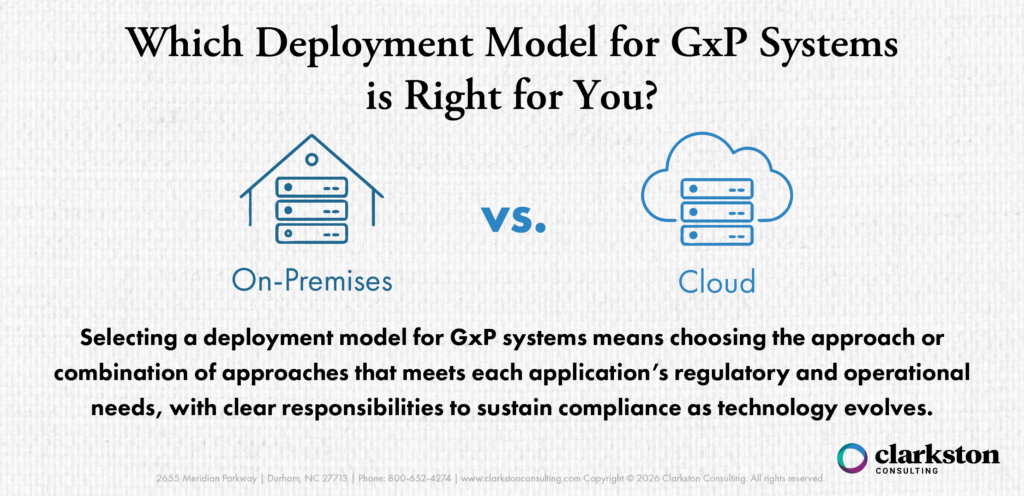
Selecting a deployment model for GxP systems means evaluating regulatory requirements alongside the operational needs of each application. Cloud services can reduce infrastructure demands, while on-premises deployments may provide the control needed for particular manufacturing or laboratory requirements.
For many organizations, a combination of approaches will be appropriate. The deployment decision should reflect each application’s operational needs and GxP requirements. Clearly defined responsibilities help teams sustain compliance as the technology environment evolves.
Learn more about our Quality + Compliance Consulting Services.