How to Reduce Trade Spend Leakage in Foodservice

Trade spending is one of the largest investments that foodservice manufacturers make to drive growth.
Unlike traditional retail, where transactions typically occur between a manufacturer and a retailer, foodservice transactions often involve multiple parties, including operators and distributors, with group purchasing organizations (GPOs) negotiating agreements on behalf of participating operators. These relationships influence how products are purchased, priced, and reimbursed.
Operators frequently layer direct contracts on top of GPO agreements to secure better pricing or more customized terms. While this may appear to be a process flaw, overlapping agreements are often a reflection of the foodservice ecosystem’s complexity and require rules for determining which incentives apply.
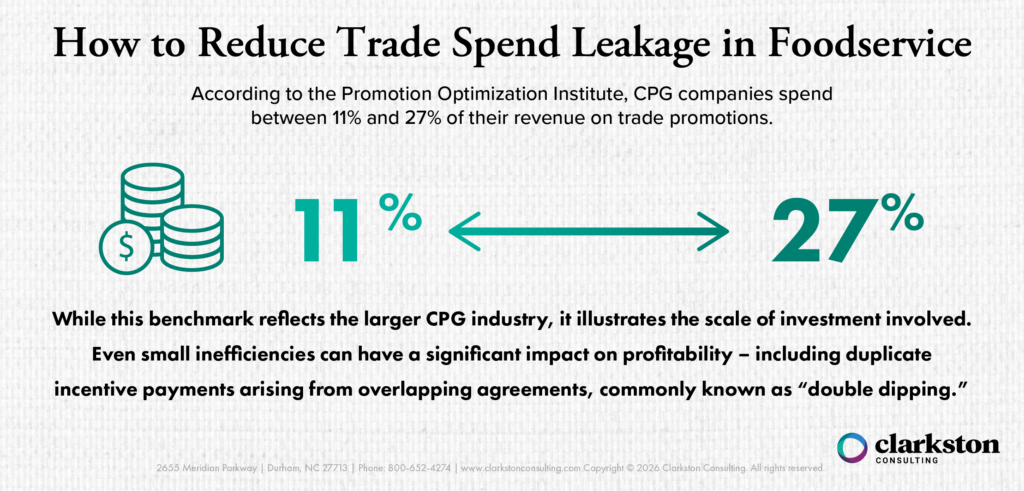
According to the Promotion Optimization Institute, CPG companies spend between 11% and 27% of their revenue on trade promotions, and though this benchmark reflects the larger CPG industry, it illustrates the scale of investment involved.
How Does Double Dipping Occur?
Even small inefficiencies can have a significant impact on profitability – including duplicate incentive payments arising from overlapping agreements, commonly known as “double dipping.”
Consider a foodservice manufacturer that has a direct relationship with an operator. Within that relationship, the operator can negotiate their own agreement, which includes pricing, rebates and/or special incentives. That same operator may also belong to a GPO that has its own agreement with the manufacturer, where the goal is to secure broader purchasing power on behalf of its members. In this case, the operator purchases products through a distributor, which generates the transaction data associated with the order.
Now comes the challenge. At the end of the claim period, the manufacturer may receive two separate claims: one from the operator under its direct agreement, and another from the GPO that includes the same purchase volume under the GPO agreement.
Both claims may appear valid when reviewed independently. Without validation controls and strong visibility into the full end-to-end transaction, that same purchase can apply across multiple claim streams. When that happens, manufacturers risk reimbursing the same transaction twice, creating unnecessary trade spend leakage through duplicate incentive payments – or “double dipping.”
So, Why is Double Dipping Difficult to Detect?
While multiple parties and overlapping agreements contribute to the risk of double dipping, internal data and process limitations can make duplicate claims harder to identify. Some of the most common challenges include:
- Fragmented data across stakeholders: Operators, GPOs, and distributors each maintain their own data and submit claims independently. While manufacturers receive information from each party, connecting those data sources to identify overlapping claims can be challenging.
- Data inconsistencies: The same operator may appear differently across systems, making it difficult to accurately match transactions across agreements. Bill-back claims use Electronic Data Interchange (EDI 867) data, which captures product transfer and resale information. Errors in the underlying data or its integration into an ERP system can then make duplicate or potentially invalid claims even harder to identify.
- Siloed claims review: In an iTradeNetwork survey of 60 foodservice manufacturing organizations, more than 80% of participants cited manual processes and inconsistent data as primary hurdles in trade spend management. In these instances, claims are often reviewed in silos, with operator and GPO submissions processed independently rather than cross functionally. As a result, duplicate claims spanning multiple agreements can be difficult to detect.
Over time, these isolated overpayments can add up, creating significant trade spend leakage. Beyond the direct financial impact, duplicate payments can reduce confidence in trade spend reporting and make it more difficult for organizations to accurately assess promotional effectiveness.
Reducing the Risk of Double Dipping
Addressing double dipping requires looking beyond individual claims to the data and controls to validate them. To reduce the risk of double dipping, organizations should consider the following approaches:
Establish Contract Hierarchy Rules
By establishing rules and validation around contract hierarchy, organizations can determine which agreement takes precedence when overlapping agreements exist. This helps ensure that the appropriate agreement is used to calculate incentive payments and reduces the risk of reimbursing the same transaction twice.
Cleansing Master Data
Improving the quality of data across different systems (TPM, ERP, claims systems, etc.) can help organizations accurately match transactions and flag potential overlaps. For example, the same operator might appear as “Restaurant #123” in one system and “Restaurant – Smallville, TN” in another. These records need to map to the same operator for teams to identify overlapping claims. Consistent customer and ship-to identifiers support that connection, while standardized product identifiers help match the purchase details.
Validation Checkpoints
Adding validation checkpoints before claims are paid provides another layer of protection against duplicate payments, which can be difficult to recover once processed. Depending on the solution and available data, TPM systems can be configured to automatically flag duplicates by cross-referencing customer information, shipping address, product, volume, and transaction date. This allows organizations to focus their efforts on transactions that warrant additional review, rather than manually reviewing every claim.
AI can complement these checks by analyzing large volumes of claims and transaction data to identify patterns or anomalies that warrant closer review. Teams should validate flagged exceptions against applicable agreement terms before deciding whether a payment is appropriate.
The Role of TPM in Reducing Trade Spend Leakage
TPM systems can provide manufacturers with greater visibility and control over trade investments, customer agreements, and claims processing. But can TPM systems alone solve the double dipping problem?
The answer is… it depends.
Foodservice promotional programs have unique requirements that are often more complex than traditional retail promotions, while many TPM platforms were originally designed with retail processes in mind. As a result, organizations may need to adapt their TPM solution to reflect those arrangements and the associated validation requirements.
When implemented effectively, TPM solutions can serve as important control points for manufacturers, but their effectiveness depends on strong contract governance and reliable, high-quality master data, supported by well-defined claims validation processes.
This is where Clarkston can help. Many organizations have implemented TPM solutions but aren’t fully leveraging their capabilities to improve visibility, strengthen controls, and reduce the risk of trade spend leakage.
We’ve seen firsthand how technology alone can’t address underlying data and process challenges. In one client engagement, a leading food manufacturer implemented both ERP and TPM capabilities, but limitations in the overall TPM design and system complexity made it difficult to accurately track promotional spending and reconcile claims. Clarkston worked with the manufacturer to assess its existing processes and systems, prioritize over 20 issues, and ultimately resolve challenges in the system to support their financial reconciliation.
Clarkston can help manufacturers assess how agreement rules and transaction data inform claims decisions, then identify where additional controls are needed. Connect with our team if you’re looking for guidance on evaluating your claims validation process and prioritizing improvements that reduce the risk of double dipping.