Project Change Management: Keeping Projects on Track Amid Shifting Priorities

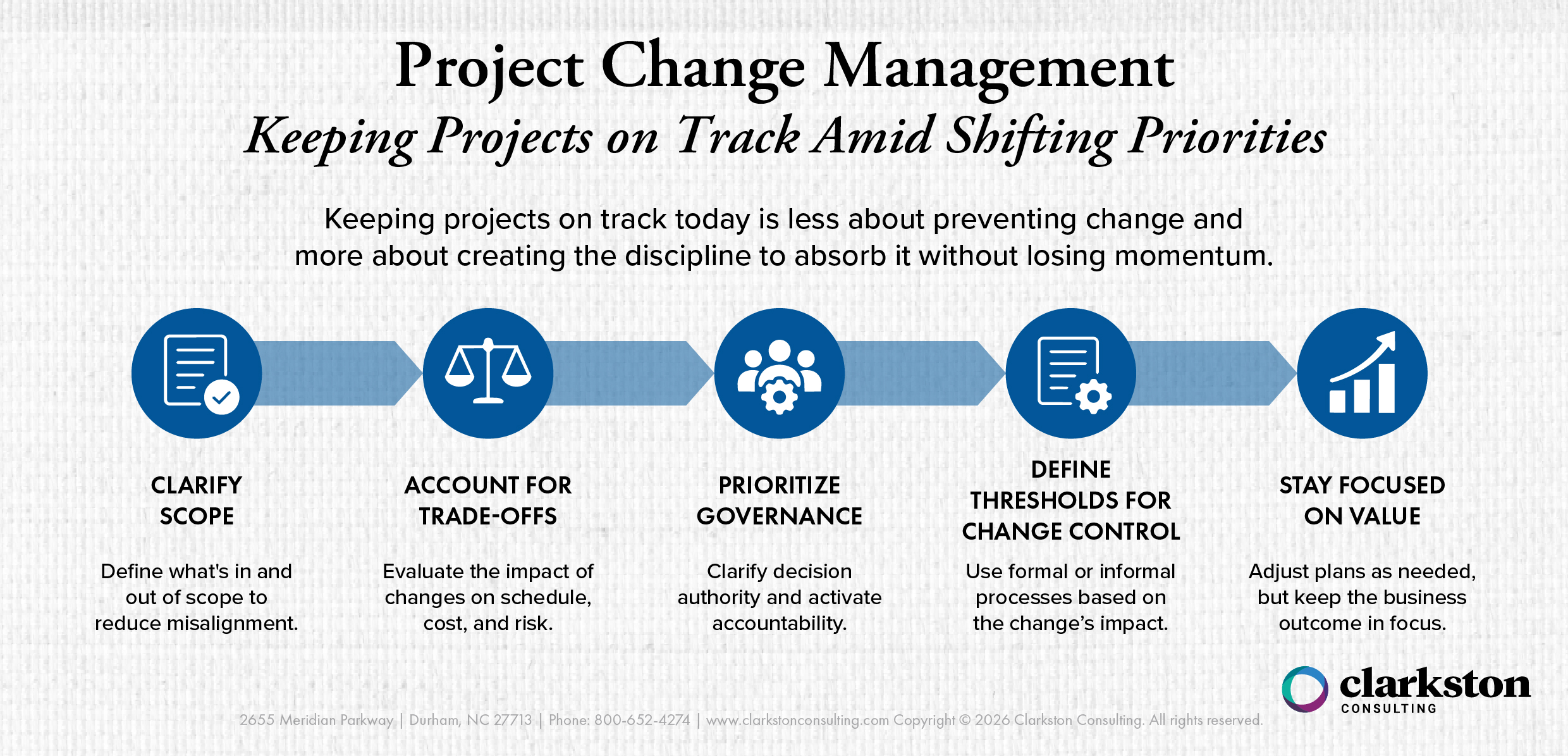
The core takeaway: keeping projects on track today is less about preventing change and more about creating the discipline to absorb it without losing momentum.
Keeping Projects on Track When Priorities Are Constantly Changing
The way organizations deliver projects is changing. Projects increasingly operate in environments where priorities shift throughout execution. As a result, organizations need to focus not only on managing the plan, but also on managing the changes that affect it
Traditional assumptions of stable scope and priorities don’t always hold, with research indicating that 92% of leaders view change as a constant. Organizations that find ways to adapt to change can outperform their peers in project execution. Below, we look at how organizations can maintain control as strategic priorities evolve and build change management into project execution.
The Core Challenge – Uncontrolled Change, Not Change Itself
Projects don’t fail because of change – they fail because change isn’t managed effectively. 50% of projects experience scope creep, one of the most common results of uncontrolled change, as well as other scope-related issues that contribute significantly to project challenges. Uncontrolled changes drive impacts on cost, schedule, and quality, highlighting organizations’ need to take control by transitioning from reactive to structured change management.
Establishing Clarity – Defining Scope and Priorities
Clear scope and priorities give teams a reference point when change occurs. As unclear scope contributes to around 37% of project failures, organizations should establish a clear, cross-functional understanding of what the project includes and where its boundaries sit. This can help prevent misalignment and unplanned expansion. It also gives stakeholders consistent basis for evaluating new requests, which can reduce ambiguity and rework
The Role of Trade-Offs – Prioritization as a Discipline
Every change has an impact, so prioritization needs to account for the trade-offs a change creates. Best practices require evaluation of factors such as schedule, cost, and risk impacts. Effective change management needs to include impact analysis and plan adjustment.
A defined prioritization and decision framework can give leaders a consistent way to weigh those impacts. It can also help teams avoid committing to new work without accounting for what needs to move or change elsewhere in the project.
Governance as an Enabler
Governance is a critical factor for successful delivery and value realization, reducing fragmented decisions and ensuring alignment across functions. It also activates accountability for project decisions.
Organizations should design governance around the decisions a project actually requires. A right-sized structure clarifies who has decision authority and when an issue needs to be escalated. This becomes especially important when priorities are changing quickly.
Change Control – A Foundational Capability
Once organizations clarify who makes decisions and how trade-offs are evaluated, they also need to determine when escalation is required. From there, teams need a consistent way to distinguish changes that require formal review from those that can be handled within the project team. Change control puts that governance into practice during day-to-day execution.
- Formal Change Control : Uncontrolled changes can lead to project failure if they’re not managed. That’s why formal change control is necessary for high-impact or cross-functional changes, with PMI recommending structured change control processes in these cases. Industry guidance also emphasizes documented and traceable change processes that contribute toward ensuring consistency, auditability, and risk management.
- Informal Change – When Formal Control is Not Required : Change is inevitable and must be managed appropriately. Not all changes, however, require formal governance like above – some can be handled informally within the team. High-impact cross-functional changes require formal control when changes affect scope, schedule, cost, or stakeholders. Conversely, low-impact contained changes can be handled informally. This informal handling of change prevents over-bureaucratization, maintaining execution speed while preserving control where it matters.
Defining these thresholds in advance helps teams determine how a change should be handled instead of making that decision from scratch each time. A tiered model can preserve execution speed while maintaining formal oversight where the consequences are greater.
Redefining Success – From Delivery to Value
Organizations are also broadening how they define project success. Success is increasingly being assessed in terms of value delivered beyond traditional measures such as scope and cost. Schedule performance remains important, but high-performing organizations are also emphasizing strategic alignment and outcomes.
A value-focused approach gives teams a stronger basis for reassessing priorities when conditions change. Instead of treating the original plan as the only measure of success, organizations can evaluate whether project decisions continue to support the intended business outcome.
Operating in a Continuous Change Environment
When priorities change frequently, the goal isn’t to preserve the original plan at all costs. Organizations need enough structure to understand a proposed change and make a deliberate decision about how to respond.
Clear governance establishes decision authority, while structured change control provides a practical way to manage those decisions during execution. Keeping the focus on business value helps teams adjust course without losing sight of why the project exists in the first place.
Subscribe to Clarkston's Insights
Contributions from Spencer Simco