Moving from Retail Workforce Management to Workforce Orchestration

Ask any retail leader about what’s changed over the last few years, and you’ll hear a familiar list: labor shortages, rising wages, omnichannel fulfillment complexities, employee burnout, and unpredictable demand. Retail has changed dramatically, but many workforce management practices have not.
For decades, workforce management was designed to answer a simple question: How do we minimize labor costs while covering demand? That approach made sense when retail operating models were relatively stable and success depended on matching staffing levels to expected customer traffic.
Today’s retail environment requires something different, yet many organizations still rely on workforce management practices built for a different era. Retailers that succeed in the years ahead will be those that move from retail workforce management to workforce orchestration, building a workforce capable of adapting as conditions change, not just one that operates more efficiently.
Workforce Management is Solving the Wrong Problem
Traditional workforce management assumes labor is primarily a cost. Many retailers still manage labor as an expense to be controlled, measured, and reduced whenever possible. Labor is certainly one of retail’s largest expenses, but it’s also one of the most important drivers of business performance.
This is where the disconnect begins. Retailers measure labor through schedules, hours, and budgets. Employees see things differently. Pay matters, but it’s rarely the only reason people stay. Flexibility, predictable schedules, supportive workers, workplace safety, manageable workloads, and opportunities to grow all play a meaningful role in retention.
Four Reasons Workforce Management is Breaking Down
1. Retail is No Longer Predictable
Most workforce planning starts with forecasting demand, building a schedule, and executing the plan. The challenge is that retail has become far less predictable. Promotions create unexpected spikes, weather changes shopping patterns, eCommerce demand fluctuates daily, and employee availability also changes from week to week.
As conditions shift, workforce plans that looked good on paper often struggle to keep up with what’s actually happening in the store. Retail has become more dynamic, while many workforce planning approaches still assume a level of certainty that no longer exists.
2. Labor is Still Treated Like a Cost Input
Store labor remains one of the largest expenses on a retailer’s income statement, so workforce decisions are often evaluated through a cost lens first.
The perspective overlooks labor’s impact on business results. Store associates influence customer experience, sales, inventory accuracy, and operational execution. Research has demonstrated that retailers have increased revenue by 5-6% after improving staffing levels and training, further reinforcing this point.
Moving forward, retailers need to manage labor as an investment in performance rather than just a cost control.
3. Scheduling Ignores Human Reality
Retailers have become incredibly sophisticated at measuring labor hours; however, they’re often less effective at paying attention to how employees experience workload and stress on the job. Lack of schedule flexibility, physical exhaustion, and stress are among the most common reasons employees consider leaving retail jobs. This can exacerbate associate churn, compounding costs associated with sourcing, onboarding, and training replacements.
This highlights a weakness in traditional workforce management. A store can be perfectly staffed according to the labor model and still create an unsustainable workload – labor hours and workload are not the same thing.
4. Retail Jobs Have Changed Faster Than Workforce Models
Traditional workforce management was built around clearly defined roles – the cashier, the stocker, the customer service associate, and the department manager. Today’s store associates do far more. They fulfill online orders, support curbside pickup, process returns, manage inventory, handle delivery drivers, and serve customers across multiple channels. Omnichannel retailing has created a more diverse set of functions a store must perform. The retail store operating model changed, but the workforce management model largely did not.
Why AI Won’t Fix Workforce Management
Many retailers see AI as the next step in workforce management. AI can absolutely improve forecasting, scheduling, and labor allocation, and those are meaningful advances, but that doesn’t solve the underlying challenge. Retailers need workforce models that can adapt to changing demand rather than relying solely on static staffing plans, enabling them to build a workforce that can respond when operating conditions change.
AI alone can’t create a more flexible workforce, develop new skills, or redesign the way work gets done. Those are leadership and operating model decisions. Technology can improve execution, but it shouldn’t replace workforce strategy.
What Replaces Workforce Management?
If workforce management is breaking down, what comes next?
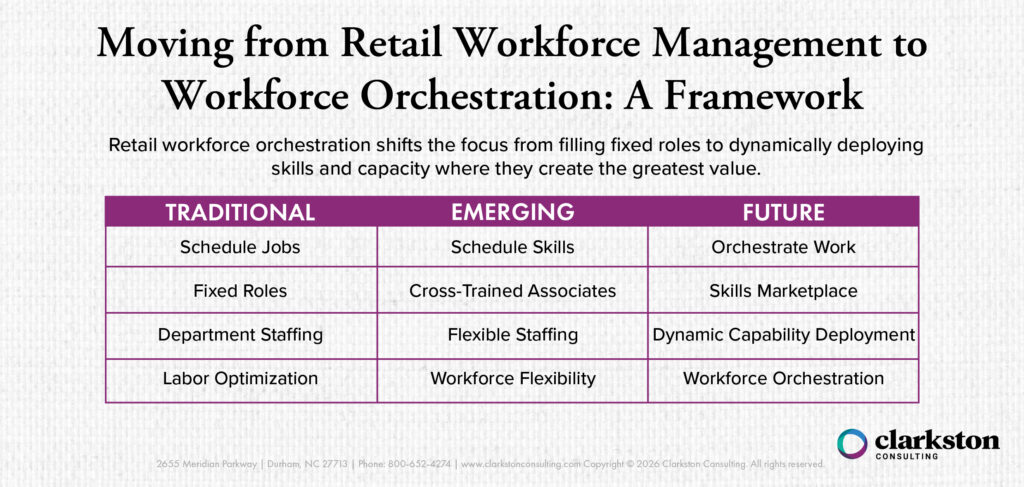
We believe the answer is workforce orchestration. Workforce orchestration shifts the focus away from determining labor hours toward matching skills where they’re needed most. It requires retailers to build organizations that can respond quickly while supporting both business performance and the employee experience. The three requirements for successful workforce orchestration are:
- Greater workforce flexibility. Multiskilled workforce models have been shown to reduce staffing needs, improve adaptability, and deliver cost savings compared to traditional single-skilled staffing approaches when demand is uncertain. Walmart, for example, creates small cross-trained teams that provide additional coverage during busy periods (or when employees want to take time off) while giving associates greater scheduling flexibility.
- Focus on capabilities rather than job titles. The goal is not to train everyone to do everything. Targeted cross-training delivers better results than broad multiskilling programs because it builds flexibility where the business needs it most. Rather than hiring people into rigid jobs, Target has been transforming their staff through cross-training and backup training so associates can move where demand or need is highest.
- Balance business performance with the employee experience. Employees stay because of stability, flexibility, safety, belonging, and growth opportunities. The retailers that figure out how to align these needs with business performance will be better positioned to attract and retain talent.
Many leading retailers are already investing in these capabilities through cross-functional teams, broader skill development, backup training, and cross-trained associates who can move across the operation as business needs evolve.
From Scheduling to Orchestration
Workforce orchestration matches people, skills, and work in a way that helps stores respond quickly as customer demand changes. The shift is bigger than improving schedules, though. It’s also building a workforce designed for stability and for change. Below, we’ve outlined a framework for moving from traditional retail workforce management to workforce orchestration.
The Retailers That Win Will Build Adaptive Workforces
Managing retail labor is no longer just about building schedules. The retailers that do well over the next decade won’t necessarily have the lowest labor costs, but they will have the most adaptable workforce systems. They’ll be able to move people where they’re needed, develop new skills faster, support omnichannel operations, and create employee experiences that people want to stay part of.
The most effective workforce isn’t the one optimized for a single forecast. It’s one that can adapt when reality doesn’t match the plan. That’s really the difference between workforce management and workforce orchestration – workforce management is built around optimization and workforce orchestration is built around adaptability. And in today’s retail environment, adaptability is becoming the more valuable capability.
Thinking about labor as an asset to leverage rather than a cost to bear can be a way forward. If these sound like challenges your organization continues to face, let’s chat. We help retailers implement and optimize workforce management solutions to reduce labor costs, automate scheduling, and increase store productivity.
Subscribe to Clarkston's Insights
AI-assisted: A human led the content and final approval of this piece, with AI used to support ideation, drafting, editing, summarization, or repurposing.